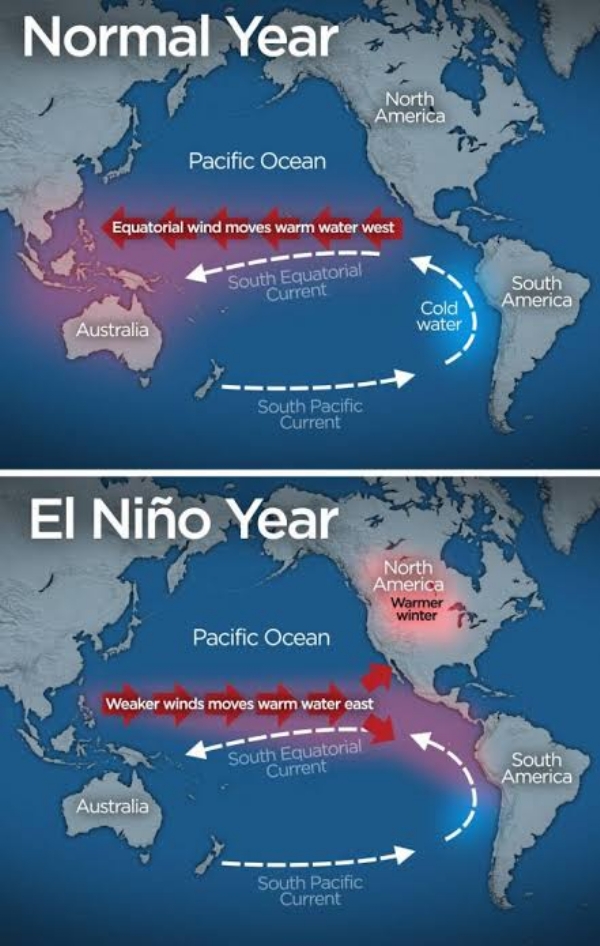
Thiruvananthapuram, 13 July (H.S.): For centuries, Kerala's identity has been shaped by the southwest monsoon. The annual arrival of rain over the state's coast marks not only the beginning of India's rainy season but also replenishes rivers, reservoirs and groundwater, sustains agriculture, powers hydroelectric stations and supports millions of livelihoods. Today, however, that dependable rhythm is becoming increasingly uncertain as the combined impact of El Niño and climate change reshapes the state's rainfall patterns.
The 2026 southwest monsoon has once again underlined Kerala's growing vulnerability to global climatic shifts. According to the India Meteorological Department (IMD), Kerala had received only about 93 per cent of its normal monsoon rainfall by mid-July, translating into a rainfall deficit of around seven per cent, with several districts recording even larger shortfalls following prolonged dry spells. Scientists attribute much of the weakening monsoon to the emergence of El Niño conditions over the equatorial Pacific Ocean, which traditionally suppress rainfall over large parts of India, particularly peninsular regions.
A comparison with recent years illustrates the increasing variability in Kerala's monsoon. The state received an above-normal southwest monsoon in 2024, recording around 106 per cent of the long-period average rainfall. This was followed by a near-normal monsoon in 2025, when rainfall remained close to 100 per cent of normal. The return of a rainfall deficit in 2026 marks a sharp reversal and reinforces concerns among climate scientists that Kerala's rainfall is becoming increasingly erratic, with alternating years of excess and deficit replacing the relatively stable monsoon patterns of the past.
El Niño is a naturally occurring climate phenomenon characterised by unusually warm sea surface temperatures in the central and eastern Pacific Ocean. Although it develops thousands of kilometres away from India, it weakens the atmospheric circulation that drives the southwest monsoon. Historically, many of India's major drought years, including 1982, 1987, 2002, 2009 and 2015, coincided with strong El Niño events.
Meteorologists, however, point out that climate change is amplifying El Niño's effects. Rising global temperatures are warming both the oceans and the atmosphere, enabling the air to hold more moisture while simultaneously disrupting traditional weather systems. Instead of receiving steady rainfall spread across several weeks, Kerala is increasingly witnessing prolonged dry spells punctuated by short periods of intense rainfall.
The IMD had cautioned before the onset of the 2026 monsoon that the strengthening El Niño could suppress seasonal rainfall across much of the country. While weather systems such as the Madden-Julian Oscillation and the Indian Ocean Dipole occasionally provide temporary relief, they have not been sufficient to offset the broader weakening influence of El Niño over southern India.
The changing rainfall pattern is having widespread consequences across Kerala's economy.
Agriculture remains the first casualty. Farmers cultivating paddy depend on timely monsoon showers for land preparation, nursery raising and transplantation. Plantation crops such as rubber, tea, coffee, cardamom and pepper also require sustained soil moisture rather than intermittent heavy rain. Long dry spells increase irrigation costs, delay sowing operations and reduce crop yields. Vegetable growers across several districts have already reported difficulties due to inadequate rainfall during crucial stages of cultivation.
The state's hydropower sector is equally vulnerable. Kerala generates a substantial share of its electricity from hydroelectric projects located in the Western Ghats. Reservoirs feeding these projects rely almost entirely on monsoon inflows. Deficient rainfall lowers reservoir storage, reducing electricity generation and forcing the state to depend more heavily on expensive thermal power purchased from outside.
Drinking water availability is another growing concern. Many rivers, reservoirs and groundwater sources depend on sustained monsoon rainfall for recharge. When rainfall remains below normal or arrives in short, intense bursts, groundwater replenishment becomes inadequate even if isolated heavy showers temporarily increase river flows.
Ironically, a weaker monsoon does not necessarily mean fewer floods. Climate scientists have repeatedly observed that warming oceans are increasing atmospheric moisture, making individual rainfall events much more intense. Kerala has experienced devastating floods and landslides in recent years despite recording seasonal rainfall deficits. The challenge is no longer simply how much rain falls, but when and how quickly it falls.
The catastrophic floods of 2018, followed by repeated landslides in the Western Ghats and several extreme rainfall events in subsequent years, have demonstrated that both drought-like conditions and flood disasters can occur within the same monsoon season. Scientists describe this as one of the clearest manifestations of climate change interacting with natural climate cycles such as El Niño.
Experts believe Kerala must fundamentally rethink its water management strategy. Rainwater harvesting, restoration of wetlands, protection of forests in the Western Ghats and scientific reservoir management will become increasingly important as rainfall grows more erratic. Strengthening weather forecasting and localised early warning systems can also help communities prepare for sudden cloudbursts and landslides.
Agriculture will likewise need to adapt. Researchers recommend climate-resilient crop varieties, improved soil moisture conservation techniques, micro-irrigation, revised cropping calendars and expanded crop insurance coverage to reduce farmers' vulnerability to changing rainfall patterns.
Scientists are also studying how interactions between the Pacific Ocean, the Indian Ocean and the Atlantic Ocean collectively influence India's monsoon. These evolving climate relationships may improve long-range forecasting in the future, enabling governments to better prepare for deficient or excessive rainfall years.
For Kerala, where the monsoon remains the lifeline of its economy and ecology, the implications are profound. The state can no longer assume that the rains will arrive on time, remain evenly distributed or replenish water resources as they once did. The return of El Niño in 2026 serves as another reminder that climate change is altering one of nature's most dependable systems.
While El Niño itself is a recurring natural phenomenon, its interaction with a warming planet is making Kerala's monsoon increasingly unpredictable. Building resilience through scientific planning, climate adaptation and sustainable management of water resources will determine how effectively the state copes with an uncertain climatic future. As global temperatures continue to rise, the rains that have long defined Kerala's landscape are becoming one of its greatest environmental challenges.
---------------
Hindusthan Samachar / Arun Lakshman
13 Jul 2026
Delhi High Court Reserves Verdict on Javed Siddiqui's Interim Bail Plea in Red Fort Blast Case
13 Jul 2026
Supreme Court Issues Notice to H.D. Revanna on Karnataka Government's Plea Challenging His Acquittal

13 Jul 2026