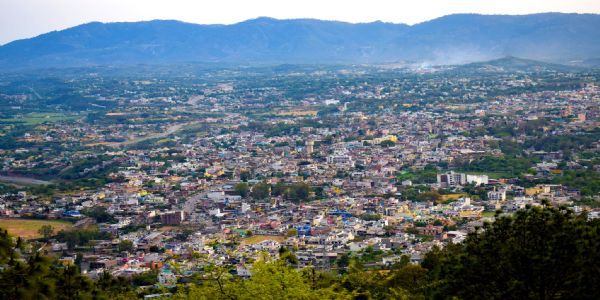
Jammu, 11 July (H.S.): Situated
in the Jammu division of the Union Territory of Jammu and Kashmir, Udhampur
District is a land where history and mythology blend with breathtaking
landscapes and ancient culture. While the district is known for its scenic
beauty and pilgrim trails, it is equally rich in historic and heritage sites
that reflect centuries of architectural craftsmanship, religious devotion, and
strategic importance. From ancient temple complexes predating the medieval era
to majestic forts built by regional rulers, Udhampur’s heritage is diverse and
profound.
Historical Buda Kedar Nath
Buda
Kedar Nath is the historical and prominent Tirtha of Lord Shiva in Chenani area
in District Udhampur.
It
is situated at a distance from Jammu town 113 kilometres 47 km from Udhampur
town and is well connected by a pacca road.
In
order to reach Buda Kedar Nath, one has to take a right side turn from the exit
point of Chenani town towards Chenani-Pattangarh road.
After
crossing River Tawi the road takes an eastern course along with the serpentine
flow of the majestic river Tawi.
After
a distance of 14 kms a link road takes the right side turn from Raji Mohra
towards Buda Kedar Nath temple.
The
length of this well-built road is about 5 kms. In between Raji and Buda Kedar
Nath, there is another important Tirtha called ‘Gaya’ on the left side of the
road across the Nallah coming from hilltops.
The
temple of Buda Kedar Nath is built over a hard stone natural cave. Nearby flows
a sacred rivulet called ‘Devak’ locally. In this cave there is a stone turned
knee of Lord Shiva, which exactly resembles a human knee.
Moreover
there are many idols of Gods in this cave with a natural source of Holy Water
inside the cave.
In
order to reach the seat of Buda Kedar Nath and to have the Darshan of the knee,
we have to pass through a small dark cave.
Due
to some miracles of Lord Shiva, the first ray of the rising sun falls on the
knee of Lord Shiva through some invisible hole. Second important thing
concerning this temple is that as per a belief held from the centuries nobody
can stay in this temple during night.
JALANDARA DEVI TEMPLE
Jalandara Devi Temple, a state protected
monument, located at village Ladden Kotli at about 10 km in Udhampur town not
only seers medieval cultural vibrancy but also depicts architectural tenth
century ad built probably by King Jalandhra of Trigarta according to folklore.
Jalandara Devi Temple, Laddan Kotli, near
Laddan Power Station on the left bank of the Udhampur Tawi is a unique example
of the blend between Margi and Desi traditions.
This temple is constructed with sandstones
in Nagara style, a typical North Indian architectural style where the
‘Shikhara’ remains the most prominent element of the temple and the gateway is
usually modest or even absent.
About one hundred and fifty figures carved in stones that of Gods and Goddesses
besides wrestlers, animals, birds and guards remind one of Khajuraho style of
stone carvings that are visible on all four sides of this magnificent temple.
There are no boundaries marked in this
type of Nagara style construction and the pedestal on which this temple has
been built is higher than ground.
Krimchi Temples: The Ancient Temple Complex
Perhaps the most iconic historic
site in Udhampur District is the Krimchi Temple Complex, often called the “Mini
Khajuraho of Jammu.” Located about 12 kilometers from Udhampur town near the
village of Krimchi, this remarkable set of temples stands as testimony to early
medieval North Indian temple architecture.
Archaeological estimates place the
origin of these temples between the 8th and 9th centuries CE, although some
stylistic elements may be even older. The complex originally comprised seven
temples, symbolically linked to the Sapta Rishi (seven sages) in Hindu
tradition, although not all structures have survived intact. Built in a
classical Nagara style, these temples are characterized by curvilinear
shikharas (spires), intricately carved columns, and sculptured motifs depicting
gods, goddesses, celestial beings, and symbolic geometric patterns.
Local folklore associates the site
with the Pandavas of the Mahabharata, and it is sometimes known as the “Pandava
Temples.” While there is no historical evidence directly linking it to the
epic, this legend reflects how deeply these ruins have embedded themselves into
the cultural imagination of the region.
Today, the Archaeological Survey of
India (ASI) protects the site, which continues to draw historians, pilgrims,
and tourists alike who are keen to explore a piece of ancient Indian heritage
tucked away in the Himalayan foothills.
Ramnagar
Fort and Palace: Echoes of Rajput Valor
Another
historic jewel of the district is the Ramnagar Fort, located in the town of
Ramnagar along the National Highway between Udhampur and Jammu. Constructed in
the early 19th century by Raja Suchet Singh, a prominent Dogra ruler and
younger brother of Maharaja Gulab Singh (the founder of the Dogra dynasty),
this fort was once a center of governance and military strategy.
Unlike
many older forts in India that date back to medieval or early medieval periods,
the Ramnagar Fort reflects the late traditional Rajput fort architecture
influenced by local styles and necessity. Built primarily with stone and
timber, the fortification includes defensive walls, bastions, and a network of
rooms that once housed soldiers, administrative officials, and the royal household.
Adjoining
the fort is the Sheesh Mahal a palace whose name literally means “Mirror
Palace.” Though partly in ruins, Sheesh Mahal once sparkled with glasswork and
decorative embellishments reflecting artistic sensibilities of the Dogra era.
Historical records and local accounts also tell of a samadhi (memorial) of the
Maharani, a tribute to her courage and tragedy, rooted in the era’s complex
royal traditions.
Today,
Ramnagar Fort stands as a silent witness to the region’s military history and
political evolution, inviting visitors to walk through chambers that once
echoed with royal footsteps and the clatter of galloping cavalry.
Sudh Mahadev
Temple: A Sacred Journey Through Millennia
Nestled
in a verdant valley about 30 kilometers from Udhampur town is the Sudh Mahadev
Temple, one of the oldest and most revered Shiva shrines in the region. Located
near the village of Sudhmahadev, this temple complex is believed to be 2,800 to
3,000 years old, predating many well-known historic temples elsewhere in North
India.
The
temple’s setting is as mesmerizing as its antiquity: a natural spring flows
beside the shrine, and the surrounding limestone caves and forested hills
create an atmosphere of serene spirituality. Pilgrims and devotees flock here
especially during Sawan (the sacred monsoon month) and Mahashivratri,
performing rituals and offering prayers to Lord Shiva.
Legend
holds that the lingam (symbol of Shiva) in this temple is swayambhu —
self-manifested — meaning it was not installed by human hands but emerged on
its own. While this notion is rooted in faith rather than documented history,
it speaks volumes about the temple’s deep cultural and spiritual resonance
among devotees.
Sudh
Mahadev’s ancient roots, coupled with the breathtaking natural beauty around
it, make it not only a place of worship but also a destination where visitors
feel transported through time.
Sankri
Devta Temple: A Blend of History and Tradition
Another
significant religious and historic site in Udhampur District is the Sankri
Devta Temple, located near Meer village in the Panchari area. This temple is
dedicated to Sankri Devta, a local deity revered by the mountain communities.
Although
not as architecturally grand as the Krimchi temples or as ancient as Sudh
Mahadev, Sankri Devta Temple embodies centuries of folk tradition and regional
history. It is believed to be over 500 years old, and its annual Sankri Mela
(fair) attracts villagers and pilgrims from across the district. The fair is an
important cultural event featuring traditional music, dance, and communal
worship.
The
temple’s appeal lies not only in its religious importance but also in its role
as a center of community life, where age-old traditions are kept alive through
collective memory and annual pilgrimage.
Pingla Devi Shrine:
A Cave Temple of Power and Devotion
High
in the hills of Pinger village, the Pingla Devi Shrine is an ancient cave
temple dedicated to Mata Pingla, a form of the Mother Goddess or Shakti. This
sacred place is especially vibrant during Navaratri and the Sawan festival,
when devotees perform rituals seeking blessings for protection, prosperity, and
well-being.
The
shrine is set within natural rock formations and caves, and its architecture
blends seamlessly with the surrounding terrain. The spiritual energy of the
place, combined with panoramic views of the Himalayan foothills, makes Pingla
Devi an unforgettable highlight for pilgrims and heritage travelers.
Moungri Caves:
Silent Witnesses of Antiquity
Scattered
across parts of the Udhampur hills are the Moungri Caves, ancient natural
formations that have served as shrines, hermitages, and resting places for
ages. Carved by nature and utilized by early inhabitants, these caves hold
archaeological and cultural significance.
While
not as developed or well-known as some other temple complexes, the Moungri
Caves reflect a way of life that is deeply intertwined with nature and
spirituality — where caves functioned as sanctuaries for meditation, worship,
and community gatherings long before monumental temples arose.
Conclusion: A
Tapestry Woven Through Time
Udhampur District’s historic places are more than
just stone and sculpture — they are living threads in the fabric of Indian
civilization. From the ancient shrines ofBuda
Kedar Nath, Jalandara devi temple, Krimchi and Sudh Mahadev to the regal
Ramnagar Fort and the sacred caves of Pingla Devi and Moungri, each site tells
a unique story of faith, power, culture, and human aspiration.
These
places not only attract historians and pilgrims but also travelers seeking to
understand the deep roots of India’s past — where legends and realities
converge in serene valleys, rugged hills, and whispering temples. Visiting
these sites offers more than sightseeing; it is a journey into the heart of
history itself
---------------
Hindusthan Samachar / Krishan Kumar