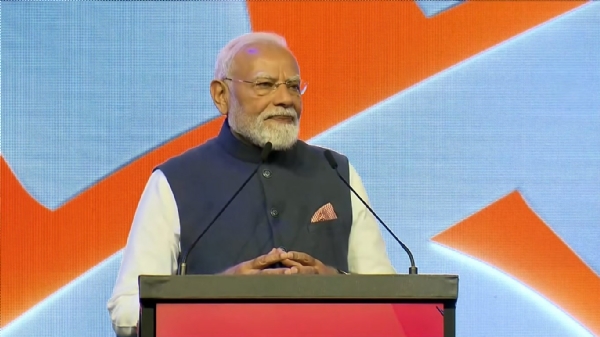
Auckland, 11 July (H.S.):
Prime Minister Narendra Modi said on Saturday that India and New Zealand have taken the historic decision to elevate their bilateral ties to the level of a Strategic Partnership. He said the Free Trade Agreement (FTA), concluded in record time between the two countries, would create new opportunities for industry, farmers, and youth, while laying a strong foundation for doubling bilateral trade over the next five years.
Addressing a State Banquet hosted by New Zealand Prime Minister Christopher Luxon, Prime Minister Modi said that the first official visit by an Indian Prime Minister to New Zealand in four decades marks the beginning of a new chapter in bilateral relations. Expressing his gratitude to Prime Minister Luxon for the warm welcome and gracious hospitality, Modi remarked that the warmth of the reception had made Auckland's winter feel much milder.
Prime Minister Modi said that India and New Zealand are natural partners because of their shared faith in democratic values. He noted that bilateral relations have gained fresh momentum in recent years and will now be advanced further through concrete goals and practical cooperation.
He said that bilateral trade between the two countries has grown by more than 50 per cent over the past three years. The Free Trade Agreement, concluded in record time this year, will generate new opportunities in trade, investment, agriculture, dairy, food processing, and for young people, while helping to double bilateral trade over the next five years.
The Prime Minister said that the partnership extends beyond trade, with both countries building a strong bridge of technology, innovation, and mutual trust. Efforts will be made to integrate India's Unified Payments Interface (UPI) with New Zealand's payment system in the fintech sector. A comprehensive framework has also been prepared to expand cooperation in agriculture, dairy, and food processing, benefiting farmers and livestock rearers in both countries.
He said that, considering the rich traditions of both nations in the field of traditional medicine, they have agreed to enhance its role in bilateral health cooperation. In addition, both sides have reached an agreement on a framework for maritime cooperation in the Indo-Pacific, under which coordination will be strengthened in naval exercises, logistics cooperation, and hydrography.
Prime Minister Modi said that the Cultural Cooperation Agreement signed between the two countries will provide fresh momentum to exchanges in art, culture, heritage, and the creative industries. He also invited New Zealand universities to establish campuses in India.
He noted that India and New Zealand are celebrating the centenary of their sporting ties this year. To commemorate the historic achievements of the Indian hockey team led by Major Dhyan Chand a century ago, several sporting events will be organised in both countries. Besides cricket, the two nations have also adopted a Joint Sports Action Plan to strengthen cooperation in other sports.
Prime Minister Modi said that India and New Zealand are trusted partners on the global stage and share the view that reform of global institutions, including the United Nations, is the need of the hour. He added that both countries have also agreed to establish a Joint Working Group to further strengthen cooperation against terrorism. He emphasised that India-New Zealand cooperation will play a vital role in ensuring peace, stability, and security across the Indo-Pacific region.
Hindusthan Samachar / Jun Sarkar