Mumbai, July 1 (HS): India's stainless steel industry has urged the Central Government to introduce a National Stainless Steel Policy and a National Anti-Corrosion Policy to strengthen domestic manufacturing, secure critical raw materials and promote the use of corrosion-resistant materials in infrastructure projects.
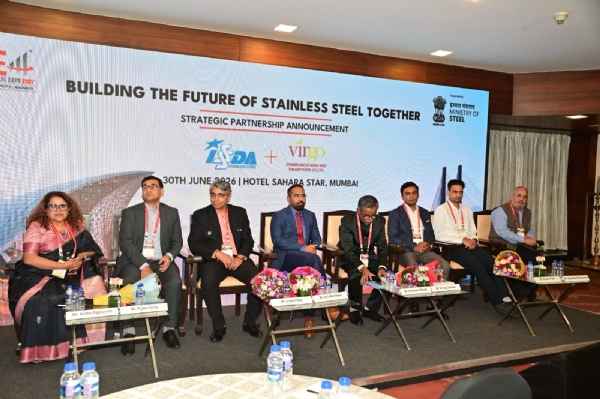
The demand was raised during the announcement of a strategic partnership between the Indian Stainless Steel Development Association (ISSDA) and the Global Stainless Steel Expo (GSSE), organised by Virgo Communications and Exhibitions Pvt. Ltd.
Industry leaders said India incurs annual economic losses of nearly ₹12 lakh crore due to corrosion, while domestic stainless steel manufacturing continues to face challenges from rising imports and underutilised production capacity.
ISSDA President Rajamani Krishnamurti said India has an installed stainless steel production capacity of around 7.5 million tonnes but is operating at only 60-65 per cent capacity utilisation. He noted that nearly one-fourth of domestic demand is still met through imports, largely from China.
He said stainless steel requires a separate policy framework as it differs significantly from conventional steel in terms of manufacturing processes, raw material requirements and end-use applications. According to him, a dedicated National Stainless Steel Policy would help ensure raw material security, encourage investments and enhance India's position as a global producer of value-added stainless steel.
Krishnamurti said India's per capita stainless steel consumption stands at about 3.5 kg, significantly lower than the global average of 6-7 kg, indicating substantial growth potential. He added that increasing consumption would require additional production capacity and support the country's infrastructure and manufacturing expansion.
Highlighting the impact of corrosion, he said India loses nearly four per cent of its GDP annually due to damage to infrastructure, transportation networks, industrial assets and public utilities. He stressed that a National Anti-Corrosion Policy would promote lifecycle-based infrastructure planning and wider adoption of corrosion-resistant materials, particularly in coastal regions where maintenance costs are high.
He also noted that stainless steel is becoming increasingly important for sectors such as green hydrogen, ethanol, water infrastructure, ports, bridges, coastal construction and specialised engineering applications.
Virgo Communications and Exhibitions Managing Director Anitha Raghunath said the partnership between ISSDA and GSSE would combine industry expertise with a global business platform to promote wider adoption of stainless steel, facilitate knowledge sharing and expand business opportunities.
Rajeev Garg, Group Head (Marketing and Sales) at Jindal Stainless Limited, said the collaboration comes at a time when the domestic industry needs stronger policy support to address challenges such as rising imports, raw material security and sustainable infrastructure development. He added that although stainless steel accounts for a relatively small share of total steel production by volume, it contributes significantly through value addition, durability and lifecycle savings.
The ISSDA-GSSE partnership will focus on strengthening policy dialogue, promoting global best practices, expanding domestic applications of stainless steel, facilitating international collaborations and creating a knowledge-sharing platform during the fourth edition of the Global Stainless Steel Expo.
---------------
Hindusthan Samachar / Indrani Sarkar
01 Jul 2026
Marking 11 Years of Digital India, PM Modi Says Technology Is Driving Inclusive Growth and Innovation
01 Jul 2026