New Delhi, 01 July (H.S.): The Congress on Wednesday alleged that the newly notified Viksit Bharat – Guarantee Mission for Employment and Livelihood (Rural), or the VB-G RAM G (Viksit Bharat - Guarantee for Rozgar and Ajeevika Mission), would impose a financial burden on both the poor and state governments because of its 60:40 cost-sharing formula between the Centre and the states.
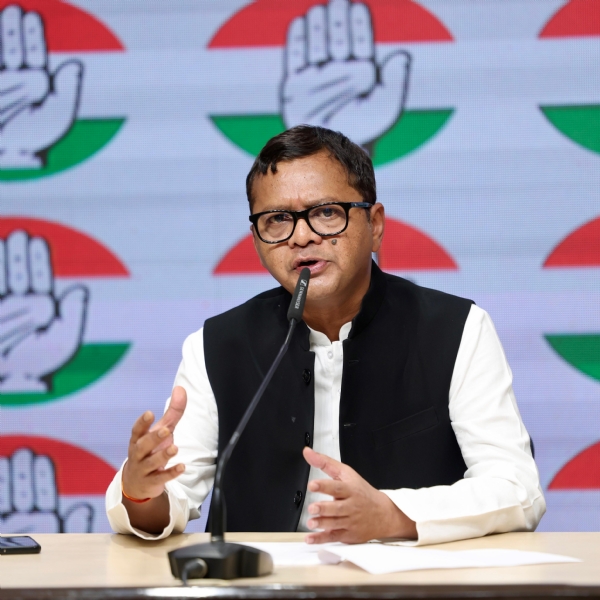
Addressing a press conference at the party headquarters, Congress MP and Chairman of the Parliamentary Standing Committee on Rural Development and Panchayati Raj, Saptagiri Ulaka, said the Mahatma Gandhi National Rural Employment Guarantee Act (MGNREGA) was a rights-based, demand-driven employment programme, whereas the new scheme places an additional financial burden on the states.
Ulaka said that under MGNREGA, the Central government bore almost the entire wage cost, while the material component was shared between the Centre and the states in a 60:40 ratio. This kept the financial burden on the states relatively low. Under the VB-G RAM G Act, however, both wage and material costs are to be shared in a 60:40 ratio, significantly increasing the states' financial responsibility.
He cited Haryana as an example, saying that out of an allocation of Rs 9.84 billion (Rs 984 crore), the state would have to contribute 40 percent, or about Rs 3.93 billion (Rs 393 crore). Despite this expenditure, he claimed the scheme would provide only 13.78 days of employment. If employment were to be extended to 125 days, the state would have to spend an additional Rs 57.86 billion (Rs 5,786 crore), he added.
Ulaka said that although the Central government claims the scheme will provide 125 days of employment, the funding gap demonstrates that the promise is unrealistic. He also alleged that the new scheme removes the role of the Gram Sabha and transfers decision-making powers to government officials. Under MGNREGA, he said, the Gram Sabha decided which development works should be undertaken.
He further claimed that under MGNREGA, workers who did not receive employment within 15 days of demanding work were entitled to an unemployment allowance. According to him, this entitlement has been removed under the VB-G RAM G Act.
Congress General Secretary (Communications) Jairam Ramesh said the Modi government has notified the VB-G RAM G scheme along with the revised wage rates. He alleged that the daily wages fixed under the scheme are unjustifiably low, amounting to around Rs 300 per day in most states.
Ramesh said the Congress had promised a national minimum daily wage of Rs 400 under its Shramik Nyay campaign. He also noted that the Dr. Anoop Satpathy Committee, constituted by the Modi government, had recommended a national minimum wage of Rs 375 per day as early as 2019.
He said protests were taking place in industrial areas over minimum wages, while stagnating rural wages were increasingly being viewed as a major obstacle to economic growth. Keeping wage rates low under such circumstances, he said, was not only unfair to workers but also reflected flawed economic policy.
Ramesh said the Congress would continue its campaign, both on the streets and in Parliament, for the restoration of MGNREGA in its original form. He said the programme was fundamentally a rights-based and demand-driven employment guarantee scheme that promised work for every willing hand and fair wages for that work.
---------------
Hindusthan Samachar / Jun Sarkar