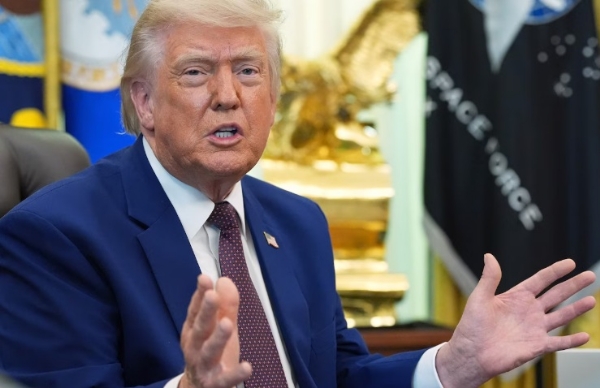
WASHINGTON, June 4 (H.S.): The United States House of Representatives on Wednesday passed a concurrent resolution by a vote of 215-208 seeking to restrict President Donald Trump's authority to engage in military action against Iran without congressional approval.
Significantly, four Republican lawmakers crossed party lines to support the Democrat-led measure. They included Representatives Warren Davidson of Ohio, Brian Fitzpatrick of Pennsylvania, Tom Barrett of Michigan, and Thomas Massie of Kentucky.
According to reports, the resolution states that President Trump must cease the use of United States Armed Forces in hostilities against Iran, its military, or any part of its government unless Congress formally declares war or enacts specific legislation authorizing the use of military force.
The measure will now move to the Senate for consideration. However, even if approved by the Senate, a concurrent resolution does not carry the force of law. It is not presented to the President for signature and is not subject to a presidential veto.
Following the vote, senior Democrat on the House Foreign Affairs Committee, Gregory Meeks, told reporters that Congress had upheld its constitutional responsibilities.
Congress has followed the Constitution today, Meeks said. Democrats and Republicans alike have said enough is enough. It is time to end this war. It is time for the President to explain to the American people why the United States became involved in this conflict.
This marks the fourth vote in the House on a Democrat-led Iran War Powers Resolution since the outbreak of hostilities.
Ahead of the vote, Mike Johnson opposed the measure, arguing that limiting the administration's flexibility during an ongoing conflict would be risky.
I believe it would be a very dangerous step to take away the administration's and the Commander-in-Chief's ability to respond at this moment, Johnson said.
A White House official attributed the resolution's passage in part to the absence of six Republican members during the vote. The official emphasized that President Trump would continue exercising his constitutional authority as Commander-in-Chief to safeguard US national security while maintaining transparency with Congress.
The President will continue to protect America's national security under his constitutional powers as Commander-in-Chief and will remain fully transparent with Congress, the official said.
The vote reflects growing bipartisan concern in Congress over the scope of presidential war-making powers and the United States' expanding military involvement in the ongoing confrontation with Iran. While largely symbolic, the resolution sends a strong political message regarding congressional oversight of military action and the constitutional requirement for legislative authorization before entering a broader conflict.
---------------
Hindusthan Samachar / Jun Sarkar

04 Jun 2026