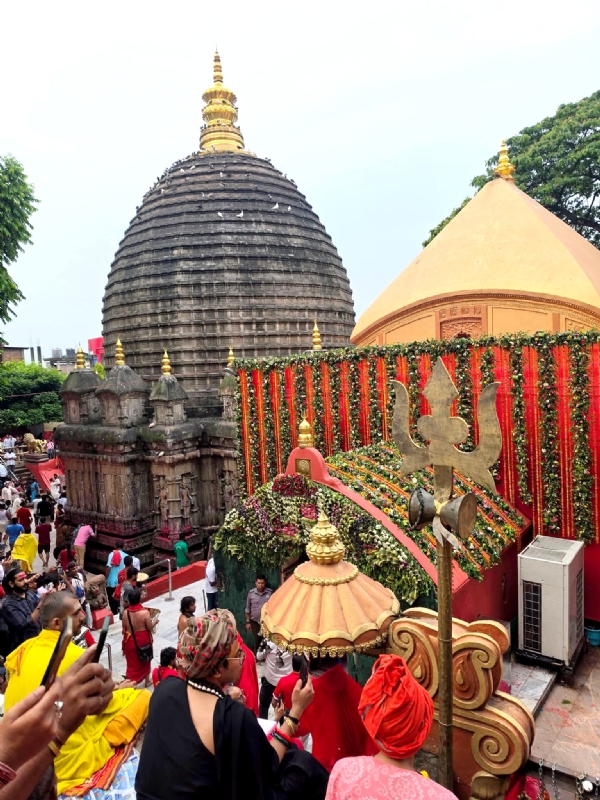
Guwahati, 26 June (HS): The annual Ambubachi festival at the revered Kamakhya Temple in Assam has once again drawn global attention to one of Hinduism's most distinctive spiritual traditions, where the cycles of nature, the Earth and feminine power are celebrated as sacred. The four-day observance, which concluded on Friday with the reopening of the temple doors, attracted lakhs of devotees, ascetics and pilgrims from India and abroad.
Situated atop the Nilachal Hills overlooking the Brahmaputra River in Guwahati, the Kamakhya Temple is regarded as one of the 51 Shakti Peethas in Hindu SHAKT tradition. Unlike most Hindu shrines, the temple does not house an idol of the goddess. Instead, worship is offered to a naturally formed rock fissure symbolising the divine feminine, making it one of the world's most unique centres of goddess worship.
During Ambubachi, the temple remains closed for four days, reflecting the belief that Goddess Kamakhya, representing Mother Earth, undergoes her annual menstrual cycle. Religious rituals are suspended during this period and many farming communities traditionally refrain from agricultural activities as a mark of respect, symbolising the Earth's need for rest and renewal. The temple reopens after ceremonial purification, marking the beginning of fresh worship and attracting massive crowds of devotees.
The festival is deeply rooted in the mythology of Goddess Sati. Hindu scriptures narrate that after Sati immolated herself following the insult of Lord Shiva by her father, King Daksha Prajapati, Lord Vishnu used his Sudarshan Chakra to divide her body into 51 parts to calm Shiva's cosmic grief. These sacred sites later became the Shakti Peethas, with Kamakhya believed to be the place where Sati's yoni (creative source of life) fell, giving the temple its exceptional spiritual significance.
Historical records indicate that the original temple suffered destruction during the 16th century before being rebuilt under the patronage of the Koch kings, particularly Maharaja Nara Narayan and his brother Chilarai. The present architectural form of the temple largely dates back to that period and continues to remain one of India's most important centres of Tantric worship.
Beyond its religious significance, Ambubachi has increasingly attracted scholars, cultural historians, environmental thinkers and international visitors interested in indigenous traditions that honour fertility, womanhood and ecological harmony. At a time when global discussions focus on environmental sustainability and gender dignity, the festival presents an ancient Indian worldview that reveres the regenerative power of nature and the feminine as integral to the balance of life.
The Ambubachi festival thus stands not only as a major pilgrimage but also as a powerful cultural expression of India's civilisational philosophy, where spirituality, ecology and respect for womanhood converge in a tradition that continues to inspire millions across the world.------------
Hindusthan Samachar / Sriprakash

26 Jun 2026
Top Leaders Pay Floral Tribute to Chhatrapati Shahu Ji Maharaj, Hail His Legacy of Social Justice and Reform


26 Jun 2026