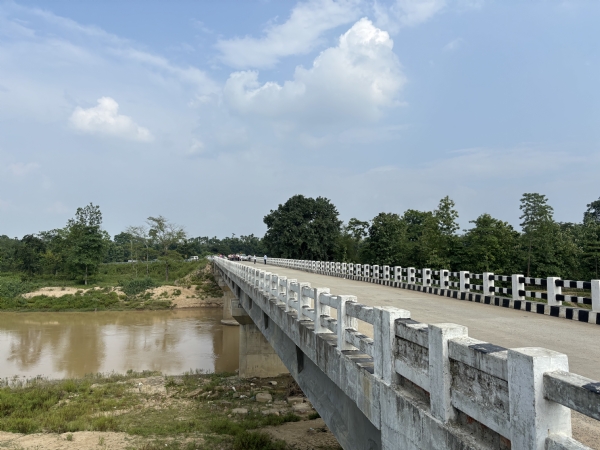
KARBI ANGLONG (ASSAM), 26 June (H.S.): A newly constructed reinforced cement concrete (RCC) bridge over the Dhansiri River and an all-weather paved road linking East Karbi Anglong and Golaghat districts in Assam have transformed the lives of nearly 45,000 people across more than 40 villages. Built under the Union Ministry of Development of North Eastern Region's North East Special Infrastructure Development Scheme (NESIDS), the infrastructure project has significantly improved connectivity, safety, livelihoods, and access to essential services for local tribal communities and rural residents.
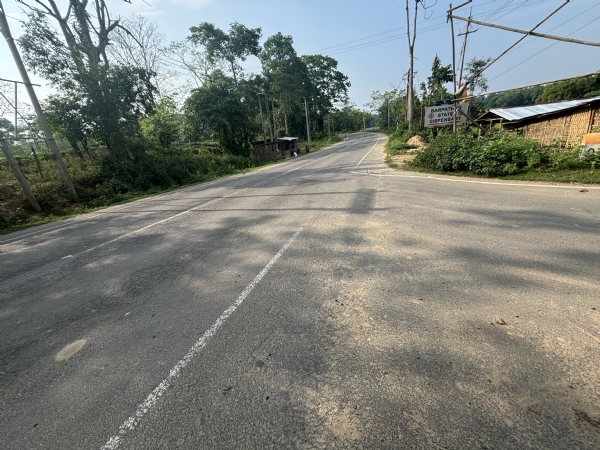
The project has emerged as a lifeline for villagers, students, daily wage earners, and small traders. Recalling the hardships of the past, local resident Nuwalshyam said that for the last 30 to 40 years, people had depended solely on a temporary bamboo bridge to cross the river. The road leading to the crossing was uneven, muddy, and unpaved, making travel extremely difficult even under normal weather conditions.
He explained that during the monsoon, when the perennial Dhansiri River, originating from Laisang in Nagaland, overflowed, the entire region would become completely cut off from the rest of the country. Patients, elderly people, and pregnant women had to be ferried across the river in small boats, often risking their lives to reach hospitals. With the construction of the sturdy RCC bridge and an all-weather road, the decades-long isolation and transportation challenges have finally come to an end.
Before the project was completed, the absence of a proper road and bridge prevented farmers from transporting their produce to major markets on time. Following the opening of the route, local farmers have recorded a remarkable 60 per cent increase in agricultural profits due to improved market access.
The project has also brought substantial improvements to education. During the monsoon season, flooding and muddy roads previously forced students to miss school and college for months. With year-round connectivity now available, students attend educational institutions regularly, resulting in a 40 per cent increase in attendance and greater interest in higher education. While transportation on the old dirt road came to a complete halt during the rainy season, nearly 10,000 people now use the route every day without disruption.
Trade and commerce in the region have also witnessed a major boost. Even after 6 p.m., more than 200 heavy trucks carrying tea leaves, agarwood, bamboo, and rubber travel through the newly developed corridor daily to markets across the country. Previously, residents had no option but to cross the river using fragile bamboo structures, and there was no permanent bridge within a 10-kilometre radius. Today, a modern 102-metre RCC bridge has replaced that unsafe crossing.
Another local resident, Abhijit Dhule, said the bridge has established permanent, all-weather connectivity between communities living on both banks of the Dhansiri River. He noted that parents no longer worry about sending their children outside the region for higher education because travel has become safe and reliable.
He added that local businesses have expanded considerably, with inter-district movement for work and trade increasing significantly. Access to healthcare has also improved dramatically, as ambulances and emergency vehicles can now reach villages directly whenever required.
Farmers in this geographically sensitive region primarily cultivate tea, rubber, bamboo, and agarwood. With the all-weather road and bridge now operational, transportation costs have fallen sharply and post-harvest losses have been virtually eliminated. Small and marginal farmers belonging to Karbi, Ahom, Nepali, Bodo, Mising, Khamyang, and tea garden tribal communities now enjoy direct and faster access to major commercial centres, including Diphu, Guwahati, Golaghat, and neighbouring Nagaland, enabling them to receive fair and timely prices for their produce.
Improved transport and connectivity have accelerated inter-district trade and strengthened the region's small-scale industries. The enhanced infrastructure has also generated new employment and self-reliance opportunities for local youth and Self-Help Groups (SHGs). In addition, government welfare schemes, development programmes, and essential public services such as the Public Distribution System (PDS) are now reaching remote villages more efficiently and transparently.
The project also carries considerable strategic importance for security and law enforcement. The border region, which was affected by insurgency for many years, had posed serious logistical challenges for security forces. The modern bridge now enables faster movement of police and paramilitary personnel, helping curb illegal activities, smuggling, and infiltration along the Assam-Nagaland border.
Tourism has also received a significant boost. The improved road provides easy access to the famous hot springs inside the Garampani (Nambor) Wildlife Sanctuary, located just seven kilometres away. In addition, the historic Durga Temple at Devpani, situated around eight kilometres from the bridge, has witnessed a sharp rise in the number of pilgrims and tourists, benefiting local hotels, transport operators, and handicraft businesses.
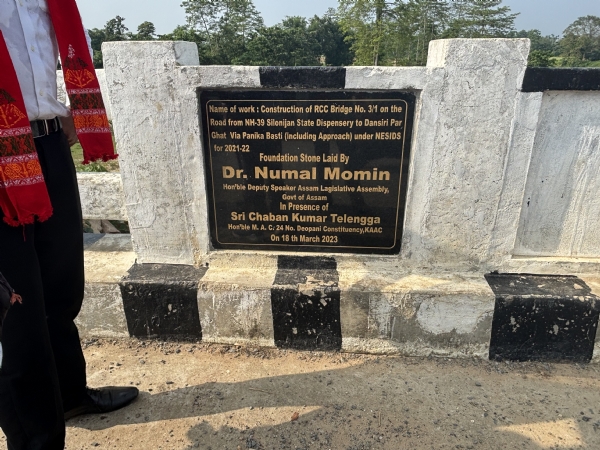
According to the project's administrative and technical details, the Assam Public Works Department (Roads), Barpathar Division, constructed RCC Bridge No. 3/1 along with its approach road over a total stretch of four kilometres from National Highway-39 near Silonijan State Dispensary through Paniyaka Basti to Dhansiri Par Ghat. The main bridge spans 102 metres.
The project received administrative and financial approval on April 20, 2022, at a sanctioned cost of Rs 20.59 crore. Physical construction commenced on October 19, 2022. Although the official completion deadline was October 2025, the project was completed ahead of schedule in January 2025 through timely administrative execution and has since been opened for public use.
---------------
Hindusthan Samachar / Jun Sarkar

26 Jun 2026
Top Leaders Pay Floral Tribute to Chhatrapati Shahu Ji Maharaj, Hail His Legacy of Social Justice and Reform


26 Jun 2026