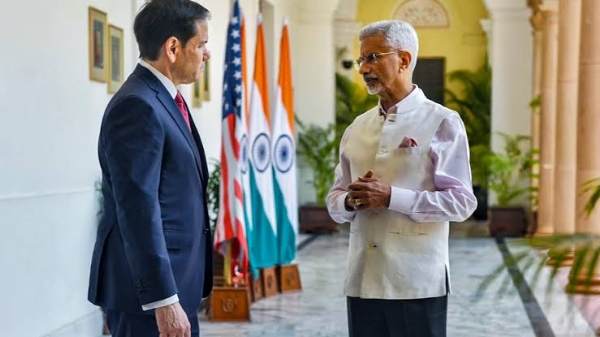
Delhi, 13 June (H.S.): India has sharply escalated its diplomatic response following the deaths of three Indian sailors in a United States naval strike on a commercial oil tanker in the Gulf of Oman, with External Affairs Minister S. Jaishankar conveying India's strong protest directly to US Secretary of State Marco Rubio and describing the use of lethal force against commercial shipping as unjustified.
The diplomatic intervention came amid growing concerns over maritime security in the region and follows a series of incidents involving commercial vessels carrying Indian crew members.
In a statement issued after his conversation with Rubio on Friday evening, Jaishankar said he had reiterated India's strong objections to the attacks carried out by US naval forces in the Gulf, which resulted in the deaths of three Indian mariners.
According to the minister, New Delhi views the use of deadly force against civilian and commercial vessels with utmost seriousness, particularly when such actions lead to loss of life among seafarers engaged in legitimate maritime activities.
The conversation followed an earlier move by the Ministry of External Affairs, which summoned Jason Meeks, the Charge d’Affaires of the United States Embassy in New Delhi, to formally register India's protest.
During the meeting, Indian officials conveyed their deep concern over what they described as continuing attacks by American naval forces on commercial vessels carrying Indian sailors in the Gulf of Oman. The ministry stressed that the deaths were both tragic and avoidable and underscored the need for greater safeguards to protect civilian lives in conflict-affected maritime zones.
In an official statement, the Ministry of External Affairs said that the use of lethal force against civilian shipping was unacceptable and posed a threat to the safety, security, and stability of international maritime commerce. It further warned that such incidents undermine confidence in one of the world's most strategically important shipping corridors.
Indian authorities also urged the United States to ensure that all necessary precautions are taken by its forces operating in the region to prevent civilian casualties and avoid similar incidents in the future.
The diplomatic row intensified after Indian authorities confirmed that three crew members who had initially been reported missing following the strike were later found dead.
The vessel involved, the Palau-flagged oil tanker Settebello, was carrying a crew of 28, including 24 Indian nationals and four foreign nationals comprising two Pakistanis, one Ukrainian, and one Russian citizen. Rescue operations managed to save 21 Indian sailors, while efforts to locate the missing crew members ultimately ended in tragedy.
The deceased Indian sailors were identified as deck cadet Aditya Sharma, fitter Shivanand Chaurasia, and chief engineer Pattanala Suresh.
The United States military has acknowledged responsibility for the strike. According to the US Central Command, the tanker was targeted after allegedly failing to comply with instructions issued by American naval personnel and was suspected of transporting Iranian oil in violation of an American maritime blockade.
US military officials stated that an American aircraft disabled the vessel after repeated warnings and directions issued to the crew reportedly went unanswered.
The incident occurred against the backdrop of heightened instability across West Asia, where competing maritime restrictions, military operations, and regional tensions have increasingly disrupted international shipping routes.
India has maintained that the vessel was engaged in commercial operations and that the presence of a large number of Indian crew members makes the incident particularly concerning from both humanitarian and diplomatic perspectives.
The Ministry of External Affairs linked the attack to the broader regional conflict and reiterated India's longstanding call for de-escalation.
Indian officials warned that continued hostilities and attacks on merchant vessels threaten global trade flows, maritime safety, and regional stability. New Delhi has urged all parties involved in the conflict to exercise restraint and work toward reducing tensions.
The latest diplomatic exchange marks one of the strongest public protests by India over a maritime security incident involving the United States in recent years and highlights growing concerns in New Delhi about the safety of Indian nationals serving aboard commercial vessels operating in conflict-prone waters across West Asia.
---------------
Hindusthan Samachar / Jun Sarkar


13 Jun 2026
Police Conduct Extensive Search at Abhishek Banerjee’s Kalighat Residence, Break Open Lock to Enter Premises
13 Jun 2026