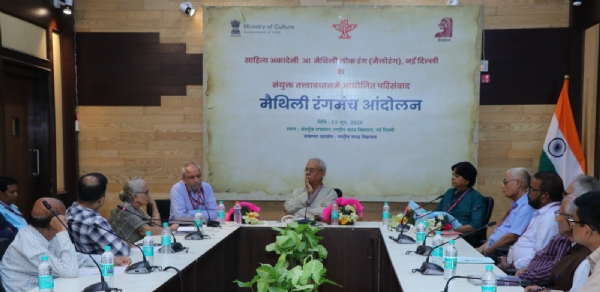
New Delhi, 13 June (HS): The Maithili theatre movement has sustained a continuous tradition in independent India and evolved through both translated and original dramatic works, speakers observed at a symposium on the Maithili theatre movement held in New Delhi on Saturday.
The symposium was organised at the Antarmukh Auditorium of the National School of Drama under the joint aegis of the Sahitya Akademi and Maithili Lok Rang (Mailorang).
Delivering the keynote address, noted playwright, poet and linguist Uday Narayan Singh 'Nachiketa' said that although the history of the Maithili theatre movement may not be very long, it has maintained continuity and expanded through original writing alongside translated works. He referred to early original plays such as Goraksha Vijaya and Dhurta-Samagam while discussing the development of theatre in the language.
Pradeep Bihari said the Maithili theatre landscape had become richer through various theatre movements and discussed challenges faced by theatre groups and practitioners in both urban and rural areas of Mithila. He called for greater social support, including awards and recognition for theatre artistes.
Namonarayan Mishra highlighted the contribution of theatre organisations and practitioners in Kolkata towards strengthening the movement, while Kislay Krishna presented a research paper on Maithili theatre activities in Mithila and Nepal.
Veteran theatre actor Premlata Mishra 'Prem' discussed theatre movements in Patna and noted that increased social awareness had encouraged greater participation of women as actors and directors in Maithili theatre.
In the second session, Arunabh Saurabh presented a paper on the influence of global theatre on the Maithili theatre movement and examined various theatrical styles. Sanjeev Sinha discussed audience engagement with Maithili theatre in Delhi and its social impact.
Presiding over the second session, Professor Devshankar Navin expressed hope that the Maithili theatre movement would continue to contribute positively to the society and culture of Mithila. He said literature has historically served as an instrument of social reform in addition to entertainment.
Earlier, N. Suresh Babu, Deputy Secretary of the Sahitya Akademi, welcomed the invited scholars, participants and audience on behalf of the Akademi's Secretary, Dr. Varun Gulati. The symposium witnessed participation from a large number of Maithili writers, poets, critics and theatre enthusiasts.
---------------
Hindusthan Samachar / Indrani Sarkar
13 Jun 2026
Lieutenant General Dhiraj Seth Appointed as India’s Next Army Chief, to Assume Office on June 30
13 Jun 2026