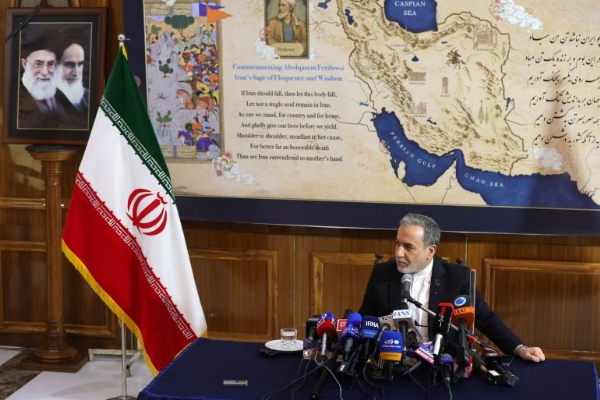
Tehran, 13 June (H.S.): Iranian Foreign Minister Abbas Araghchi has indicated that a draft agreement between Iran and the United States aimed at ending months of conflict is nearing completion, while cautioning against premature speculation over its final provisions.
Speaking on Friday, Araghchi said an “Islamabad Memorandum of Understanding” designed to address the conflict involving Iran, the United States and Israel had “never been closer” to fruition. He stressed that Tehran would disclose the full details only after the document is formally finalised, describing the approach as responsible and transparent.
At the centre of Araghchi’s remarks was the future of maritime security in the Strait of Hormuz, one of the world’s most strategically important shipping corridors. He said the draft agreement includes provisions for the complete lifting of what Iran describes as a naval blockade on its ports, calling it the first and most significant element of the proposed arrangement.
Araghchi also suggested that the management of the Strait of Hormuz could undergo substantial changes. He stated that Iran had made a firm decision that the administration of the waterway would no longer operate under previous arrangements and revealed that discussions on the issue were continuing with Oman.
The Iranian foreign minister further alleged that Israel was attempting to obstruct the emerging agreement. He argued that opponents of the deal were searching for opportunities to derail the diplomatic process at a critical stage, reflecting the deep divisions that remain over efforts to end the conflict.
His comments came amid a series of conflicting statements from various parties involved in the negotiations. While Iranian officials have maintained that discussions are still underway, reports from Washington suggested that Tehran had agreed in principle to significant commitments concerning its nuclear programme and maritime access.
The proposed framework is also reported to include a 60-day period of negotiations focused on a long-term nuclear agreement. Iranian media outlets have insisted that Tehran would retain key sovereign rights, including authority over uranium enrichment and continued influence over the Strait of Hormuz, despite ongoing diplomatic concessions.
The latest developments have raised expectations that a broader settlement could be within reach after months of military confrontation and regional instability. Any agreement affecting the Strait of Hormuz would carry global significance, as the narrow waterway serves as a vital route for international energy supplies and commercial shipping.
Although optimism surrounding the negotiations has grown, Iranian officials continue to emphasise that no final accord has yet been signed. Araghchi reiterated that details of the understanding would be released publicly only after all parties complete the formal process, leaving the outcome of the negotiations uncertain despite signs of progress.
---------------
Hindusthan Samachar / Jun Sarkar
13 Jun 2026
Araghchi Signals Breakthrough in Iran-U.S. Talks, Says Draft Agreement Could Reshape Hormuz Administration

13 Jun 2026