




TEHRAN/MANAMA/WASHINGTON, 10 June (HS): The escalating conflict between Iran and the United States has spread to Bahrain, with Iran's Islamic Revolutionary Guard Corps (IRGC) claiming responsibility for a drone attack on the headquarters of the U.S. Naval Forces Central Command in Manama early Wednesday.
According to reports from multiple international media outlets, the IRGC said the strike was carried out in retaliation for U.S. military attacks on southern Iran. The United States Central Command (CENTCOM) had earlier stated that American forces conducted self-defence strikes against targets in southern Iran on Tuesday in response to the downing of a U.S. Army Apache helicopter over the Strait of Hormuz on Monday.
Iranian officials said the country's air defence systems had been activated to counter any further attacks. Authorities in Tehran also claimed that Iranian forces shot down an American MQ-9 drone and a helicopter over the southern province of Bushehr.
The IRGC and Iran's Khatam al-Anbiya Central Headquarters confirmed that Iranian forces had launched attacks against American military positions in the region. While officials did not specify the total number of targets, they identified the U.S. Naval Forces Central Command headquarters in Bahrain's capital, Manama, as one of the locations struck.
Khatam al-Anbiya, Iran's principal military command structure responsible for coordinating operations among the armed forces, the IRGC and intelligence agencies, said the attack was a response to what it described as American aggression against Iranian territory.
Iranian authorities have not disclosed how many drones were used in the operation, nor have they confirmed whether missiles were involved. In its statement, Khatam al-Anbiya warned that any further U.S. military action against Iran would trigger larger and more forceful attacks on American military facilities across the region.
CENTCOM, meanwhile, reiterated late Tuesday that its strikes on Iranian air-defence systems, ground-control stations and surveillance radar sites near the Strait of Hormuz were conducted as a defensive measure following the Apache helicopter incident. The command stated that the operation had fulfilled its immediate objective.
Earlier, U.S. President Donald Trump said the Apache helicopter had been brought down by Iranian forces while operating near the Strait of Hormuz. He confirmed that both pilots were rescued safely and warned that the United States would respond firmly to the attack.
The latest escalation comes only hours after Trump indicated that negotiations with Iran were in their final stages and suggested that an agreement could be reached within days. The status of those diplomatic efforts remains unclear following the recent military exchanges.
Regional tensions have also been heightened by Israel's ongoing military operations against the Iran-backed Hezbollah movement in Lebanon. Health officials reported that at least eight people were killed in fresh strikes on the southern Lebanese city of Tyre on Tuesday. Iran had warned earlier this week that it would respond to any new Israeli attacks in Lebanon.
Officials in Tehran said conditions along Iran's southern coastline near the Strait of Hormuz had stabilised after explosions reported in the area. Reports also indicated that U.S. forces targeted several Iranian air-defence and radar installations around the strategic waterway, prompting renewed threats of retaliation from Iranian Foreign Minister Abbas Araghchi.
Bahrain's Interior Ministry confirmed that a nationwide alert had been issued following reports of the attack. In a statement posted on social media, authorities said warning sirens had been activated and urged citizens and residents to remain calm and move to the nearest safe location.
The IRGC claimed that the strike on the U.S. Navy's Fifth Fleet headquarters was carried out using Shahed-136 one-way attack drones at approximately 2:30 a.m. local time. Iranian Foreign Minister Abbas Araghchi later warned that the United States should withdraw its military presence from the region, declaring that Iran's patience had reached its limit.
Why the U.S. Fifth Fleet Is Strategically Important
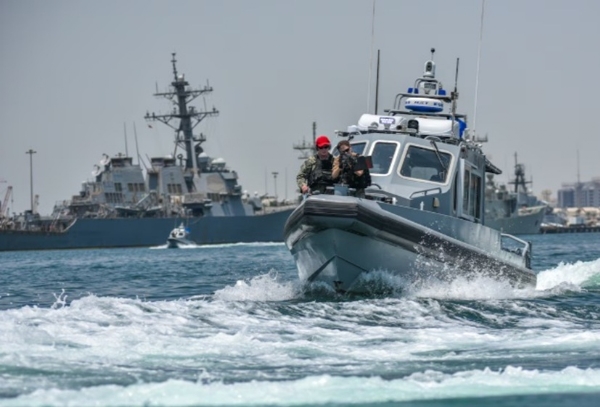
The United States Fifth Fleet is one of Washington's most critical military formations in the Middle East. Headquartered at Naval Support Activity Bahrain in the Juffair district of Manama, it oversees nearly 2.5 million square miles of maritime territory.
Its area of responsibility includes the Persian Gulf, the Red Sea, the Gulf of Oman, the Arabian Sea and parts of the Indian Ocean. The fleet plays a central role in safeguarding vital global shipping routes, including the Strait of Hormuz, the Suez Canal and the Bab el-Mandeb Strait.
The installation also serves as the headquarters of U.S. Naval Forces Central Command and reports directly to CENTCOM, making it a key component of America's military presence and maritime security operations across the region.
---------------
Hindusthan Samachar / Jun Sarkar

10 Jun 2026
New US Strikes on Iran May Distance Tehran From Dialogue With Washington- Iranian Lawmaker
10 Jun 2026