Mathura,
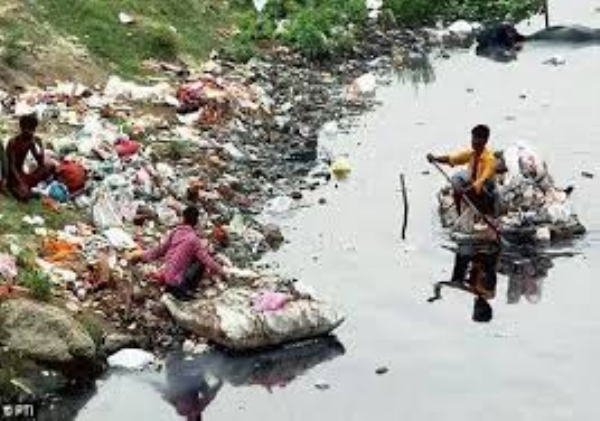
03 May (HS): The deteriorating state of the Yamuna river is rapidly developing
as a crucial political issue in Mathura ahead of 2027 Uttar Pradesh assembly
elections, with opposition parties intensifying their attacks and the ruling
BJP claiming continuing clean-up efforts. The State Pollution Control Board's
most recent February 2026 data shows worrisome pollution levels at major areas
like as Kesi Ghat, Vishram Ghat, and Gokul Barrage. KP Singh of the
Biodiversity Research and Development Society, who evaluated the samples using
official data, stated that, while fundamental characteristics like as
temperature and pH stay below permissible ranges, some crucial pollution
indicators exceed safe thresholds. He stated that high levels of turbidity,
Biological Oxygen Demand (BOD), and Chemical Oxygen Demand (COD) at all three
sites indicate severe organic contamination in the river.
According
to the research, Vishram Ghat had the most turbidity and bacterial contamination;
making it the most contaminated location, whereas Gokul Barrage had relatively
better dissolved oxygen but the largest organic load. Kesi Ghat has fairly high
pollution levels. The investigation also identified abnormally high levels of
total and fecal coliform bacteria in all areas, indicating serious sewage
pollution. According to experts, such circumstances render the water dangerous
for human consumption and even swimming without adequate treatment, while also
threatening aquatic biodiversity, enabling only pollution-tolerant species to
thrive. The data also revealed that the water quality remained in Category D
(suitable exclusively for aquatic life) in December 2025, January 2026, and
February 2026.
The
research ascribed the drop to untreated sewage discharge, increasing human
activities along ghats, and poor wastewater treatment systems. Gopeshwar Nath
Chaturvedi, an environmental activist and the initial petitioner in the Yamuna
Action Plan, condemned the executing agencies' weak attitude in the face of
several court rulings and regulations. According to Chaturvedi, poisonous forms
can be seen on the other side of the Yamuna River's Gokul Barrage. He went on
to say that industries such as brass polishing and Todiya operate with very
dangerous chemicals like cyanide as a cleaning agent. The untreated water is
then freely released into the river. Sewage treatment plants are meant to handle
sewage, not chemicals, he said, adding that treating chemical-laden river water
with chlorine and alum for drinking is a useless practice because chlorine and
alum cannot remove chemicals.
Chaturvedi
also advocated stringent enforcement, stating that no overflow should be
permitted from sewage treatment facilities with drains connected to pumping
stations. Pankaj
Yadav, a Pollution Control Board officer, stated that while the Yamuna water is
suitable for aquatic life, it is unsafe for drinking without treatment. The
froth on the other side of the Gokul barrage is mostly the result of home
detergent usage. When water falls from a height, it creates foam. The formation
is dependent on the temperature differential. As a result, it stands out more
throughout the winter. He further stated that the department has established a
specific push to close down 'todiya' outlets. The problem has now taken a
political turn, with opposition parties planning to highlight it during the
assembly elections.
According
to Congress politician Pradeep Mathur, the sacred river has become a sewage
pool as a result of widespread corruption. Total and fecal coliform bacteria
levels are alarmingly high. The river remains pure just till the HathniKund
Barrage. It is nearly dead over the next 35 kilometers because the Haryana
government refuses to give water, and it is so contaminated that it cannot
recover; there is no fresh water left in it. He noted that, despite BJP regimes
at the Centre and in Uttar Pradesh, Haryana, and Delhi, coordinated efforts
were absent, and questioned saints' silence. Are they satisfied with the status
of the river? he said, adding that this will be a key issue in next year's
Vidhan Sabha elections.
According
to Rashtriya Lok Dal leader Ashok Agrawal, Vishram Ghat, an important holy site
on the river, is the most polluted location. Lakhs of devotees go from all over
the world to Vishram Ghat to take a ceremonial drink of water and bathe in the
Yamuna. This is offending their religious feelings. We expect a
Sanatani government to at least preserve religious heritage, he
continued. Sanjay Chaturvedi 'Alpine', a sewayat at the Shri Yamuna temple at
Vishram Ghat, claims that diminishing water quality has begun to disrupt
religious rites.
The
river water is now so contaminated that Gopal Ji and Yamuna Maharani cannot
bathe in it. He said that instead, we utilize well water. He stated that Yamuna
Ji now receives a scented bath every day at the temple, and river water is no
longer held in a jhari (long-necked vessel) for giving to the deity. He stated
it destroys the silver vessel and infests the water with worms.
Mathura
MP Hema Malini responded to the worries, saying, It's not just a river,
it's a heritage, and that the government is developing an action plan. Projects
worth 460 crores have already been completed, while projects worth around 493
crores have been sanctioned and are now underway under the Namami Gange
project. I highlighted the problem in my meetings with Prime Minister Modi and
Uttar Pradesh Chief Minister Yogi Adityanath, and they told me that it will be
addressed promptly, she added.
Her
agent, Janardhan Sharma, stated that the monies will be utilized to tap sewers
in Mathura, Vrindavan, Chhata, and Kosi, as well as to construct sewage
treatment plants and renovate infrastructure. Srikant Sharma, a BJP politician
and Mathura MLA, stated that the river's health has greatly improved since the
BJP administration took office in 2017. We decided to tap the nalas and build a
huge treatment facility in Masani. Following positive findings from the
treatment plant, we began working on tapping the remaining nalas. Mathura now
has 19 nalas out of 23 while Vrindavan has 11 nalas out of 13. The remaining
nalas' work is scheduled to be completed soon. The effects of these efforts
will be obvious shortly, he stated.
Meanwhile,
Mukul Agrawal of Indian Oil's Mathura Refinery stated that the facility's
infrastructure has been updated to reduce emissions. The refinery employs a
Sour Water Stripper Unit to remove H2S and NH3 gasses, allowing the stripped
water to be reused and lowering fresh water use, he said, adding that effluent
treatment systems such as reverse osmosis are in place. With scientific
evidence pointing to serious pollution and political parties swapping
accusations, the Yamuna's status, which is connected with faith, environment,
and public health, is expected to be a divisive and emotional subject in
Mathura leading up to the 2027 assembly elections.
Hindusthan Samachar / Abhishek Awasthi
03 May 2026
IUML writes to PM seeking centre to bear ₹10,000 additional Hajj cost
IUML writes to PM seeking centre to bear ₹10,000 additional Hajj cost..
03 May 2026