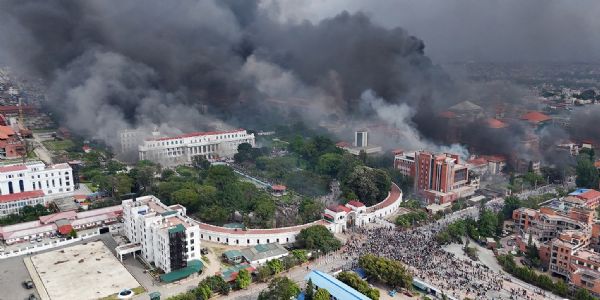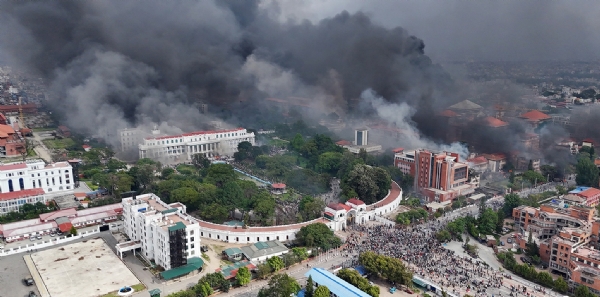
Kathmandu, May 28 (H.S.): Shocking revelations have emerged regarding the “Gen Z Movement” held on September 8 and 9, 2025, demanding the lifting of social media restrictions imposed by the government led by then Prime Minister K. P. Sharma Oli and calling for good governance. According to a detailed investigation report by the National Human Rights Commission, the protest was neither spontaneous nor entirely peaceful; rather, there had been serious prior planning to turn it violent and destructive.
The report states that while one group intended to keep the movement peaceful, another group had systematically planned to “hijack” it and even prepare for arson attacks targeting the Parliament building. Elements with malicious intent had deliberately infiltrated the gathering of youths assembled at Maitighar demanding the removal of the social media ban and actively worked to incite violence.
According to the commission, preparations to make the protest violent had begun well before the demonstrations through digital platforms. Certain individuals, in the name of making the movement “result-oriented,” hacked digital boards and websites of various schools and displayed slogans such as “No more screens, we are on streets” and “We dont want likes - we want change - 8 September 2025.”
Furthermore, a day before the protest, a TikTok account named “Wake Up Nepal” publicly called on people to come prepared with petrol bombs, posting: “Anything could happen in tomorrow’s protest, so be ready with a Molotov cocktail...” The commission stated that AI-generated images and videos depicting the Parliament building and Singha Durbar engulfed in flames had already gone viral on social media beforehand, confirming prior preparations for destruction.
The report also mentions a conspiracy to use students as “human shields.” A fake Facebook page created in the name of Nepal Police spread misinformation claiming that security forces would not use force against those wearing school uniforms. Under this pretext, people were urged to attend the protest dressed in school uniforms.
The commission viewed the subsequent deactivation of those social media accounts after the incident as evidence of a deliberate and organized strategy. The report stated that despite receiving multiple warnings and clues in advance, the government and security agencies failed to shut down such accounts or counter the misinformation, reflecting serious shortcomings on their part.
In its report, the commission wrote that protesters were misled through the fake Facebook page and students were encouraged to participate in the movement as “human shields.” Based on statements from security personnel, the commission treated this fact as established.
According to the report, individuals including Sudan Gurung, Ankit Malla, and Khemraj Saud of the organization “Hami Nepal” had obtained permission from the District Administration Office for a peaceful demonstration by estimating the participation of 500 to 800 people. However, even before the protest began, tents for first aid, health volunteers, and three ambulances had already been arranged at Maitighar Mandala, which the commission described as suspicious.
At around 9 a.m. on September 8, groups led by Raksha Bam and Jasmin Ojha—considered among the leading faces of the Gen Z movement—arrived at the protest site and reportedly objected to these preparations. They questioned Sudan Gurung as to why such extensive medical arrangements had been made for a supposedly peaceful demonstration. However, Gurung reportedly failed to provide a clear explanation.
The demonstration, which began at around 10:30 a.m. from Maitighar, moved beyond the limits designated by the administration and proceeded via Babarmahal toward the Everest Hotel area in New Baneshwor, after which the situation turned violent. Amid a crowd of nearly 25,000 people, a group of 15 to 20 bikers wearing black T-shirts and “TOB” tattoos suddenly entered the gathering. According to the commission, this group played a key role in provoking and agitating the crowd.
At around noon, protesters led by Sudan Gurung began breaking through security barricades and entering prohibited zones, triggering clashes with security forces and turning the situation into a violent riot.
The commission’s report states that police used tear gas and water cannons only after clashes with protesters escalated. Thereafter, the violent mob resorted to stone-pelting outside Gate No. 1 of the Parliament building and vandalized an Armed Police Force water cannon vehicle. The crowd became so aggressive that ambulances and even vehicles belonging to the Human Rights Commission’s monitoring team were vandalized and set ablaze, while staff members were assaulted.
The commission concluded that the peaceful protest of the youth had been hijacked by the “TOB” group, which attempted to attack and even set fire to the Parliament building. The report added that the organizers made no effort to prevent infiltration during the escalation of violence, and therefore bore primary responsibility for the loss of life and property.
At the same time, the commission stated that further in-depth investigation is necessary to determine who the bikers wearing “TOB” T-shirts and tattoos were, what links they had with the organizers, and under whose direction they were operating.
---------------
Hindusthan Samachar / Jun Sarkar