– Defence Ministry Sends ‘Request for Proposal’ to Three Private Sector Companies
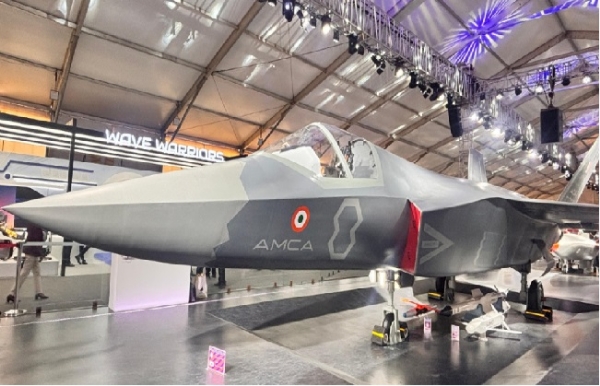
New Delhi, May 27 (H.S.): Hindustan Aeronautics Limited (HAL) has finally been excluded from the construction of India’s indigenous fifth-generation Advanced Medium Combat Aircraft (AMCA). The Ministry of Defence on Wednesday issued Requests for Proposal (RFPs) to three shortlisted private sector consortiums. Under the project, five prototypes will be developed at an estimated cost of nearly ₹15,000 crore. The twin-engine stealth fighter aircraft will feature supercruise capability and will be equipped with state-of-the-art sensors.
For the first time, prototypes will be developed through private sector participation in collaboration with the Defence Research and Development Organisation (DRDO) and the Aeronautical Development Agency (ADA). Accordingly, tenders have been sent to Tata Advanced Systems, Larsen & Toubro-Bharat Electronics, and Bharat Forge-BEML.
A Core Integration and Flight Testing Centre is also being established at Puttaparthi in Andhra Pradesh at a cost of approximately ₹2,000 crore for the aircraft’s development and flight testing. The first prototype is expected to roll out by the end of 2026 or early 2027, followed by its maiden flight by 2028. The target is to induct the aircraft into the Indian Air Force by 2034–2035.
According to DRDO, the Advanced Medium Combat Aircraft (AMCA) will be a single-seat, twin-engine aircraft being developed for both the Indian Air Force and the Indian Navy. The fifth-generation stealth, multirole, air-superiority fighter will also incorporate select sixth-generation advanced technologies. The aircraft has been designed by the Aeronautical Development Agency (ADA), the aviation design and development agency functioning under DRDO.
The Mark-1 version of the AMCA will feature 5.5-generation technologies, while the Mark-2 version will incorporate sixth-generation technological upgrades.
Key Features
The indigenous fifth-generation fighter jet will be capable of performing air superiority missions, ground attack, bombing, interception, and several other combat roles. It will feature supercruise capability, stealth characteristics, advanced AESA radar, super manoeuvrability, data fusion, and cutting-edge avionics, enabling it to outperform previous-generation fighter aircraft in multiple land and maritime operations.
The aircraft is expected to eventually complement and replace several platforms in service with the Indian armed forces, including the HAL Tejas, Sukhoi Su-30MKI, and Rafale in the Indian Air Force, as well as the HAL Naval Tejas and MiG-29 in the Indian Navy. The indigenous fighter jet is also intended to serve as the successor to the Jaguar, Mirage 2000, and MiG-27 aircraft in the Indian Air Force.
The AMCA will become India’s third indigenous supersonic jet after the HAL Marut and HAL Tejas.
---------------
Hindusthan Samachar / Jun Sarkar