




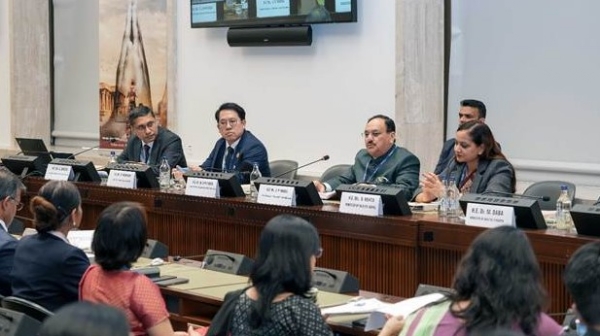
New Delhi, May 21 (H.S.): Union Health and Family Welfare Minister Jagat Prakash Nadda said that artificial intelligence (AI) has the potential to transform healthcare services, but its benefits can reach every citizen only if it is guided by robust regulation, rigorous research, ethical oversight, and a commitment to equity.
Addressing the event titled *“Artificial Intelligence in Healthcare: Law, Ethical Oversight, Research and Equity”* during the 79th session of the World Health Assembly, Nadda stated that India is actively advancing a safe, transparent, and people-centric healthcare AI framework.
He said that the Digital India initiative launched in 2015 prepared the country for future technologies, particularly AI. He noted that the National Health Policy of 2017 envisioned an integrated and inclusive digital health ecosystem, which was further strengthened in 2021 through the Ayushman Bharat Digital Mission and a consent-based digital health data framework.
Referring to the *Strategy for AI in Healthcare for India (SAHI)* launched in February 2026, the minister said it is the first comprehensive strategy to emerge from the Global South and is designed to guide India’s healthcare transformation in an ethical, transparent, and citizen-centric manner.
He further said that India has developed the *Benchmarking Open Data Platform for Health (BODH-AI)* to ensure that AI-driven healthcare solutions are based on real-world data and remain safe, reliable, and equally accessible to all citizens.
Nadda emphasized that no country can address the challenges and opportunities of AI alone. He said India will continue to work with global partners to strengthen trusted and interoperable health data systems, promote collaborative research, advance ethical AI development, and jointly address shared healthcare challenges.
The Union minister stated that the future of AI in healthcare will not be determined solely by algorithms, but by the collective decisions of governments, institutions, and societies. He added that India believes not only in Artificial Intelligence, but also in “All Inclusive Intelligence,” and urged the global community to make AI a force for global welfare and human well-being.
---------------
Hindusthan Samachar / Jun Sarkar

21 May 2026
DRI Seizes Three Lakh E-Cigarettes and Vapes Worth Rs 120 Crore in Major Anti-Smuggling Operation


21 May 2026