




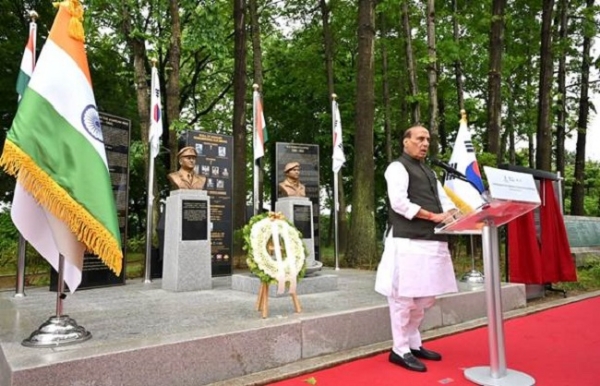
-Memorial Built to Mark the 75th Anniversary of the Korean War
New Delhi, May 21 (H.S.): On the final day of his visit to South Korea, Defence Minister Rajnath Singh on Thursday inaugurated the Indian War Memorial at Imjingak Park in Seoul. Addressing the gathering, the Defence Minister highlighted India’s enduring contribution to peace and humanitarian assistance on the Korean Peninsula. He said that the shared history and sacrifices of both nations continue to serve as the strong foundation of the India–Republic of Korea Special Strategic Partnership.
Former South Korean Minister of Patriots and Veterans Affairs Kwon Oh-yul joined Rajnath Singh at the inauguration ceremony of the Indian War Memorial. The memorial has been built to commemorate the 75th anniversary of the Korean War and to honour the courage, sacrifice, and humanitarian service of the Indian Army’s 60 Para Field Ambulance and the Custodian Force of India (CFI) during the conflict.
The two ministers paid floral tributes at the memorial in honour of the brave Indian soldiers whose service continues to be remembered with deep respect and gratitude by the people of the Republic of Korea.
Rajnath Singh stated that remembering the role of Indian soldiers strengthens mutual understanding among people and renews attention toward the historical ties between the two countries. He expressed deep gratitude to the Government of the Republic of Korea, particularly the Ministry of Patriots and Veterans Affairs, for its valuable support in the establishment of the memorial.
The former South Korean veterans affairs minister praised India’s role during the Korean War. To honour soldiers who participated in the war and strengthen exchanges among veterans, both ministers signed a Memorandum of Understanding (MoU). A commemorative publication dedicated to the selfless sacrifices of the soldiers was also released on the occasion.
During the Korean War, the 60 Para Field Ambulance, led by Lieutenant Colonel (Dr.) A.G. Rangaraj, a recipient of the Maha Vir Chakra, earned widespread acclaim for providing exceptional medical care and treatment to thousands of wounded soldiers and civilians amid intense gunfire and battlefield conditions. For their extraordinary courage and humanitarian service, they were affectionately referred to as the “Maroon Angels” by injured soldiers and civilians.
Following the signing of the Korean Armistice Agreement in 1953, India continued to play an important role through the Custodian Force of India, which was assigned responsibilities under the Neutral Nations Repatriation Commission (NNRC).
The Indian War Memorial has been constructed in the same region where the Custodian Force of India had established “Hind Nagar” in September 1954. Approximately 22,000 prisoners of war were housed there until their peaceful repatriation. The project was undertaken with financial assistance from the Ministry of Defence, Government of India.
Senior officials, military representatives, veterans, members of the diplomatic community, and distinguished guests from both countries attended the ceremony.
With the inauguration of the Indian War Memorial, Defence Minister Rajnath Singh concluded his four-day visit to Vietnam and South Korea.
---------------
Hindusthan Samachar / Jun Sarkar
21 May 2026
DRI Seizes Three Lakh E-Cigarettes and Vapes Worth Rs 120 Crore in Major Anti-Smuggling Operation

21 May 2026