




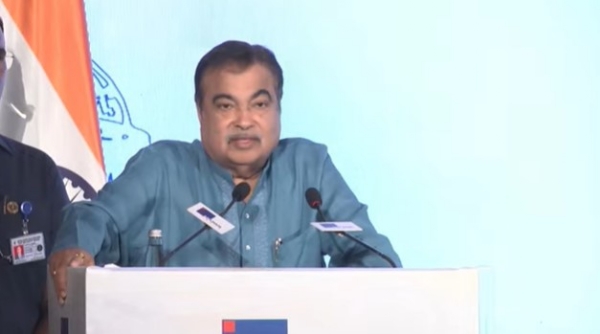
New Delhi, May 21 (H.S.): Union Minister for Road Transport and Highways Nitin Gadkari said that the rapid development of green expressways and controlled-access highways across the country is completely transforming the nature of road travel in India. He stated that after the construction of the Mumbai-Pune Expressway, air services between the two cities had nearly ceased, and a similar trend is now emerging on the Delhi-Dehradun and Delhi-Jaipur routes due to the significant reduction in travel time by road.
Addressing the annual leadership summit of the American Chamber of Commerce in India, Gadkari said that modern technology, innovation, research, skills, and efficient working systems are the foundation of the future economy. He added that converting knowledge into wealth is becoming the biggest economic model of the future, and India is steadily progressing in that direction.
He said India is now rapidly moving towards a circular economy, where waste is being converted into wealth. The Ministry of Road Transport and Highways is using legacy municipal solid waste in road construction projects. So far, more than 9 million tonnes of municipal solid waste have been utilised in road construction.
Gadkari said successful research has been completed on bio-bitumen, and petroleum bitumen can now be blended with up to 30 percent bio-bitumen. In addition, 15 percent rubber powder derived from used tyres and seven percent plastic waste are also being used in road construction. He stated that roads built using these technologies have proven successful.
The Union Minister said that one of the country’s biggest challenges had been logistics costs. Earlier, India’s logistics costs were around 16 percent, but they are now moving towards single-digit levels. According to recent reports by the Indian Institute of Technology Bangalore, Indian Institute of Technology Kanpur, and Indian Institute of Technology Madras, the country’s logistics costs have declined by nearly six percent. He said green highways and controlled-access expressways are the biggest contributors to this transformation.
He further stated that travel time on the Delhi-Dehradun route, which earlier took eight to nine hours, has now been reduced to nearly two hours after the construction of the new green highway. The Delhi-Mumbai journey, which previously took nearly 48 hours, can now be completed in around 12 hours after 80 percent of the expressway work has been completed. Travel time on the Delhi-Jaipur route has been reduced to two-and-a-half hours, while the Delhi-Meerut journey now takes just 45 minutes instead of four hours. Similarly, travel time between Bengaluru and Mysuru has reduced from three-and-a-half hours to nearly one hour.
Gadkari said that 36 controlled-access highways are currently being developed across the country. Large-scale road infrastructure projects are underway to connect North India with South India. The Delhi-Mumbai Expressway is being extended to Surat, from where new road corridors are being developed towards Nashik, Ahmednagar, Solapur, Kurnool, Chennai, Bengaluru, Kanyakumari, Kochi, and Thiruvananthapuram. He said that once these projects are completed, the distance between Delhi and Chennai will reduce by nearly 340 kilometres.
The minister also highlighted the rapid pace of tunnel construction in the country. Earlier, it took around three-and-a-half hours to travel from Manali to Rohtang Pass, but after the construction of the tunnel, the journey can now be completed in just eight minutes. Five new tunnels are being constructed in the Kargil region, while nearly 80 percent of the work on the Zojila Tunnel has been completed. He described it as the longest tunnel in Asia. Work is also underway on new tunnel projects in the Sonamarg and Srinagar regions.
Gadkari said India is rapidly moving towards reducing dependence on fossil fuels. The country imports fossil fuels worth nearly Rs 22 lakh crore annually, which is also a major cause of air pollution. The government is actively promoting alternative fuels such as ethanol, methanol, biodiesel, liquefied natural gas, electricity, and hydrogen.
He said hydrogen is the fuel of the future, and several pilot projects have already been launched in India. Hydrogen fuel-based vehicle trials are currently being conducted on 10 routes, including Greater Noida-Delhi-Agra, Ahmedabad-Vadodara-Surat, Pune-Mumbai, Jamshedpur-Kalinganagar, Thiruvananthapuram-Kochi, and Kochi-Ernakulam. He added that testing of hydrogen-powered trucks developed by Tata Motors has also begun.
Gadkari further said that India is emerging as one of the world’s leading countries in electrolyser manufacturing. The government aims to bring down the cost of hydrogen production to one dollar per kilogram. He added that work is also underway to produce hydrogen and bio-CNG from agricultural residue, organic municipal waste, and biomass. To curb pollution caused by stubble burning in Delhi, more than 400 projects have been launched, out of which work has already commenced on 200 projects.
---------------
Hindusthan Samachar / Jun Sarkar
21 May 2026
DRI Seizes Three Lakh E-Cigarettes and Vapes Worth Rs 120 Crore in Major Anti-Smuggling Operation

21 May 2026