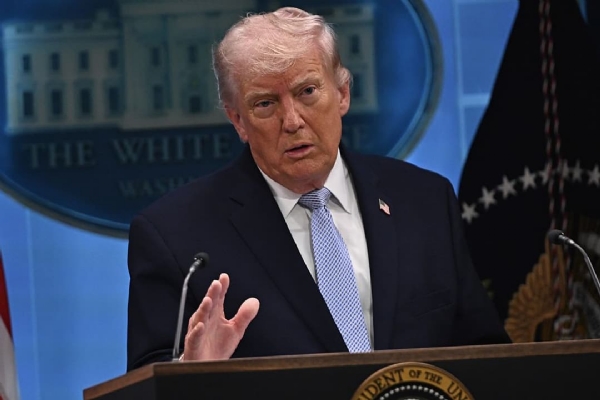
Washington DC, 02 May (H.S.):
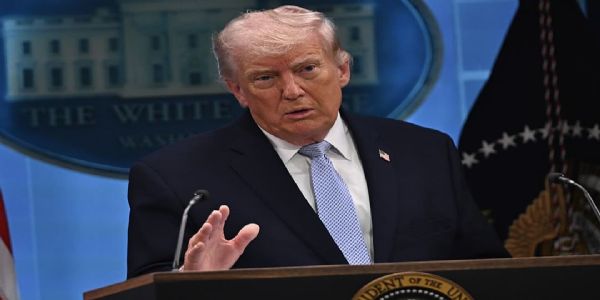
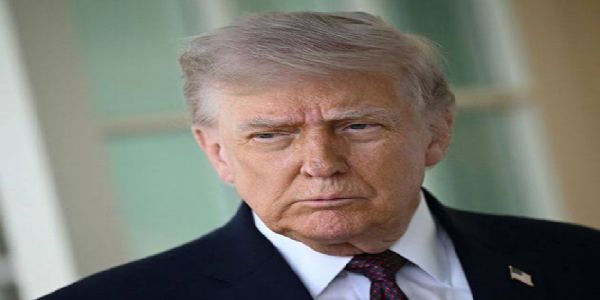
On Friday, President Donald Trump delivered a forceful defence of his administration’s military campaign against Iran’s nuclear programme, asserting that the United States had acted decisively to “save” the Middle East and Europe from a potential nuclear catastrophe.
Speaking at the Villages Charter School in Florida, Trump framed the confrontation with Tehran as existential, insisting that without U.S. intervention, Iran would have acquired a nuclear weapon and that “Israel, the Middle East, and Europe would have been blown to pieces.”
Trump claimed that Iran’s conventional military power had been severely degraded, stating that the country now had “no navy, no air force, no anti‑aircraft equipment, no radar, and no leaders,” a characterization that significantly exceeds assessments by independent defence analysts but serves to underscore his portrayal of a crippled adversary.
He also suggested that rival factions within Iran’s leadership had rendered the regime “very disjointed,” arguing that this internal fragmentation compels Iran to seek a deal yet prevents it from offering terms that satisfy Washington.
Despite having previously announced that “hostilities” with Iran had “terminated” in a formal letter to Congress, Trump reiterated that the United States would not withdraw prematurely from the region, warning that doing so could allow the same security threat to re‑emerge within a few years.
A senior U.S. official corroborates that Trump continues to view the conflict as politically and strategically unresolved, with the Pentagon keeping forces on high alert across the Persian Gulf even as hostilities are formally declared over.
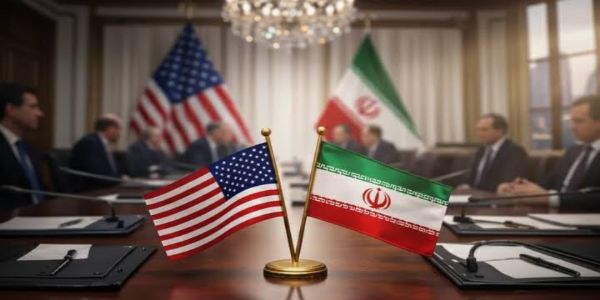
Trump disclosed that Iran had transmitted a new peace proposal via third‑party channels, but he professed dissatisfaction with the offer’s terms, stating that he was “not satisfied with it” and that he doubted whether Tehran would ultimately submit to a settlement Washington could accept.
Public statements by U.S. diplomats and leaked summaries reported by Western wire services indicate that Washington demands tight, verifiable restrictions on Iran’s uranium enrichment and missile programmes, as well as extensive inspection access, concessions that the Iranian side appears unwilling to concede in full.
In remarks shortly before flying to Florida, Trump tied the continuation of the conflict to global energy markets, arguing that gasoline prices would fall once the Iranian nuclear threat was fully neutralized.
He claimed that other consumer prices had already declined, but he singled out fuel costs as a lingering burden that would only ease “when this is over,” an assertion that critics describe as a speculative linkage between military outcomes and domestic inflation.
Trump’s latest comments come amid growing scrutiny over the legality and duration of the campaign, with congressional Democrats warning that his repeated shifts between “hostilities terminated” letters and fresh threats and sanctions risk undermining checks on presidential war powers.
Hindusthan Samachar / Jun Sarkar