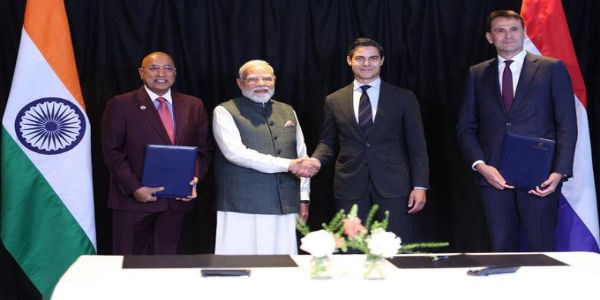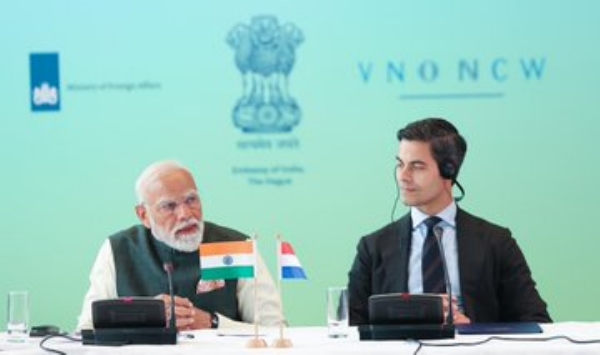
The Hague, Netherlands/New Delhi, 17 May (H.S.): Prime Minister Narendra Modi and Dutch Prime Minister Rob Jetten have co‑chaired a high‑level CEO Roundtable on Economic Ties in The Hague, where business leaders from both countries discussed expanding investments in India across sectors ranging from semiconductors and clean energy to advanced manufacturing and digital infrastructure.
In his remarks,PM Modi framed India as a “hub of scale, stability, and speed” and invited Dutch and global firms to deepen their presence in the country by collaborating with a young, skilled workforce and participating in next‑generation reforms.
Modi’s reform‑driven pitch to CEOs
At the CEO Roundtable, PM Modi highlighted India’s persistent reform trajectory, pointing to deregulation, easing of compliance, and the opening of space, mining, and nuclear energy to the private sector as markers of a more predictable investment environment.
He noted that India now accounts for about 17 per cent of global growth, underscoring rapid progress in infrastructure, renewable power, and digital connectivity as key drivers of private‑sector confidence.
“Today’s India offers not just a large market but a platform for innovation,” Modi told the assembled executives, inviting them to “design, innovate, and manufacture in India” rather than confine their operations to simple outsourcing.
He cited the growing footprint of global technology firms’ capability centres in India and the emergence of the country as a global hub for services and software, while also stressing that manufacturing costs are becoming increasingly competitive alongside rising automation and quality standards.
Jetten promotes two‑way trust and strategic alignment
Prime Minister Rob Jetten, speaking alongside Modi, positioned the Netherlands as a natural partner for India in an era of tighter global supply chains and technology‑driven growth.
He emphasised that Dutch companies already rank among India’s largest foreign‑direct‑investment (FDI) sources, and that the two countries are now elevating their relationship to a “strategic partnership” with shared priorities in climate, digitalisation, and innovation.
Jetten reminded the CEOs that the Netherlands serves as a gateway to Europe, with the Port of Rotterdam handling a significant share of Indian exports and re‑exports into the EU, and that deeper integration with Indian manufacturers can enhance Europe’s resilience and sustainability goals.
He urged firms to see India not just as a site for production, but as a co‑development partner for new technologies, including in water‑management systems, precision agriculture, and circular‑economy solutions.
Sectoral focus: semiconductors, green tech, and AI
A central theme of the roundtable was the joint push into semiconductors, where a newly signed collaboration between Tata Electronics and the Dutch semiconductor‑equipment giant ASML aims to strengthen India’s planned fabrication facility in Dholera, Gujarat.
Modi and Jetten framed this as a template for India–Netherlands co‑investment: combining Dutch high‑tech know‑how with Indian manufacturing capacity and a growing domestic demand for chips across electronics, mobility, and defence.
The leaders also highlighted convergence in climate and green‑transition strategies, pointing to Dutch leadership in offshore wind, hydrogen technologies, and flood‑control engineering, which can be deployed alongside India’s expanding renewable‑energy parks and grid‑modernisation programmes.
Both premiers encouraged CEOs to explore joint ventures in AI‑driven logistics, smart‑city platforms, and health‑tech, where Indian data‑scale and digital‑governance infrastructure can complement European research and standards.
Emphasis on India’s youth and talent
PM Modi repeatedly returned to the role of India’s young workforce, describing the country’s demographic advantage as a “strategic asset” for global firms seeking innovation‑rich, cost‑efficient talent. He noted that science, engineering, and digital skills are being systematically upgraded through higher‑education reforms and industry‑linked skilling programmes, creating a pipeline of engineers, data scientists, and design‑centric professionals ready to work on global projects.
Inviting companies to “collaborate with our talented youth,”PM Modi underlined that long‑term profitability in India will depend less on wage arbitrage and more on co‑creation, co‑development, and deep integration into local ecosystems. In this context, the roundtable was framed less as a one‑off promotional event and more as the beginning of structured business‑to‑business dialogues that will feed into broader India–EU trade and investment frameworks.
---------------
Hindusthan Samachar / Jun Sarkar
17 May 2026
PM Modi Set to Embark on Sweden Visit to Deepen India–Nordic Ties on Energy, Trade and Tech
17 May 2026
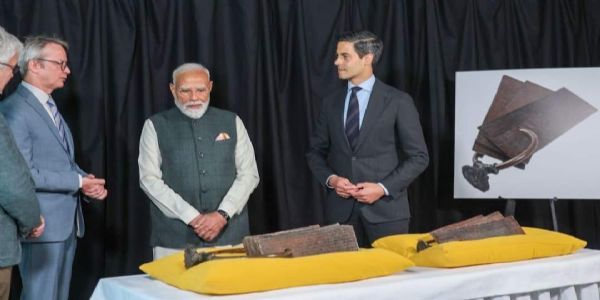
PM Modi Hails Return of 11th‑Century Chola Copper Plates as “Pride of India’s Civilisational Legacy”
17 May 2026