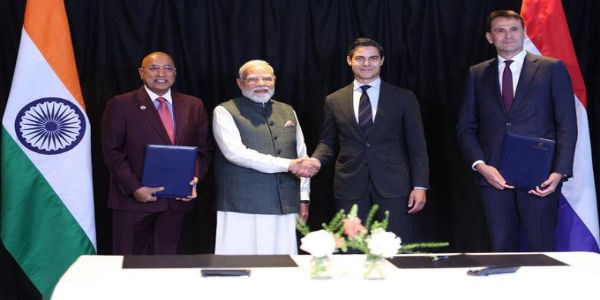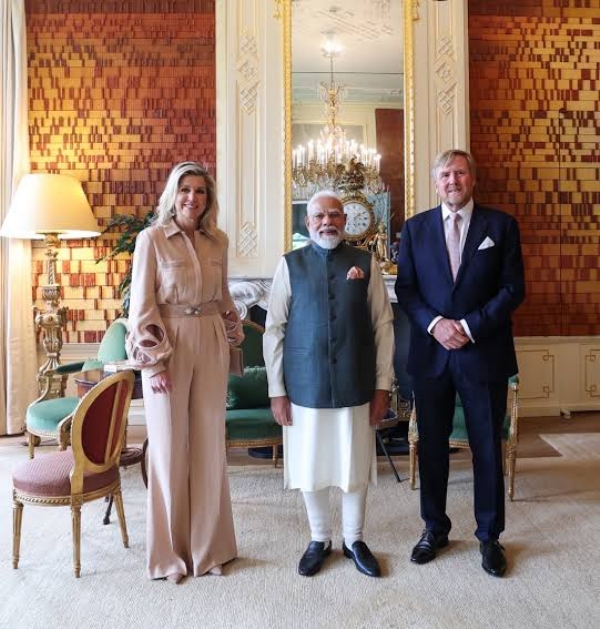
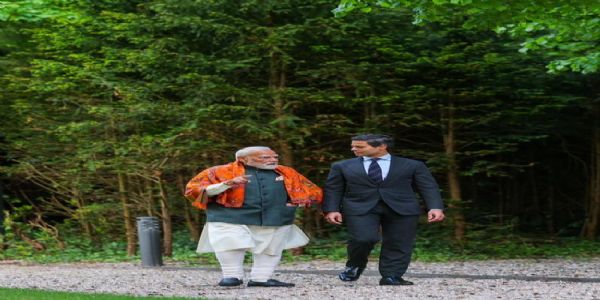
The Hague, Netherlands/New Delhi, 17 May (H.S.): Prime Minister Narendra Modi has met King Willem‑Alexander and Queen Máxima of the Netherlands at the Huis ten Bosch Palace in The Hague, marking a high‑point in his five‑nation European‑West Asian tour and underscoring the growing strategic alignment between New Delhi and The Hague.
In a formal palace call followed by a state dinner hosted by the Dutch royals, the two sides discussed ways to deepen people‑to‑people linkages as well as institutionalise cooperation in trade, technology, water, and green transitions.
Diplomatic warmth at Huis ten Bosch
During the meeting at the royal residence, Prime Minister Modi and King Willem‑Alexander exchanged views on expanding the bilateral relationship across political, economic, and cultural spheres. Officials in both capitals described the interaction as “warm and forward‑looking,” with the leaders noting the importance of more stable, long‑term frameworks for investment, innovation, and youth mobility.
PM Modi also recalled the Dutch monarch’s state visit to India in 2019, which had helped cement a sense of mutual goodwill and set a tone for the subsequent intensification of official‑level dialogues.
In line with the Netherlands’ role as one of India’s largest European trading partners and a key conduit for goods entering the European Union through the Port of Rotterdam, the discussions emphasised the need to further open two‑way corridors for technology‑intensive industries, including semiconductors, renewable energy, and digital infrastructure.
The leaders also touched on the recently institutionalised India–Netherlands Joint Trade and Investment Committee (JTIC), which is expected to meet annually to review trade barriers, investment flows, and sectoral cooperation.
Knowledge and green partnerships
A recurring theme in the talks was the shared interest in combining Dutch expertise in water management, climate resilience, and sustainable agriculture with India’s large‑scale infrastructure pushes and digital‑governance platforms.
The Netherlands has long been a pioneer in flood‑control engineering and clean‑water technologies, while India has rolled out one of the world’s largest digital‑identity and financial‑inclusion systems, creating complementary niches for joint research and pilot projects.
Both sides also flagged the importance of clean‑energy and green‑transition partnerships, with Dutch companies already active in Indian logistics, offshore wind, and renewable‑energy value chains.
PM Modi has repeatedly framed India as a “platform for global growth,” and in his remarks before the Dutch business community he reiterated that the country offers policy predictability, expanding sectors such as semiconductors and AI, and faster‑tracked infrastructure that can accommodate large‑scale European investment.
Strengthening people‑to‑people ties
Beyond the formal dialogues, the meeting with the Dutch King and Queen also served as a symbolic affirmation of the Indian diaspora’s role in the Netherlands, where the community has long been active in academia, technology, healthcare, and entrepreneurship.
PM Modi’s address to the Indian community in The Hague drew large crowds and highlighted the cultural continuity of “Bharatiya” families living abroad, even as they adopt local civic identities.
Analysts in both countries see the royal‑level engagement as part of a broader pattern of “soft institutionalisation” of India–Netherlands ties, where high‑profile meetings at the top complement routine ministerial dialogues and private‑sector collaborations.
With trade volumes already exceeding 20 billion dollars in recent years and Dutch firms increasingly present in India’s manufacturing, energy, and agri‑tech sectors, the Modi–Willem‑Alexander meeting signals an intent to convert goodwill into concrete, project‑based partnerships in the coming years.
---------------
Hindusthan Samachar / Jun Sarkar
17 May 2026
PM Modi Set to Embark on Sweden Visit to Deepen India–Nordic Ties on Energy, Trade and Tech
17 May 2026
PM Modi Hails Return of 11th‑Century Chola Copper Plates as “Pride of India’s Civilisational Legacy”
17 May 2026