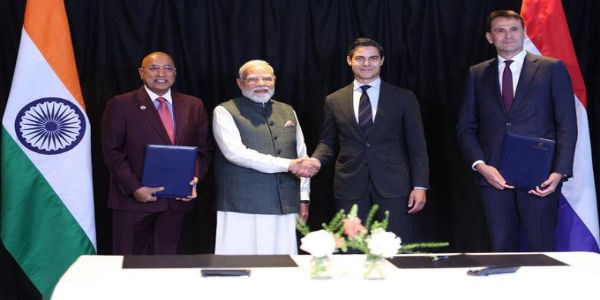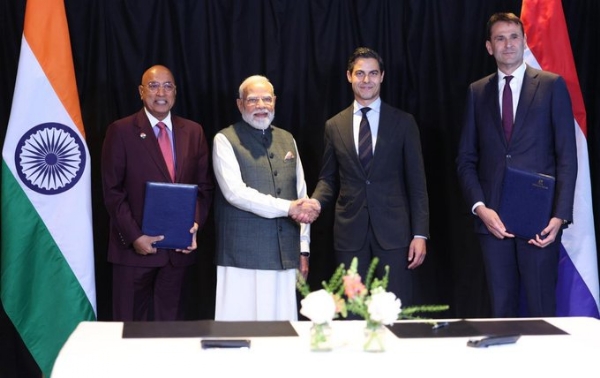
The Hague, Netherlands/New Delhi, 17 May (H.S.): Prime Minister Narendra Modi and Dutch Prime Minister Rob Jetten have jointly witnessed the signing of a pivotal memorandum of understanding (MoU) between Tata Electronics and the Netherlands‑based semiconductor‑equipment giant ASML, aimed at strengthening India’s domestic chip‑manufacturing ecosystem.
The pact, inked in The Hague, will see ASML support the establishment and scaling of Tata Electronics’ upcoming 300 mm (12‑inch) semiconductor fabrication facility in Dholera, Gujarat, marking a major step toward India’s ambitions as a global semiconductor hub.
PM Modi pitches India as a semiconductor homeland
Speaking after the MoU signing, Modi described the Tata–ASML partnership as an “important milestone” in India’s journey to build a robust, end‑to‑end semiconductor ecosystem. He emphasised that the country’s strides in advanced chips open up “immense opportunities” for Indian youth, particularly in engineering, design, and high‑tech manufacturing, and pledged to keep adding “vigour” to the sector in the coming years.
The Prime Minister framed the collaboration as a fusion of Dutch technological leadership and India’s industrial scale, noting that ASML will deploy its advanced lithography tools and holistic solutions at the Dholera facility to help set up and ramp a front‑end semiconductor fab of global standards.
This, he said, signals that India is no longer confined to electronics assembly but is actively moving into the core of chip‑making value chains, where design, materials, and ultra‑precision equipment converge.
Rob Jetten highlights strategic and technological convergence
Prime Minister Rob Jetten, standing alongside Modi, hailed the agreement as a cornerstone of the newly elevated India–Netherlands strategic partnership, which now includes explicit commitments on critical and emerging technologies.
He noted that ASML’s involvement in the Dholera project represents its first major partnership with an Indian fab and underlines the Netherlands’ role as a key enabler of advanced semiconductor infrastructure worldwide.
Jetten underscored that the deal will not only boost India’s technological self‑reliance but also create a two‑way corridor for talent, research, and supply‑chain resilience, with Dutch companies contributing deep‑tech expertise and Indian firms offering manufacturing scale and regional market access.
He described the collaboration as emblematic of how democratic economies can “de‑risk” highly sensitive supply chains while investing in open, innovation‑driven ecosystems rather than fragmented protectionism.
How the Tata–ASML pact shapes India’s tech landscape
Under the MoU, ASML will assist Tata Electronics in the deployment of advanced lithography tools at the Dholera semiconductor fab, which is being positioned as India’s first large‑scale front‑end chip‑manufacturing plant.
The partnership also includes commitments to nurture domestic talent through targeted training in lithography‑intensive skills, setting up local research initiatives, and building a resilient supply chain around the new facility.
Analysts point out that this collaboration plugs directly into India’s broader semiconductor push, which includes incentives for domestic fabs, design‑house clusters, and partnerships with global equipment makers. By anchoring one of its key fabs on ASML’s technology platform, India seeks to leapfrog into the league of advanced semiconductor‑producing nations, while simultaneously creating high‑value employment for engineers, technicians, and data‑driven professionals.
Modi’s vision for “futuristic sectors” and youth
PM Modi reiterated that semiconductors are one of the “futuristic sectors” where India is consciously choosing to invest heavily, aligning with global trends in artificial intelligence, electric mobility, and advanced telecommunications. He stressed that the success of such sectors ultimately rests on a young workforce that can absorb cutting‑edge tools, adapt to rapid technological churn, and co‑create solutions rather than merely follow instructions.
In this context, the Dholera–ASML project is being presented not just as an industrial contract, but as a long‑term talent‑creation platform, where Dutch know‑how and Indian execution can jointly incubate a new generation of chip‑engineers and R&D leaders.
PM Modi’s message to young Indians was clear: the semiconductor revolution is no longer confined to Silicon Valley or Europe; it is now being woven into India’s own industrial and social fabric, with policymakers and global partners deliberately aligning incentives to channel youth energy into high‑value, technology‑driven careers.
---------------
Hindusthan Samachar / Jun Sarkar
17 May 2026
PM Modi Set to Embark on Sweden Visit to Deepen India–Nordic Ties on Energy, Trade and Tech
17 May 2026
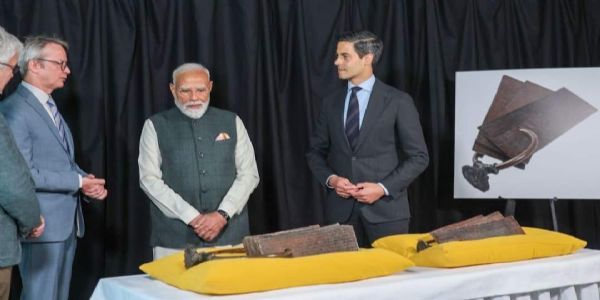
PM Modi Hails Return of 11th‑Century Chola Copper Plates as “Pride of India’s Civilisational Legacy”

17 May 2026