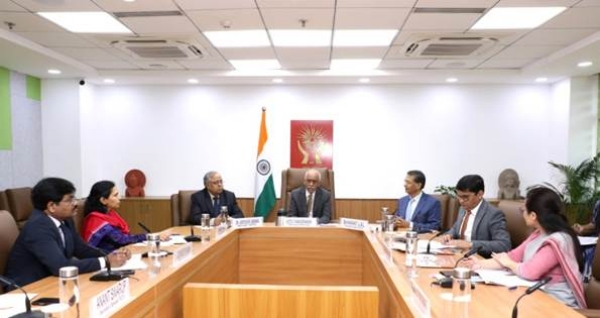
New Delhi, 13 May (H.S.): Justice V. Ramasubramanian of the National Human Rights Commission (NHRC) said that India must move away from a “compliance‑based” approach and adopt a rights‑based culture. He was addressing a core‑group meeting at the NHRC campus in New Delhi on the theme “Protecting the Rights of Migrant Workers: A Shared Responsibility of Government and the Private Sector,” where the focus was on practical implementation and systemic reforms rather than mere policy changes.
Presiding over the meeting, Justice Ramasubramanian observed that migrant workers are more vulnerable than other labourers, and barriers such as language difficulties and the absence of permanent housing impede their ability to organise.
“The time has come to recognise that simply obeying orders is not enough; we must foster a culture that respects each individual’s rights,” he said.
Pointing to shortcomings in the 1979 law governing migrant workers, he noted that employers frequently send workers on leave before they complete the statutory eligibility period (240 days) to evade legal protections.
Justice (Dr.) Bidyut Ranjan Sarangi, a member of the Commission, took a firm stance, stressing that delayed wage payments defeat the very purpose for which migrant workers leave home. He recommended creating databases not only for workers but also for accompanying family members to ensure access to essential services such as education and healthcare.
Secretary‑General Bharat Lal underlined migrants’ contribution to the global and national economy, noting that roughly 28.9 percent of India’s population comprises migrant workers. He cited evidence that welfare measures can increase factory workers’ productivity by 1.38 times and argued that successful schemes like “One Nation, One Ration Card” should be extended to encompass health and social security benefits.
During a multi‑stakeholder discussion, experts proposed several measures for the way forward, including establishing a National Coordination Council for administrative interstate cooperation; integrating the e‑Shram digital governance portal with Aadhaar, EPF and ESIC; issuing QR‑based migrant IDs; making corporate accountability mandatory by including migrant‑worker data in ESG and BRSR reporting; embedding migrant housing and services as core elements in city master plans rather than as afterthoughts; and adopting a “living wage” standard instead of merely a minimum wage to secure financial stability.
It was also decided that regulatory safeguards should not be confined to top‑listed companies but must extend to migrant workers employed in micro, small and medium enterprises.
Representatives from SEBI, the Ministry of MSME and various industry bodies, including the FCCI and CII, participated in the meeting.
---------------
Hindusthan Samachar / Jun Sarkar

13 May 2026