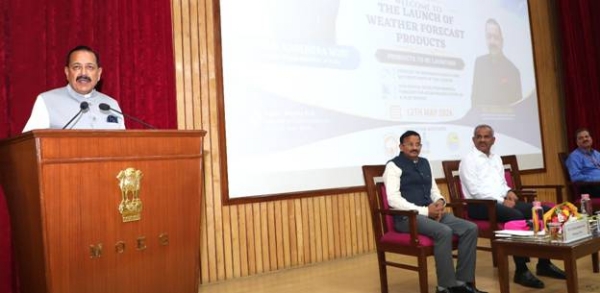
New Delhi, 12 May (H.S.): Weather forecasting in India is set to become more advanced and accurate with the launch of two new artificial intelligence (AI)‑based forecast services on Tuesday by the Ministry of Earth Sciences. These services will now provide people with precise monsoon information at the village and block level, up to four weeks in advance. This information will be issued every Wednesday. Along with this, a special service has been launched for farmers in Uttar Pradesh, offering weather forecasts up to 10 days ahead at a resolution of one kilometre.
The systems have been jointly developed by the India Meteorological Department (IMD), the Indian Institute of Tropical Meteorology (IITM), Pune, and the National Centre for Medium Range Weather Forecasting (NCMRWF).
Speaking at the inauguration of the two services, Director General of the IMD, Dr.
Mrityunjay Mahapatra, said the first AI system will predict the advance of the monsoon up to 10 days ahead. For example, if the monsoon arrives in Kerala, people will soon know exactly which villages and districts across 16 states and over 3,000 districts it will reach over the next 10 days, giving farmers and administrators time to plan.
In addition, a high‑precision, one‑kilometre resolution rainfall forecast system has been launched for Uttar Pradesh, capable of providing highly accurate rainfall predictions up to 10 days in advance.
The new technology uses AI along with satellite data, Doppler radars, and automatic weather stations to significantly improve forecast accuracy.
Speaking on the occasion, Union Minister of State (Independent Charge) for Science and Technology and Earth Sciences, Dr. Jitendra Singh, said India’s weather forecasting capability has improved dramatically over the past several years. About one and a half decades ago, there were barely 16–17 Doppler weather radars in the country; now the number has risen to around 50, with plans to install 50 more under Mission Mausam. The expansion of the observational network, automatic weather stations, high‑performance computing systems, and digital dissemination platforms has greatly enhanced forecasting and early‑warning capacity nationwide.
Dr. Singh added that the accuracy of forecasts for extreme weather events in the past decade has improved by about 40 per cent, while the accuracy of predictions for cyclone track, intensity, and landslides up to 72 hours ahead has improved by around 30–35 per cent, with a notable reduction in forecast errors.
He stressed that due to climate change and the increasing frequency of extreme weather events, accurate and timely forecasts have become more crucial than ever. The Modi government, he said, has initiated several transformative measures to modernise weather and climate services, including Mission Mausam, expansion of radar networks, strengthening observation systems, modernising data communication infrastructure, and boosting high‑performance computing facilities, all together building a stronger, technology‑driven forecasting system.
The event was attended by Earth Sciences Secretary Dr. M. Ravichandran, IITM Director Dr. Suryachandra Rao, and senior scientists from IMD, IITM, and NCMRWF.
---------------
Hindusthan Samachar / Jun Sarkar

13 May 2026