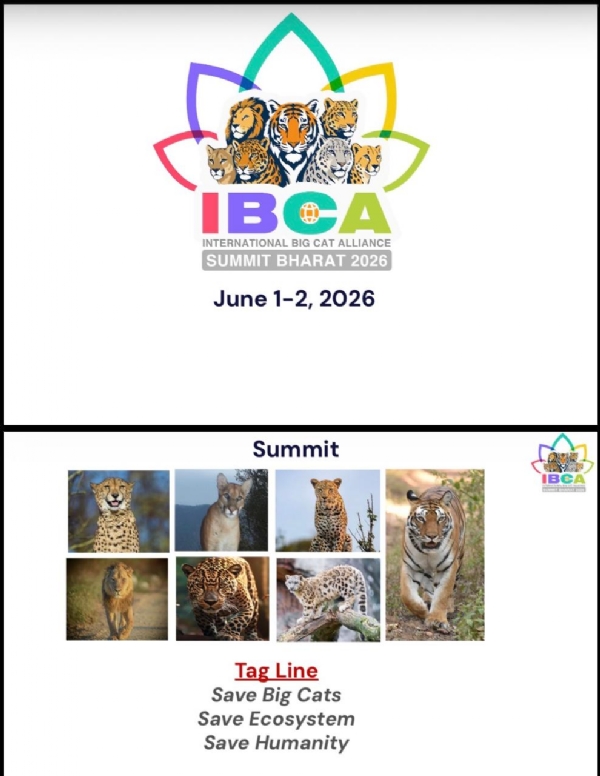
New Delhi, 11 May (H.S.): Prime Minister Narendra Modi will inaugurate the first global summit of the International Big Cat Alliance (IBCA) in New Delhi on 1 June 2026, marking a major milestone in the world’s coordinated effort to conserve the planet’s large‑cat species. The summit will be held at Bharat Mandapam under the theme “Save Big Cats, Save Ecosystems, Save Humanity”, and is expected to draw participants from 95 countries worldwide.
At the summit, conservationists, scientists and policymakers will focus on the seven great cat species covered by the Alliance: the tiger, lion, leopard, snow leopard, cheetah, jaguar and puma. Discussions will centre on protecting these animals, securing their natural habitats and minimising the impact of human‑wildlife conflict, climate change and habitat fragmentation.
Representatives from global big‑cat range countries, including heads of state and government, environment ministers and conservation‑focused agencies, will attend plenary sessions on 1–2 June. Dr S. P. Yadav, Director General of the International Big Cat Alliance, informed media here on Monday that world leaders will share their countries’ experiences and strategies for big‑cat conservation.
Technical sessions scheduled for 1 and 2 June at the Taj Palace Hotel will bring together over 400 international experts—including conservation scientists, policy‑makers, multilateral agencies, financial institutions and corporate leaders—to exchange best practices, review funding mechanisms and discuss transboundary‑cooperation models.
A key outcome of the summit is expected to be the adoption of the “Delhi Declaration on Big Cat Conservation”, a landmark global document that will set shared priorities for the long‑term protection of great cats and their ecosystems. The Declaration is being viewed as a foundational policy‑roadmap that will guide national legislation, cross‑border wildlife corridors and international funding in the years ahead.
Parallel to the formal sessions, a special exhibition will be organised featuring tribal art, big‑cat‑themed paintings, wildlife photography, documentaries and virtual‑reality experiences that allow visitors to virtually “enter” tiger reserves, snow‑leopard habitats and other key ecosystems. The display aims to raise public awareness and foster a broader citizen‑centred conservation ethic, especially among youth and urban audiences.
Dr Yadav emphasised that great cats play a crucial role in maintaining ecological balance as apex predators, regulating herbivore populations and indirectly preserving plant diversity. Their habitats—often comprising forests, grasslands and mountain ecosystems—also act as carbon sinks, bolstering climate‑change mitigation and ensuring clean water‑sources for millions of people.
However, he noted that these species face mounting threats from shrinking habitats, escalating human‑wildlife conflict, climate change impacts and emerging wildlife diseases. In this context, the IBCA summit is being positioned as a critical platform to ratchet up global conservation ambition, align national policies and mobilise both public and private‑sector financing.
The International Big Cat Alliance (IBCA) was launched by Prime Minister Narendra Modi on 9 April 2023 during the event marking 50 years of Project Tiger. After approval by the Union Cabinet in March 2024, the Alliance became a formal inter‑governmental organisation headquartered in New Delhi and fully operational by February 2025.
The Indian government has committed approximately 18 million U.S. dollars over five years to support the IBCA’s activities, including research, community‑based conservancy programmes, technology‑driven monitoring and international coordination. Officials say the first New Delhi summit represents not only a celebration of India’s leadership in tiger conservation but also a concerted effort to globalise that success for the benefit of all big‑cat species.
---------------
Hindusthan Samachar / Jun Sarkar

13 May 2026