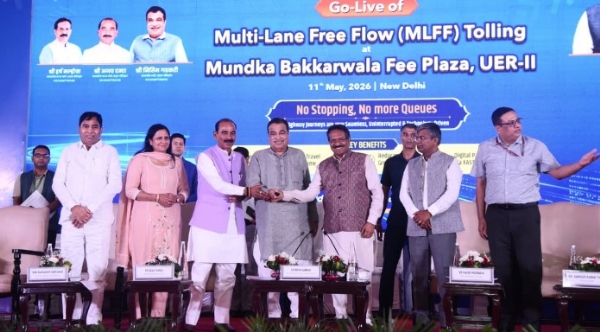
New Delhi, 11 May (H.S.): Union Minister for Road Transport and Highways Nitin Gadkari today inaugurated the Multi‑Lane Free Flow (MLFF) barrier‑less tolling system at the Mundka–Bakkarwala toll plaza on UER‑II in Delhi. This is the second such system of its kind in the country, following the launch at the Chorasyasi toll plaza on the Surat–Bharuch stretch of NH‑48 in Gujarat on 2 May 2026.
At the inauguration ceremony, Union Ministers of State Harsh Malhotra and Ajay Tamta, MPs Kamaljeet Sahrawat (West Delhi) and Yogendra Chandolia (North West Delhi), along with NHAI Chairman Santosh Kumar Yadav, were present. Officials highlighted that the new MLFF technology marks a major shift from the previous manual‑toll model.
Gadkari recalled that, under the old system, long queues at conventional toll plazas forced commuters to stand for up to one hour at a time. This not only wasted enormous amounts of travel time but also increased fuel consumption, as vehicles repeatedly shifted gears and idled with engines running.
The new barrier‑less, multi‑lane free‑flow system, he said, will eliminate these bottlenecks, provide relief to the public and make travel smoother and more efficient.
The Minister stressed that “turning knowledge into wealth” is the vision behind the system. By harnessing technology, toll‑revenue collection has become more transparent, accountable and efficient. He noted that the ministry’s toll revenue had risen from about ₹40,000–45,000 crore before the Fastag rollout to around ₹55,000 crore after its implementation.
Gadkari outlined two primary benefits of the MLFF system:
Sharp reduction in collection costs: Toll‑collection costs will fall from about 15% to around 4% of total collections, translating into annual savings of roughly ₹5,000–6,000 crore.
Virtual elimination of leaks and theft: By automating and digitalising toll operations, revenue leakages and pilferage are expected to stop altogether, potentially yielding an additional gain of ₹12,000–15,000 crore annually.
The minister also highlighted the ministry’s work to convert waste into road‑construction material. Delhi’s three major garbage mountains, he said, are being dismantled and their waste is now being used in highway construction, with plastic, glass and scrap metal separated and incorporated into road layers.
To tackle crop‑residue burning, the ministry is promoting bio‑bitumen developed by IICCI (International Centre for Clean and Climate‑Friendly Infrastructure). Under current plans, 30% bio‑bitumen, 7% waste plastic and 15% waste rubber will be blended with petroleum bitumen to create a standard road‑grade bitumen. This blend will cut pollution, reduce dependence on imported bitumen and boost indigenous manufacturing.
Under the MLFF system, vehicles will no longer need to stop or slow down at the toll plaza. High‑resolution cameras, Automatic Number Plate Recognition (ANPR), Radio Frequency Identification (RFID), radar, lidar and a Fastag‑based digital network will identify each vehicle instantaneously. As the vehicle passes through the plaza, the toll amount will be automatically debited from the linked Fastag account.
Gadkari stressed that MLFF is not just about speed and convenience but also about cost‑saving and efficiency. Studies estimate that the system will:
Save about ₹285 crore worth of fuel annually,
Reduce carbon emissions by around 81,000 tonnes per year,
Recoup millions of hours of lost travel time and enhance logistics‑chain efficiency.
Digital Payments, UPI And Annual Passes
The minister added that digital payments and UPI‑based toll collection will make the process faster and cheaper, while also making cash transactions obsolete and ensuring 100% transparency and accountability.
An annual pass mechanism has also been introduced. For ₹3,000, commuters can obtain an annual pass that effectively reduces the average cost per toll to about ₹15 per plaza over roughly 200 crossings, combining economic savings with hassle‑free travel.
Gadkari described the MLFF barrier‑less tolling system as a landmark step toward Digital India and smart mobility, serving as a model for the rest of the country. The system, he said, will not only improve commuter experience but will also contribute to environmental protection, energy conservation and higher government revenue.
NHAI noted that the system will be fully barrier‑free, with no physical toll gates or manual intervention required. Vehicles can cross the plaza at normal highway speeds, reducing long queues and traffic jams, cutting travel time and lowering fuel use and emissions.
The system is fully digital and real‑time monitored, which will make the toll‑collection process more transparent and virtually eliminate revenue leakages. The platform will also allow continuous monitoring of traffic movement, audit trails and data analytics, enabling smarter traffic‑management decisions.
NHAI said that, in the first phase, 17 toll plazas across nine states are being integrated into the MLFF framework. The Chorasyasi plaza in Gujarat is already operational, while the Mundka plaza in Delhi has now been commissioned. Plazas in Haryana, Rajasthan, Tamil Nadu, Andhra Pradesh, Maharashtra, Karnataka and Assam will be added in a staged manner by September 2026.
In the second phase, plans envisage bringing over 108 additional toll plazas under the MLFF umbrella by March 2027, gradually replacing conventional toll‑gate models nationwide.
NHAI also announced a strict enforcement regime for vehicles that fail to pay tolls. If a vehicle’s Fastag is blacklisted, has a low or nil balance, or is found invalid, the system will automatically issue an electronic notice for double the applicable toll amount. Until dues are cleared, the Fastag will remain suspended and will not work at any Fastag‑based facility.
No NOC for vehicle‑ownership transfer will be issued for vehicles with pending toll dues. The renewal of fitness certificates for commercial vehicles and the issuance of national permits will also be linked to full payment of outstanding toll liabilities, as mandated under government notifications dated 13 January and 17 March.
By combining technological innovation, cost‑saving and strong enforcement, the MLFF barrier‑less tolling network at Mundka–Bakkarwala is positioned as a transformative project that will redefine India’s highway‑travel experience.
---------------
Hindusthan Samachar / Jun Sarkar

13 May 2026