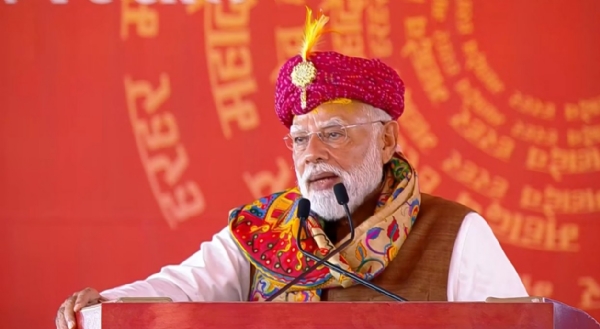
Gir Somnath, 11 May (H.S.): Prime Minister Narendra Modi has said that no force in the world can bend or pressure India, drawing a direct link between this conviction and the country’s 1998 Pokhran nuclear tests. Speaking at the Somnath Amrit Mahotsav in the coastal temple town of Somnath, Gujarat, the Prime Minister highlighted the tests as a defining moment that revealed the unyielding political will of the Indian state.
PM Modi recalled that on 11 May 1998, India conducted its first three nuclear tests at Pokhran, followed by two more on 13 May, carrying out the series under the code name “Operation Shakti”. After the first set of blasts, the world reacted with sanctions and pressure, but, he said, “The world descended on us after 11 May, yet on 13 May India conducted two more nuclear tests. That is how the world understood how unshakable India’s political will is.”
Hailing then‑Prime Minister Atal Bihari Vajpayee, the Prime Minister said the decision to conduct the tests demonstrated that for the government, “the nation is paramount.” He reiterated that, irrespective of external pressure or restrictions, India will take decisions based on its national interest and will not be coerced into reversing them.
“No power in the world can bend India, no power can bring India under pressure,” PM Modi declared, calling the Pokhran‑II tests a turning point in India’s strategic self‑confidence.
Operation Shakti And India’s Civilisational Continuity
The Prime Minister noted that the tests were christened “Operation Shakti” because the worship of Lord Shiva and Shakti has been central to India’s civilisational ethos. He said this same blend of spiritual‑cultural reverence and scientific‑technological advancement has become a source of inspiration for the nation’s modern scientific and defence achievements.
Somnath As A Symbol Of Perpetual Rebirth
At the Somnath Amrit Mahotsav,PM Modi described the event not as a mere celebration of the past, but as a festival of inspiration for the next thousand years of India’s journey. He reminded the audience that, after India’s independence in 1947, the re‑consecration of the Somnath temple in 1951 signalled the arrival of a free, sovereign and self‑aware India.
PM Modi said Sardar Vallabhbhai Patel, in integrating over 500 princely states, laid the foundation of modern India and, by spearheading the reconstruction of the Somnath temple, sent a message that India was not only free but also reclaiming and rebuilding its ancient, glorious heritage.
He recalled how invaders like Mahmud of Ghazni and Alauddin Khilji had repeatedly tried to destroy the Somnath temple, yet it has risen again and again. “Invaders could not grasp the ideological strength of India,”PM Modi observed, using the temple’s repeated reconstruction as a metaphor for the resilience of Indian civilisation.
Personal Connection And Spiritual Stewardship
The Prime Minister mentioned that, in the past, he served as Chairman of the Somnath Temple Trust, which gave him the opportunity to serve the temple and its precincts. He added that the current scale of work on the development and management of tirthas and pilgrimage sites across India is possible, in his view, because of the grace of Lord Somnath.
Using the moment to call for eco‑conscious living, Modi urged devotees to adopt lifestyles that protect nature and the environment while developing sacred sites. “As we develop tirthas and temples, we must also preserve their dignity and sanctity,” he said, stressing that development and reverence must go hand in hand.
---------------
Hindusthan Samachar / Jun Sarkar
13 May 2026