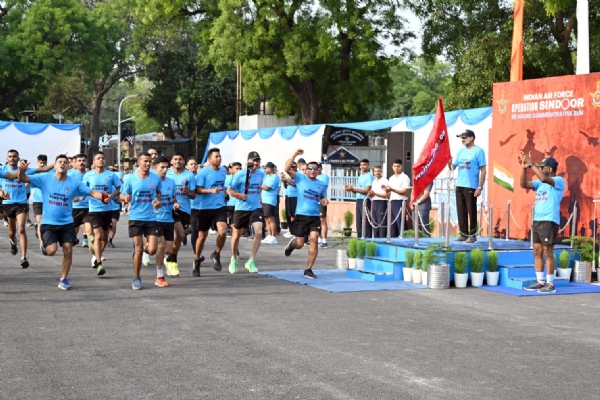
New Delhi, 11 May (H.S.): Indian service personnel marked the first anniversary of ‘Operation Sindoor’ with an 88‑hour continuous running relay held across New Delhi, honouring the precision air strikes conducted last year against terrorist camps in Pakistan following the Pahalgam terror attack. The marathon, organised by the Indian Air Force, saw the participation of around 600 runners from the Indian Air Force, Indian Army and civilian volunteers, symbolising endurance, unity and remembrance.
The event was launched on 7 May at 1:05 a.m. when the Air Officer in Charge Administration (AOC) gave the starting signal from India Gate. The relay continued non‑stop until 5:00 p.m. on 10 May, when the run was formally concluded by Air Chief Marshal A. P. Singh, Chief of the Air Staff, at Air Force Station, New Delhi.
The 88‑hour duration was chosen deliberately, echoing the time frame within which the Indian military brought Operation Sindoor to a decisive conclusion after the initial 23‑minute strike on terrorist infrastructure in Pakistani territory. Senior army officials have publicly described those 88 hours as a demonstration of both operational brilliance and overwhelming numerical and technological superiority.
The civilian contingent included asymmetric‑warfare specialists, technical staff, administrative officers and citizens associated with air‑force units, all of whom volunteered for the demanding relay. Civilian volunteers are reported to have taken part with high enthusiasm, underscoring the public’s emotional connection with the military’s strong response to cross‑border terrorism.
The Indian Air Force Band also contributed to the event’s atmosphere, staging a live musical performance at Nehru Park from 6:30 a.m. to 8:00 a.m. on 10 May, providing a ceremonial backdrop as the final legs of the run approached Air Force Station New Delhi.
The 88‑hour relay route passed through several iconic and strategic locations in the capital, including India Gate, the Brigadier Hoshiyar Singh Marg, Air Force Headquarters Air Bhawan, Nehru Park and New Moti Bagh Road. This path was chosen both for its symbolic value and for ensuring maximum visibility and public engagement across the city.
Organisers stressed that the primary aim of the marathon was to promote a sense of unity and solidarity among Air Force personnel, while also reinforcing links between the armed forces and the general public. The event doubled as an outreach initiative, intended to increase the armed forces’ visibility and accessibility and to express collective remembrance of those who gave their lives during the Pahalgam attack and subsequent operations.
The organisers described the “Operation Sindoor Memorial Relay Run” as both a commemoration of a significant military achievement and a testament to outstanding teamwork, driven not only by active‑duty personnel but also by civilian volunteers and support staff.
In the wider narrative, the 88‑hour run in New Delhi is being framed as a physical echo of the 88 hours that reshaped the India–Pakistan security equation in May 2025—when, in a matter of days, India’s decisive action silenced terrorist infrastructure and compelled Pakistan into a ceasefire. Military analysts have called those 88 hours a defining moment in India’s post‑Pahalgam counter‑terrorism doctrine, and the marathon is now a public, symbolic re‑enactment of that resolve.
---------------
Hindusthan Samachar / Jun Sarkar

13 May 2026