Washington, 07 April (H.S.):
U.S. President Donald Trump has publicly floated the idea that the United States could seize and monetise Iranian oil reserves as a potential outcome of the current military escalation, framing energy control as both a tactical and economic prize in the unfolding conflict.
In a series of remarks that blend hard‑power rhetoric with boardroom‑style cost‑benefit language, Trump has signalled that Washington might look beyond conventional war‑ending deals to a model in which energy dominance reshapes the post‑conflict order in the Middle East.
Trump’s “Businessman First” Logic
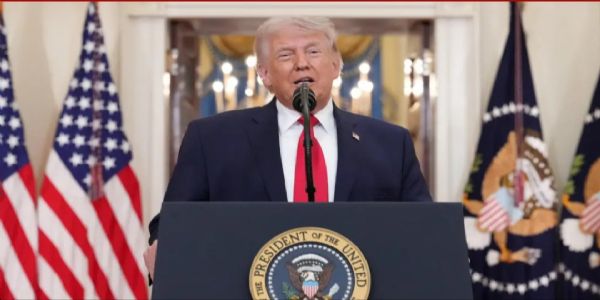
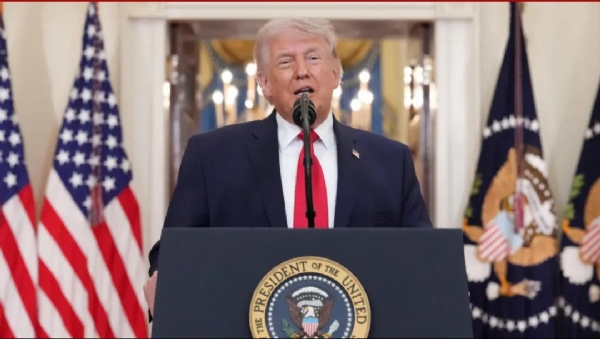
Speaking at a White House briefing, Trump was asked whether the U.S. should seek to secure Iran’s oil in the course of the war. He responded: “If I had my choice… yeah, because I’m a businessman first.”
The phrase has since become the anchor of his narrative: that military action should not be treated as a pure expenditure, but as a campaign that can yield tangible assets—chief among them Iran’s rank among the world’s largest oil and gas reserves.
Trump drew explicit parallels with U.S.‑linked operations in Venezuela, where American‑aligned authorities have gained access to significant crude volumes, and cited that experience as precedent. “We are a partner with Venezuela, and we’ve taken hundreds of millions of barrels… over 100 million barrels already,” he said, arguing that such seizures effectively paid for the earlier intervention many times over.
From War to Economic Control
The president’s framing suggests that political and military victory would be incomplete without follow‑on economic leverage. “To the victor belong the spoils… we haven’t had that in this country probably in 100 years,” he stated, echoing a long‑outdated principle of conquest in an era of formal sovereignty and international law.
On the same line, he insisted that if the U.S. emerges as the dominant force, it should have the right to shape how Iran’s energy wealth is managed: “We’re the winner… why shouldn’t we?”
Behind the slogans, Trump has linked oil to broader geopolitical architecture. He has repeatedly emphasised control over the Strait of Hormuz, one of the world’s most critical chokepoints for oil shipping, and framed “free traffic of oil” as a non‑negotiable pillar of any peace architecture.
By coupling military pressure with the promise of uninterrupted energy flows, he appears to be positioning Washington as the guarantor of global energy stability—if Iran and its allies accept the accompanying political and economic terms.
Legal and Diplomatic Flashpoints
Trump’s language, however, runs head‑on into long‑established norms of international law. The U.N. General Assembly’s 1962 resolution on the permanent sovereignty over natural resources affirms that oil, gas, and minerals are the sovereign property of the states in which they are located, regardless of foreign military presence.
Any unilateral attempt by an occupying or conquering power to seize or nationalise another country’s oilfields would likely be treated as a violation of those principles, as well as core tenets of the U.N. Charter on territorial integrity.
International legal scholars and several allied governments have privately warned that talk of “taking” Iran’s oil could harden resistance in Tehran and alienate partners who publicly advocate for a rules‑based order.
Even within Washington, officials have signalled that the idea of outright expropriation remains at the rhetorical stage, with the administration signalling that the final posture will depend on how negotiations evolve and whether Iran accepts a U.S.‑centred framework.
The Wider Context: Iran at a Crossroads
Trump’s comments come amid a broader military and diplomatic campaign that has already disrupted key Iranian infrastructure and maritime operations.
In prior speeches he has portrayed Iran’s air force and navy as effectively neutralised, claiming that its anti‑aircraft capabilities have been “obliterated,” and arguing that further pressure could force the regime into a settle‑on‑American‑terms scenario.
At the same time, Iran has rejected ceasefire overtures, instead circulating a 10‑point plan that demands a full withdrawal of foreign forces and a rollback of sanctions before any meaningful de‑escalation.
From the vantage of global markets, the president’s oil‑centric strategy injects new uncertainty. Analysts note that while the U.S. is already the world’s largest oil producer, a sharp shift toward positional control of Iranian reserves would raise questions about the future of OPEC‑Plus dynamics, regional alliances, and the credibility of long‑term supply contracts.
For consumer economies, the prospect of a conflict‑driven reshuffling of oil ownership heightens inflation and energy‑security risks, even as Washington insists it can “keep oil and make money” simultaneously.
A Transactional Turn in Foreign Policy
What stands out in Trump’s latest remarks is their openness to a transactional reading of warfare and sovereignty.
Rather than treating peace agreements as balanced compromises, he appears to view the endgame as a deal where the stronger side secures not just security guarantees but productive assets—especially oil—that can subsidise and justify the preceding campaign.
This approach marks a stark departure from the more restrained, multilateral scripts of recent decades, and it has already drawn sharp criticism from human‑rights groups and legal‑order advocates who warn that retroactively applying “spoils of war” logic to national resources risks normalising resource colonialism under a new label.
As the April 10 deadline for concrete negotiations looms, the world is watching closely: whether Trump’s “businessman first” doctrine remains campaign‑trail rhetoric, or whether it crystallises into a concrete blueprint for how power, oil, and law will intersect in the next chapter of the Middle East.
---------------
Hindusthan Samachar / Jun Sarkar