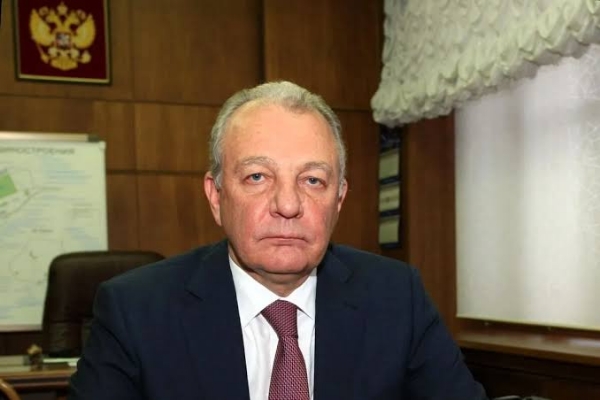
Moscow/New Delhi, 06 April (H.S.): Renowned Russian missile designer Alexander Leonov, widely credited as a key architect of the hypersonic Zircon cruise missile and the Indo‑Russian BrahMos programme, has died at the age of 74, according to Russian state‑linked reports and defence‑industry sources.
His death marks the loss of one of Moscow’s most influential hypersonic‑weapons engineers at a time when advanced cruise‑ and ballistic‑missile systems are central to Russia’s global‑power posture.
Role in Zircon and BrahMosLeonov served as CEO and Chief Designer of NPO Mashinostroyeniya (NPO Mash), the Russian state‑owned company that is the principal Russian partner in BrahMos Aerospace, the New Delhi‑based joint venture developing the BrahMos and BrahMos‑NG supersonic and hypersonic cruise missiles.
Within this framework, he oversaw successive generations of the BrahMos family, including the new‑generation BrahMos‑NG, which is being engineered for smaller platforms, reduced radar signature, and enhanced range.
Beyond BrahMos, he is most closely associated with the 3M22 Zircon (Tsirkon) hypersonic cruise missile, a ship‑ and submarine‑launched system capable of reaching speeds up to Mach 9—roughly nine times the speed of sound—and striking maritime and land targets at ranges commonly assessed between about 400 and 1,000 km, depending on trajectory and altitude.
Russian media describe Zircon as a cornerstone of Moscow’s naval and coastal‑strike capability, designed to outmanoeuvre existing missile‑defence architectures. Broader contributions to Russian defenceUnder Leonov’s leadership, NPO Mashinostroyeniya also played a central role in other major Russian missile and space‑related systems, including the Granit and Bastion coastal‑defence complexes, which employ the Oniks (Yakhont) cruise missile that forms the basis of the Indian‑Russian BrahMos design lineage.
Open‑source defence analyses note that his bureau contributed to the combat‑equipment elements of the Avangard hypersonic glide‑vehicle system and to radar‑surveillance satellites, underscoring his impact across both missile and space domains. Leonov was decorated with the title “Hero of Labour” in 2019, Russia’s highest civilian honour, in recognition of his contributions to missile‑ and space‑system design.
Russian agencies describe him as a pivotal figure in modernising Russia’s conventional and strategic‑strike capabilities over the past three decades, particularly in the shift from traditional cruise‑missile architectures toward hypersonic platforms.
Circumstances and legacyThe exact place and cause of Leonov’s death have not been formally disclosed by his employer or by official Russian channels, although several Russian‑language outlets place his passing in early April 2026.
International defence analysts stress that his work on Zircon and BrahMos‑NG will continue to shape not only Russia’s and India’s arsenals, but also the calculus of naval and coastal‑defence planning in the Indo‑Pacific and European theatres.
As hypersonic technology becomes a critical vector in global strategic competition, the death of an architect like Alexander Leonov underscores the enduring importance of individual designers in determining the character and reach of next‑generation missile systems.
---------------
Hindusthan Samachar / Jun Sarkar
06 Apr 2026