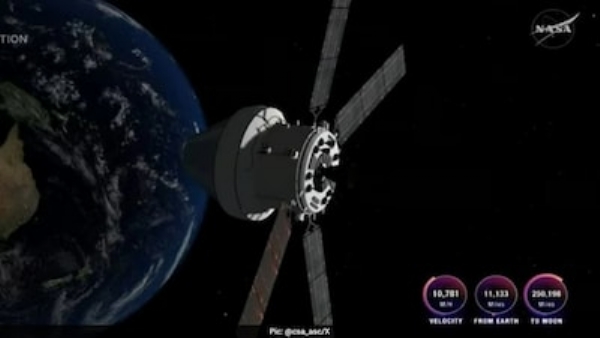
Cape Canaveral, 03 Florida: NASA’s Artemis II astronauts have broken free of low‑Earth orbit and are now barreling toward the Moon on a historic, ten‑day test flight that marks the first time humans have set course beyond shallow circuits around our planet since the final Apollo missions half a century ago.
The four‑person crew—commander Reid Wiseman, pilot Victor Glover, mission specialist Christina Koch, and Canadian Space Agency astronaut Jeremy Hansen—are riding inside the Orion spacecraft, which is being pushed toward the Moon by the European Service Module and the Space Launch System (SLS) rocket’s upper stage.
Mission profile and trajectory
Artemis II, launched from Kennedy Space Center on April 1, 2026, is designed as a fully crewed lunar flyby, not a lunar landing. More than 24 hours after liftoff, the Orion capsule performed a critical translunar injection burn, swinging out of Earth orbit and committing the crew to a free‑return trajectory that will carry them past the Moon and then back home without stopping on the surface.
During this outbound leg the spacecraft will travel roughly 6,400 kilometers beyond the Moon’s far side, setting the crew on a path to become the farthest‑traveled humans in history, surpassing the distance record set by Apollo 13 in 1970.
The mission’s overarching goal is to validate Orion’s life‑support, navigation, communications, and propulsion systems with people aboard, in preparation for Artemis III, when NASA aims to land two astronauts on the lunar surface in 2028.
By flying this fully domestic crewed test flight, the programme seeks to re‑establish American capability for sustained lunar operations and to lay the groundwork for future surface bases and eventual human missions to Mars.
Historic crew roles and milestones
The Artemis II crew embodies a deliberate shift from the all‑white, all‑male Apollo cadre. Victor Glover will become the first Black astronaut to travel to lunar vicinity, Christina Koch the first woman, and Jeremy Hansen the first Canadian national to participate in a Moon‑distance mission.
Although this is Hansen’s first spaceflight, Wiseman, Glover, and Koch have each flown in low‑Earth orbit before, giving the quartet combined experience that NASA and international partners view as critical for a high‑risk test in deep space.
From the moment of launch, the crew has been operating in a tightly choreographed sequence: post‑boost checks, cabin systems tests, and then a deliberate one‑day “hold” in a high‑Earth orbit to evaluate Orion’s environmental control and life‑support systems before committing to the lunar arc.
Engineers at mission control used this period to confirm that the capsule’s atmosphere, cooling, and electrical systems could sustain the crew for the full round‑trip journey, before clearing the pair of burns needed to send Orion chasing the Moon across nearly 400,000 kilometers.
Engineering challenges in deep space
Even in the early hours of the mission, technical glitches have underscored the complexity of operating a crewed craft so far from Earth. Orion’s onboard waste‑management system encountered a malfunction shortly after reaching orbit, prompting Mission Control to guide Koch through a series of in‑flight plumbing procedures to restore function. As a contingency, the crew resorted to using emergency urine‑storage pouches, a backup that has long been standard in human spaceflight but rarely discussed in public.
Compounding the issue, a valve problem with the cabin‑water dispenser forced controllers to have the astronauts pre‑fill several of these pouches with more than 7 liters of drinking water, ensuring reserves in case the dispenser fault worsened.
Cooling issues also emerged early: the habitable volume ran colder than anticipated, compelling the astronauts to dig into their suitcases for long‑sleeved garments and layered clothing normally reserved for post‑splashdown or post‑landing scenarios.
These incidents highlight the fine balance between spacecraft design margins and human comfort as NASA refines systems for longer Artemis missions.
Views of Earth and the Moon
As Orion climbed to its high‑Earth orbit, the crew enjoyed unobstructed views of Earth that missions in low‑orbit platforms such as the International Space Station usually cannot replicate.
Koch reported that the astronauts could trace entire continental coastlines and even clearly see the South Pole, which she had studied during a year‑long deployment at an Antarctic research station before joining NASA.
Such perspectives, often described by astronauts as “the overview effect,” are now being digitally recorded and relayed back to Earth as part of a broader effort to communicate the emotional and scientific value of returning to deep space.
Once the translunar burn was completed, Orion’s trajectory began to tilt from a focus on Earth toward the Moon’s distant horizon.
The next major milestone will be a close lunar flyby early next week, when Orion slips past the Moon’s far side and then arcs into a free‑return path that will bring it home for a splashdown in the Pacific Ocean around April 10.
During that swing, the crew will not only collect navigational and engineering data but also witness the Moon eclipsing the Sun from their vantage point, effectively a total solar eclipse visible from deep space.
Broader implications for deep‑space exploration
Artemis II is explicitly framed as a test flight, but its success is seen as the linchpin for an entire family of later missions.
International partners, including the Canadian Space Agency and the European Space Agency, are already investing heavily in Gateway components, lunar‑surface infrastructure, and logistics that assume recurring Artemis launches following this first crewed outing.
The data gathered from Orion’s systems performance, radiation exposure, life‑support operations, and crew behavior in deep space will be fed directly into the design of Artemis III and beyond, including longer‑duration stays on the lunar surface and eventual expeditions to Mars.
For the global public, Artemis II also marks a symbolic return to the Moon after more than fifty years of human spaceflight confined to near‑Earth regions.
The fact that the crew includes the first woman, first Black astronaut, and first Canadian to venture so far from home underscores a conscious effort to broaden the narrative of exploration beyond the Apollo‑era paradigm, even as the mission still relies on the foundational engineering legacy of the 1960s and 1970s.
If the remainder of the flight proceeds as planned, Artemis II will close the longest gap in human deep‑space travel in history and set the stage for a new era of sustained lunar presence.
---------------
Hindusthan Samachar / Jun Sarkar

03 Apr 2026