New.Delhi, 28 April (H.S.):
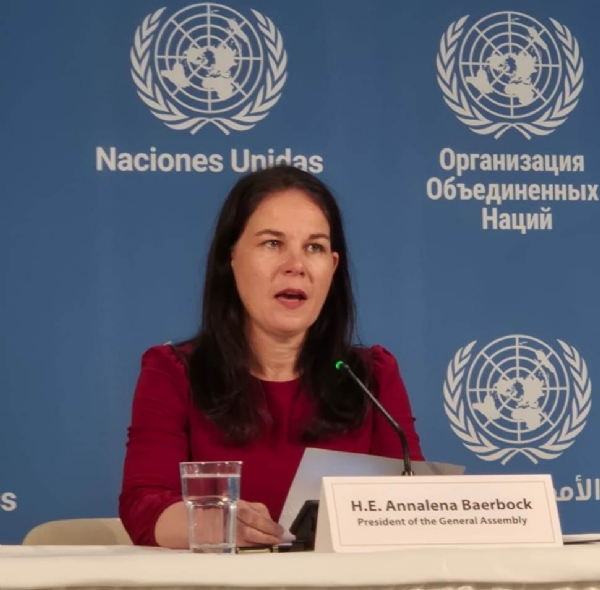
United Nations General Assembly President Annalena Bäerbock has underscored that the peaceful resolution of the West Asia conflict, including the blockage of the Strait of Hormuz and its global economic fallout, remains the United Nations’ highest responsibility.
Speaking at a press conference at the UN office in New Delhi after a meeting with External Affairs Minister Dr. S. Jaishankar at Hyderabad House, she voiced deep concern about soaring oil and fertiliser prices, the worsening humanitarian crises in Gaza and Lebanon, and repeated attacks on UN peacekeepers.
West Asia: ceasefire only the first step
Bäerbock warned that restoring peace in the region requires far more than mere rhetoric: it demands tested ceasefire‑negotiation mechanisms, strict adherence to international law, and a genuine commitment to the equal sovereignty of all states. She stressed that the UN is uniquely placed to host those talks because it is the one forum where every country—big or small, powerful or resource‑scarce—sits at the table as an equal.
In Gaza and Lebanon, she described the humanitarian situation as “deeply distressing” and condemned in the strongest terms all attacks on peacekeepers. “Secretary‑General and I jointly condemn any and every attack on United Nations peacekeepers,” she said.
“Ensuring their safety is a shared obligation of all member states, especially when people from all over the world come to serve in other countries to protect and preserve peace.”
Security Council reform and UN credibility
Addressing the long‑standing stalemate on Security Council reform, which has dragged on for 17 years, Bäerbock criticised the five permanent members for actions that appear to weaken the UN Charter and its principles. She argued that the absence of permanent representation for continental bodies such as the African Union directly affects the UN’s credibility and legitimacy.
She announced that she has appointed two co‑facilitators to lead the ongoing reform process, under which various proposals—including one from India—are pending. African‑led demands for at‑least‑one permanent seat for the continent, she noted, are “not just a regional request but a structural imperative for the post‑Cold‑War global order.”
In her dialogue with Dr. Jaishankar, the Assembly President said they focused on how to strengthen multilateral cooperation amid rising geopolitical tensions, fragmentation, and pressure on the UN’s three pillars: peace and security, development, and human rights. She acknowledged that “no country, no matter its size or power, can tackle today’s complex global challenges alone,” pointing to climate change, pandemics, and war‑induced economic shocks—such as those stemming from the closure of the Strait of Hormuz or the war in Ukraine.
“Compliance with international law and achievement of the Sustainable Development Goals are not optional extras—they are in the common interest of us all,” she said, underlining that India’s continuous leadership and partnership in multilateralism are “especially vital at this juncture.”
India’s role in UN history
Bäerbock paid tribute to India’s contribution to the United Nations since its founding, recalling that more than 184 Indian peacekeepers have made the supreme sacrifice in the service of global peace. She also highlighted New Delhi’s leadership in implementing the Sustainable Development Goals and advancing South‑South cooperation.
Referencing Dr. Hansa Mehta, the Indian woman who ensured the Universal Declaration of Human Rights (1948) declared that “all human beings are born free and equal,” not just “all men,” she concluded that the 80‑year history of the UN and the legitimacy of its Charter ultimately depend on ensuring that no one is excluded from the table—whether in Geneva, New York, or the heart of West Asia where the next steps toward a just and lasting peace must be forged.
---------------
Hindusthan Samachar / Jun Sarkar
28 Apr 2026