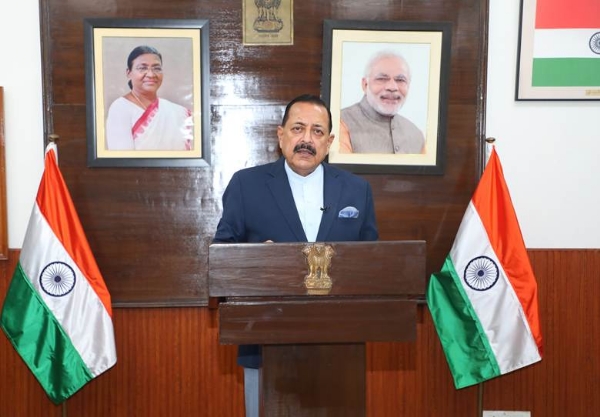
New Delhi, 26 April (H.S.): Union Minister of State (Independent Charge) for Science and Technology and Earth Sciences, Dr Jitendra Singh, has said that in the coming decades a nation’s strength will be gauged by its technological capability, not just its land or military. Speaking virtually to the PAN‑IIT Alumni Conference in Los Angeles, he added that India’s mission is not only to become a developed country by 2047, but also to shape the direction of global progress.
Dr Singh told the global gathering of technology leaders, entrepreneurs, investors and researchers that “India’s technological sovereignty” will be central to both its domestic development and its global standing. He said the country must move beyond being a consumer of technology and emerge as a creator, designer and driver of global innovation.
He stressed that critical areas such as semiconductors, artificial intelligence, robotics and quantum technologies are now essential for national security and economic resilience. Advancing India’s position in these fields, he argued, will give the country greater strategic autonomy and bargaining power on the world stage.
Under Prime Minister Narendra Modi’s leadership, Dr Singh said, India has transformed from a technology‑importing nation into a global innovation hub. He pointed to the expansion of the space programme, breakthroughs in biotechnology, and the rapid rise of deep‑tech startups as living proof of India’s growing technological muscle.
He called science, technology and innovation the bedrock of the “Developed India 2047” vision, and said that cross‑sectoral reforms—from space and nuclear to digital infrastructure—have all been driven by technology‑enabled policies.
The minister praised the contribution of the Indian diaspora, especially IIT alumni, calling them a crucial bridge between India and global innovation ecosystems. Through investments, mentorship, institutional partnerships and policy engagement, he said, overseas‑based Indians are continuously strengthening India’s development trajectory.
He urged the large base of Indian technologists abroad to deepen collaboration with Indian universities, research bodies and startups, so that India can jointly build globally relevant technologies instead of merely adapting foreign solutions.
---------------
Hindusthan Samachar / Jun Sarkar



26 Apr 2026