




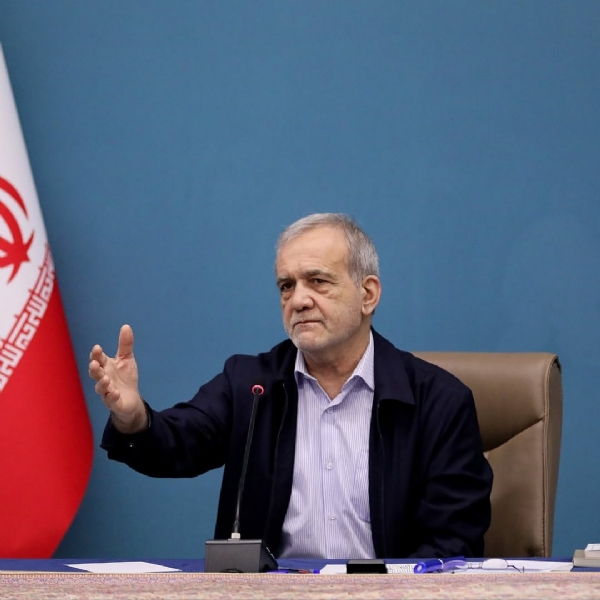
Tehran /Washington, 02 April (H.S.): Iranian President Masoud Pezeshkian has issued a pointed open letter to the people of the United States, challenging whether prolonged hostilities in the Middle East genuinely serve American interests and accusing Washington of acting as a proxy for Israel rather than pursuing an authentic “America First” strategy.
His remarks come as the US‑Israel war against Iran, launched in late‑February, enters its fifth week and global economic strains mount amid the effective closure of the Strait of Hormuz.
Core Message to the American Public
Centered around the refrain “Is ‘America First’ truly among the priorities of the U.S. government today?”, Pezeshkian’s letter frames the conflict as a choice between genuine US national interest and alignment with Israel’s security agenda.
He urges ordinary Americans to look beyond what he calls a “machinery of misinformation” in the mainstream media and to question the narratives that justify the bombing of Iranian infrastructure as a response to a hypothetical Iranian threat.
Pezeshkian stresses that attacks on Iran’s energy and industrial facilities “directly target the Iranian people” and, in his words, constitute war crimes whose consequences extend far beyond its borders.
He argues that such actions sow regional instability, inflate human and economic costs, and lay the groundwork for long‑term resentment, asking bluntly which American interests are actually being served by a war that has already disrupted global oil markets and supply chains.
Swipe at US–Israel Alliance
Explicitly invoking the US alliance with Israel, Pezeshkian questions whether Washington has entered the war “as a proxy for Israel, influenced and manipulated by that regime.” He warns that dispatching American forces to fight “to the last American soldier” for interests that are not clearly America’s own undermines the professed doctrine of “America First” and risks locking the United States into open‑ended regional commitments.
Even as he criticizes the US government and its warm‑Israel stance, Pezeshkian draws a careful distinction between the American state and its citizens, insisting that ordinary Americans are not Iran’s enemy “even in the face of repeated foreign interventions and pressures.”
He appeals to Americans to engage directly with Iranian expatriates and professionals abroad, arguing that their presence in leading Western universities and technology firms contradicts the portrayal of Iran as an inherently hostile or irrational actor.
Backdrop: Trump–Pezeshkian War of Narratives
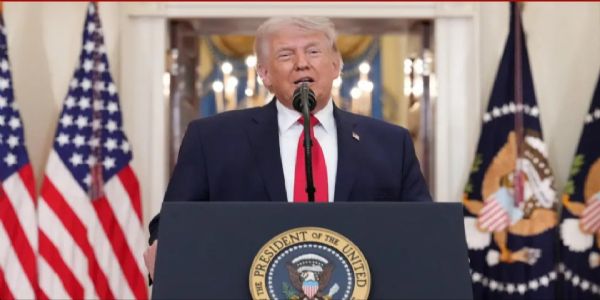
The letter was published on President Pezeshkian’s official site just hours before US President Donald Trump was scheduled to address the American public prime‑timewise on the Iran war, amid sagging domestic approval ratings and growing concern over inflation and geopolitical fallout.
Trump has insisted that Tehran is negotiating a ceasefire behind closed doors, a claim Iran has officially denied, while Trump meanwhile links any formal truce to the reopening of the Strait of Hormuz, which Tehran has effectively shut off to oil traffic in response to the US‑Israeli offensive.
Analysts describe the exchange as a classic “war of narratives”: whereas Trump emphasizes Iranian “compliance” and military dominance, Pezeshkian positions the United States as a reluctant public caught in a war orchestrated by Washington’s geopolitical calculations and its close coordination with Israel.
With the Strait of Hormuz still closed, global energy markets remain volatile, lending urgency to both leaders’ messaging as they seek to rally domestic support and manage international perceptions of the conflict.
Framing the Conflict as a Moral Choice
Pezeshkian also uses the letter to depict Iran as a historically non‑aggressive power, rejecting the idea that it poses an objective security threat to the United States or its allies. He asks whether there has been any verifiable Iranian act that justifies the scale of bombardment launched by US and Israeli forces on February 28, which involved hundreds of sorties and strikes on Iranian missile, air‑defense, and leadership‑related infrastructure.
By casting the war as a moral and existential choice for the American people—between enduring economic hardship and geopolitical entanglement, on the one hand, and holding their government accountable for a controversial alliance, on the other—Pezeshkian aims to shift the political pressure back onto Washington’s domestic audience.
As the two leaders prepare for their next high‑stakes public statements, the spotlight on “America First” may prove as significant on the battlefield as it is on the diplomatic and information fronts.
---------------
Hindusthan Samachar / Jun Sarkar


02 Apr 2026