




Cape Canaveral, Florida, 02
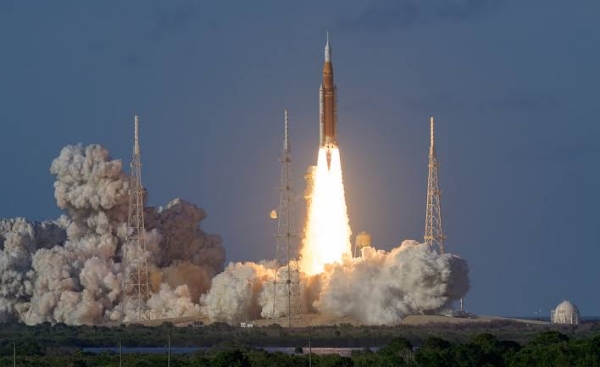
Under a dusky Florida sky streaked with cloud and bursts of artificial light, the Space Launch System (SLS) rocket punched through the atmosphere with a roar that seemed to shake the entire coast. At 6:35 pm local time(Wednesday), NASA’s Artemis II mission lifted off from Kennedy Space Center, carrying four astronauts into the second chapter of humanity’s return to the Moon.
It was the first time since 1972 that crewed vehicles had left low‑Earth orbit destined for lunar space, and the first occasion in more than 50 years that humans would fly around our nearest celestial neighbour.
Liftoff and the weight of history
The launch came after repeated delays, hardware checks, and a final roll‑out from the Vehicle Assembly Building to Pad 39B just days before. The 10‑day mission was initially scheduled for early February; technical glitches and weather forced multiple slips, even sending the rocket back to the hangar for inspections and repairs. By launch day, forecasters gave a 90 percent chance of favourable conditions, and the countdown held.
Seven seconds before liftoff, the four RS‑25 engines at the base of the SLS ignited, building thrust to full power. At T‑0, the twin solid‑rocket boosters lit, and the stack surged upward, tilting slightly before climbing into the twilight. To spectators lining the Space Coast, the light turned the sky orange‑white, and the shockwave arrived a few moments later, a low rumble that vibrated through the ground. On the launch tower, cameras captured the moment the rocket broke free of the umbilical and cleared its flame trench, arcing slowly into the darkening blue.
Inside the Orion capsule, the four astronauts – NASA’s Reid Wiseman, Victor Glover, Christina Koch, and Canadian Space Agency’s Jeremy Hansen – felt the acceleration build as gravity pushed harder into their seats. Wiseman, the commander and a former fighter pilot, had spent years in high‑G training, but this was different: the first crewed flight of both the SLS rocket and the Orion spacecraft, with no space‑station safety net, no quick return home if something went wrong.
A crew that breaks barriers
Artemis II is historic before it even reaches the Moon. Glover, selected for his precision flying and test‑pilot discipline, will become the first person of colour to travel so far from Earth, symbolically crossing a boundary that has long separated the promise of “space for all” from the reality of who actually flies. Koch, an engineer and former long‑duration ISS astronaut, will be the first woman to venture into lunar‑vicinity space, adding a new dimension to the male‑dominated images of past Apollo missions.
Hansen, representing Canada, will be the first non‑American citizen to ride aboard a dedicated lunar‑bound spacecraft, marking the growing international spine of the Artemis program.
In the final minutes on the pad, the crew had run through a rapid checklist. Hansen, strapped in beside the main window, gave a voice check that echoed through the control room: “We are going for all humanity.” The phrase, simple but loaded, travelled across the world in seconds, shared by millions watching livestreams and satellite feeds.
Launch director Charlie Blackwell‑Thompson then spoke directly to the capsule, naming each astronaut and telling them they carried not just mission hardware, but “the heart of this team, the hopes and dreams of a new generation.”
Flying around the Moon, without landing
Artemis II is explicitly not a landing mission; its role is to test systems and human resilience before boots touch the lunar surface again. Over roughly three days, the Orion spacecraft will coast outward on a free‑return trajectory, using the Moon’s gravity rather than its own engines to swing back toward Earth. At its closest approach on the far side, the crew is expected to pass within about 6,400–9,700 kilometres of the Moon’s surface, more distant than the Apollo landings but still profoundly close in cosmic terms.
Throughout the journey, the astronauts will conduct a series of critical checks. Life‑support systems inside Orion must manage air, temperature, and carbon‑dioxide scrubbing for the full 10 days. Radiation levels will be monitored constantly, as the capsule spends long stretches beyond the protective cocoon of Earth’s magnetic field. The crew will also test manual piloting of Orion, running docking‑like simulations with the spent upper stage of the SLS, and relying on star‑tracking and deep‑space navigation to confirm their position.
One of the most dramatic moments will come when the spacecraft passes behind the Moon, briefly cutting off direct radio contact with Earth. For several minutes, the crew will be alone in the void, with only automated systems and their own expertise holding the mission together. Cameras will capture close‑ups of the lunar far side, an area seen only in fragments by robotic missions, giving engineers and scientists their best look yet at how the terrain appears to human eyes.
A record‑breaking distance and a new frontier
If everything goes according to plan, Artemis II will push the crew farther from Earth than any human has ever traveled, surpassing the distance record set by Apollo 13 in 1970. The precise figure – around 400,000 kilometres – will be logged not just as a number, but as a milestone in how far humans can safely operate in deep space.
On the final leg of the mission, the capsule will execute a high‑speed atmospheric re‑entry, punching through the skies at roughly Mach 32, protected by a heat shield that must withstand temperatures close to 2,700 degrees Celsius.
The expected splashdown is in the Pacific Ocean near San Diego, where U.S. Navy teams will recover the astronauts and haul the Orion capsule onto a ship for inspection. Engineers will pore over every bolt, sensor reading, and crew report, comparing the data with previous Apollo and Artemis I test flights, and using the lessons to refine plans for Artemis III, the mission that aims to deliver astronauts back to the lunar surface by 2028.
Artemis, the Moon, and what comes next
Artemis II sits at the hinge between two eras: the first was Apollo, a brief, intense sprint to the Moon in the 1960s and 1970s; the second is a push toward something more permanent. The SLS rocket is designed for repeated returns to the Moon, while Orion is meant to ferry crews not just there, but also to future deep‑space targets. The Artemis program envisions a lunar gateway station, a surface base, and eventually a platform for missions to Mars, though the timetable is under intense political and budgetary pressure.
For the public, the Artemis II launch is a moment of spectacle and symbolism. As the rocket vanished into the night, some on the coast shouted, “We’re going to the Moon!” Others watched quietly on phones and screens, the mission stitching together images of American ambition, scientific curiosity, and international cooperation. When the crew later pointed Orion’s cameras back toward Earth, the pale blue marble framed by the blackness of space will serve as a reminder: humans are once again reaching beyond low‑orbit, not just to plant flags, but to test how far they can go without leaving each other behind.
---------------
Hindusthan Samachar / Jun Sarkar

02 Apr 2026