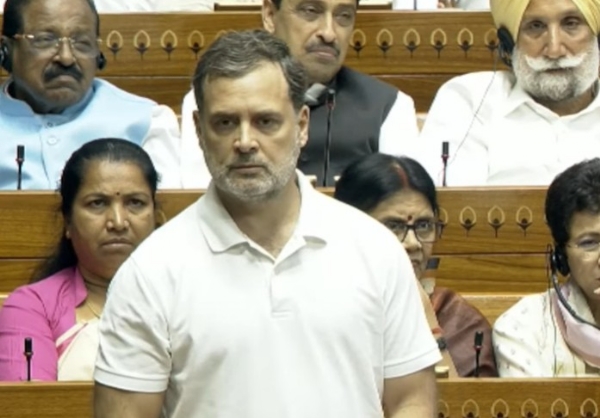
New Delhi, 17 April (H.S.): In the Lok Sabha on the second day of the three‑day special session, opposition leader Rahul Gandhi charged that the Constitution (Amendment) Bill being pushed by the government is not truly about women’s empowerment but an attempt to redraw India’s electoral map and dilute the representation of disadvantaged sections.
He argued that the government’s real objective is to rework the country’s political balance through delimitation, bypassing caste‑based enumeration and weakening the rights of Other Backward Classes (OBCs), Scheduled Castes, and Scheduled Tribes.
“Women’s Bill” or a Political Redesign?
Addressing the House on Friday, Rahul Gandhi acknowledged that women have always played a central role in India’s social and national life, saying every person has learned from mothers, sisters, and other women in their lives. Yet he insisted that the present legislation is not the “real” women’s reservation bill, because the core Women’s Reservation Act was already passed in 2023.
He urged the government to implement that 2023 law immediately, promising full opposition support; if the government’s intent is genuine, he said, there is no need for a new, delimitation‑driven proposal.
According to him, the actual purpose of the current bill is to reconfigure the nation’s political equilibrium by relying on population‑based delimitation while deliberately avoiding a caste‑wise census. This, he claimed, keeps OBCs and other backward communities from achieving fair representation and is part of a broader strategy to marginalise deprived sections from the power structure.
Rahul Gandhi cited the persistently low participation of Dalits, Adivasis, and OBCs in corporate India, the judiciary, private healthcare, and leading educational institutions, asserting that these groups are largely excluded from gatekeeping positions. He criticised the government for dismantling public‑sector openings that once provided avenues for such communities and handing that space over to the private sector, while merely offering token “recognition” without real decision‑making power.
He also warned that the ruling dispensation is gradually reducing the share of marginalised groups in the structures of power, including legislatures, bureaucracy, and key institutions, and that this trend must be reversed through concrete affirmative‑action‑style measures.
On delimitation, the Congress leader specifically highlighted the concerns of southern and northeastern states, arguing that the Centre’s approach will systematically reduce their representation in Parliament and weaken India’s federal architecture. He categorically ruled out any compromise, stating that the opposition will not accept such a diminution of regional voice and will do everything possible to defeat the bill.
Rahul Gandhi reiterated that Indian history is marked by discrimination against OBCs, Dalits, Adivasis, and women, and that the present government’s move to sidestep a caste‑based census is a deliberate tactic to postpone the issue of equitable representation for years to come.
The bill, he said, is being “dressed up” as a pro‑women reform but in substance aims at a different political project—one that must be exposed and rejected.
---------------
Hindusthan Samachar / Jun Sarkar

17 Apr 2026