New Delhi, 14 April (H.S.):
US President Donald Trump has ignited a transatlantic firestorm after deleting an AI‑generated social‑media image that recast him as a Christ‑like healer, deepening a growing rift between his political persona and the religious communities that once formed the backbone of his support.
The episode, which unfolded over less than 24 hours, crystallizes how Trump’s self‑mythologizing—framed in religious imagery—no longer merely shocks onlookers but now challenges the very theological sensibilities of millions of believers.
The Image and Its Immediate Fallout
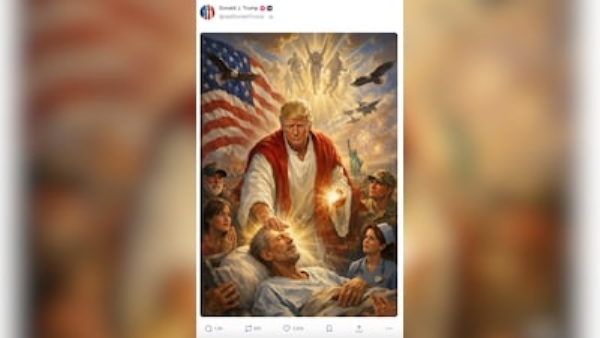
The controversial picture, shared on Trump’s Truth Social platform late on Sunday, depicted the president in flowing red and white robes reminiscent of traditional Christ iconography, with his hand resting on a man who appeared to be in distress and light radiating from his palm and head.
An American flag fluttered in the background while a crowd gazed up at him in reverence, lending the scene a distinctly hagiographic quality.
Within hours, conservative‑Christian commentators and Catholic organizations condemned the image as “gross blasphemy,” urging Trump to remove it and seek forgiveness from both the public and God.
Facing mounting pressure, Trump deleted the post on Monday and insisted the depiction was not meant to evoke Jesus but to show him as a “doctor” working in a humanitarian rather than a sacred role.
He told reporters that the image was supposed to represent him “making people better,” echoing his habit of describing himself as a restorative force in both health‑care policy and national politics.
For many critics, however, this explanation felt less like clarification and more like a deflection, as the composition—light‑filled hands, bowed onlookers, and draped robes—remained unmistakably Christ‑like.
Religious Allies Turn Critical
What made the backlash particularly significant was its source: some of Trump’s most loyal religious allies. Conservative Christians and Catholic groups who have long backed his presidency expressed dismay, with organizations such as CatholicVote.org labeling the image “blasphemous” and underscoring how the symbolism could offend millions of believers.
Senior clergy and lay commentators questioned whether the president had lost a sense of theological humility, arguing that presenting a mortal leader as a divine healer subtly erodes the distinction between temporal authority and sacred office.
Yet not all supporters followed the same line. While some urged Trump to apologize and reframe his messaging, others downplayed the episode as a miscommunication or symbolic gesture rather than a theological claim.
This schism underscores the tension within his base: many conservative Christians want to combine cultural influence with religious propriety, yet find themselves defending a leader whose imagery increasingly strains both.
The Rise of a Messianic Narrative
The Jesus‑like image is not an isolated incident, but the latest turn in a broader narrative Trump and his inner circle have cultivated over several years. During his 2023 bank‑fraud trial, he shared a sketch from a supporter that showed him seated beside Jesus in a courtroom, implicitly framing his legal troubles as a persecution akin to biblical injustice.
At this year’s Easter‑themed event at the White House, spiritual advisor Paula White‑Cain publicly compared Trump’s tribulations to those of Christ, noting that he had been “betrayed and arrested and falsely accused.”
After surviving the July 2024 assassination attempt, Trump’s rhetoric hardened further, with him repeatedly telling audiences that “God spared my life for a reason” and that his purpose is to rescue the United States from decline.
Analysts of Christian nationalism argue that such language borrows the tropes of divine election, turning the presidency into a quasi‑apocalyptic mission.
Within this framework, the Jesus image becomes less a one‑off post and more a visual manifestation of a worldview in which Trump’s political survival is cast as a sacred covenant.
Political and Electoral Consequences
The episode arrives at a delicate juncture for Trump’s coalition, especially among Catholic voters and traditional Evangelicals who watch the Middle East war with unease. Many Catholics have already been unsettled by his public clashes with Pope Leo, who has criticized American‑led military actions in Iran as “brutal” and inconsistent with Christian ethics.
The Jesus image, posted just after Trump’s latest tirade against the pontiff, compounds the sense among some believers that the president is not only warring abroad but also rewriting the symbols of faith at home.
Historians and political analysts suggest that while this controversy may deepen the discomfort of religious conservatives, it is unlikely to fracture the core of Trump’s support.
As scholar Kristin Du Mez has observed, many die‑hard supporters distance themselves from the language of blasphemy while still refusing to break ranks politically.
They acknowledge that the image was “inappropriate” and “should be taken down,” yet stop short of tying their loyalty to a moral recalibration of Trump’s behavior.
A Defining Moment in Presidential Imagery
In the broader context of modern political communication, Trump’s Jesus post marks a distinctive moment: a sitting president using artificial intelligence to craft a self‑image that deliberately mirrors the most sacred figure in Western Christianity.
It raises urgent questions about the limits of religious symbolism in democratic politics, the responsibility of leaders in handling sacred iconography, and the ways digital tools can blur the line between metaphor and hubris.
For those observing Trump’s career, the episode is less about a single deleted image and more about the consolidation of a persona that increasingly sees national leadership as indistinguishable from divine mission.
Whether voters interpret that vision as inspired or excessive will shape not only the remainder of his presidency but also the future relationship between the American electorate and the religious narratives that animate its politics.
---------------
Hindusthan Samachar / Jun Sarkar