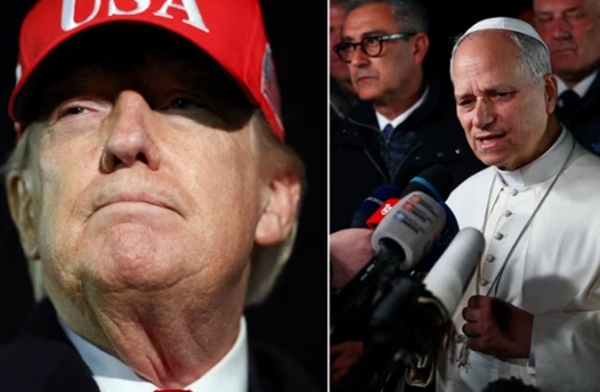
The Vatican/Washington, 14 April (H.S.): On Saturday(April 11, 2026), Pope Leo XIV delivered a pointed reflection at a prayer vigil in Rome, condemning what he described as the “delusion of omnipotence” behind the United States’ military posture toward Iran. The pontiff, America’s first native‑born pope and one of the world’s most prominent voices for peace, called for an end to “the display of power” and urged political leaders to choose dialogue over force.
Donald Trump, in Washington, responded on Sunday night, April 12, with a lengthy post on Truth Social lashing out at the Vatican. He branded Pope Leo “WEAK on Crime” and “terrible for Foreign Policy,” and insisted the pope should “focus on being a great Pope, not a politician.”
The attack marked an unusually personal and public rupture between a sitting U.S. president and the head of the Catholic Church.
The pope’s unflinching response
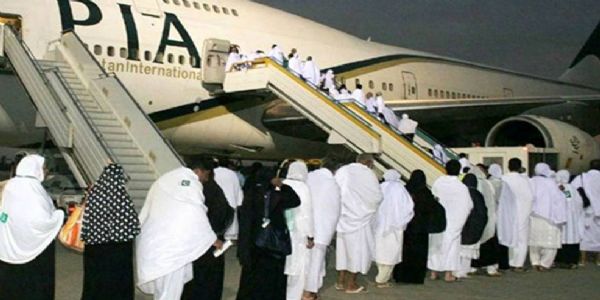
On Monday, April 13, as Pope Leo boarded the papal plane for an 11‑day tour of Africa, he addressed Trump’s remarks directly. Speaking to journalists on the tarmac before takeoff, Leo said he had “no fear of the Trump administration” and reaffirmed that his message was rooted in the Gospel, not partisan politics.
“I am sharing a Gospel message and not directly attacking Trump or anyone else with my appeals for peace,” he told Reuters, invoking the biblical beatitude “Blessed are the peacemakers.”
He added that he would continue to speak out against war and “the absurd and inhumane violence” that has deepened suffering in the Middle East, regardless of criticism from powerful leaders.
Trump’s “I’m right, he’s wrong” stance
When asked by CBS News on Monday, whether he would call the pope, Trump replied with a firm “no,” repeating that Pope Leo was “wrong on the issues.” He reiterated his earlier Truth Social language, insisting he “doesn’t want a Pope who thinks it’s OK for Iran to have a nuclear weapon” and arguing that Leo’s criticism undermined U.S. security and deterrence.
The same day, Trump doubled down in remarks at the White House, dismissing calls for an apology. “There’s nothing to apologize for. He’s wrong,” he said, framing the conflict as a moral showdown between papal pacifism and presidential “strength.”
He also suggested that the pontiff should confine himself to “matters of morality” and the internal life of the Church, while Washington handles foreign policy.
A clash that rattles American Catholics
The open feud has unsettled Catholic communities across the United States, where a majority of Catholic voters backed Trump in 2024 even as the Church’s leadership has grown increasingly critical of his Iran strategy and immigration policies.
On April 13, Archbishop Paul Coakley, head of the U.S. Conference of Catholic Bishops, and conservative‑leaning Bishop Robert Barron both denounced Trump’s tone as “entirely inappropriate and disrespectful” and urged him to offer a public apology.
Barron, who had recently praised Trump at a White House Easter event, warned that attacking the pope undermines the Church’s moral authority.
Other Catholic leaders across the political spectrum echoed that concern, stressing that the pope’s calls for peace and dialogue are consistent with the Church’s long‑standing teaching on war and human dignity.
The deeper rift: war, faith, and national identity
Analysts say the Trump–Leo clash is more than a spat between two institutions; it reflects a deeper tension over the role of religion in a militarized global order.
Kathleen Sprows Cummings, a historian of American Catholicism at Notre Dame, noted that for much of U.S. history, many Americans distrusted the pope, seeing him as a foreign, anti‑democratic threat.
Today, she said, the dynamic is inverted: “the menace is in the White House, and the pope is the one defending the ideals of liberty and human dignity.”
Pope Leo’s travels to Africa on Monday, April 13, underscored that shift. As he began his trip through nations scarred by conflict, poverty, and displacement, he reiterated that political leaders must resist “the idolization of mortals and money” and choose reconciliation over escalation.
His words came less than 48 hours after Trump announced further military tightening around Iranian ports, reinforcing the stark contrast between the pope’s call for restraint and the president’s rhetoric of overwhelming force.
A test of loyalty and conscience
For American Catholics, the feud is fast becoming a moral and political litmus test. Some lay believers remain steadfast in their support for Trump, even as they distance themselves from his attacks on the pope. Others fear the standoff may push the Church’s leadership closer to the political opposition, a rupture that could redraw ecclesial alignments for years.
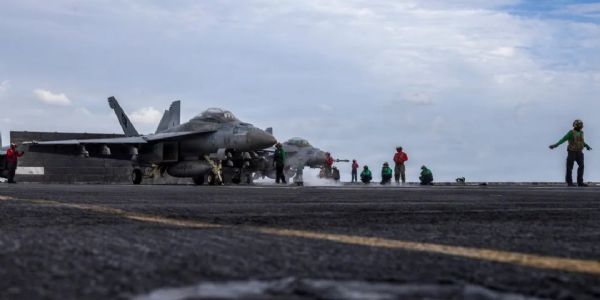
As the pope’s plane carried him toward Lagos on Monday, April 13, and Trump’s tanks, jets, and warships continued to circle the Strait of Hormuz, the two figures embodied a stark choice: one championing de‑escalation and dialogue, the other betting that fear and firepower will break Teheran’s will.
For millions of Catholics around the world and millions more watching the headlines ,the clash is no longer just about politics; it is about the soul of a nation and the conscience of a pontiff.
---------------
Hindusthan Samachar / Jun Sarkar