San Diego, 11 April (H.S.):
NASA's Artemis II crew returned triumphantly to Earth on Friday evening, executing a flawless splashdown in the Pacific Ocean off the San Diego coast and capping humanity's first crewed lunar mission in over half a century.
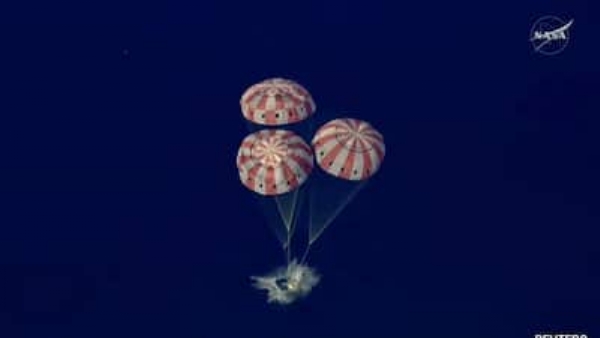
The Orion spacecraft, affectionately christened Integrity by its intrepid occupants, pierced the atmosphere at an astonishing Mach 33—equivalent to 24,661 miles per hour before deploying parachutes and settling gently into the waters at precisely 8:07 p.m. ET (0007 UTC on Saturday).
This high-stakes reentry, the most perilous phase of the 10-day odyssey launched from Florida on April 1, unfolded under meticulous oversight from Mission Control, with the U.S. Navy's USS John P. Murtha positioned for swift recovery amid a flotilla of support vessels and aircraft.
Commander Reid Wiseman, pilot Victor Glover, mission specialist Christina Koch, and Canadian astronaut Jeremy Hansen traversed a record-shattering 252,756 miles from Earth, eclipsing Apollo 13's longstanding benchmark and unveiling unprecedented vistas of the moon's far side to human gaze.
Their free-return trajectory—a daring elliptical loop around the lunar orb mirrored Apollo 8's groundbreaking 1968 voyage but incorporated advanced safeguards honed from prior uncrewed tests, including rigorous validation of the Orion's heat shield, which endured extreme thermal duress during the six-minute communications blackout.
Mission highlights abounded: the crew documented ethereal scenes of a total solar eclipse casting shadows across the lunar expanse, captured breathtaking Earthset imagery evocative of Apollo 8's iconic Earthrise, and even petitioned to christen lunar craters in tribute to their vessel and Wiseman's late spouse, Carroll.
Despite ancillary challenges such as valve malfunctions in the water and propulsion systems, alongside recurrent lavatory issues—the astronauts exuded resilience, underscoring the indispensable trade-offs inherent to pioneering exploration.
We can't probe deeper into the cosmos without embracing inconvenience, sacrifice, and calculated peril—yet these are profoundly worthwhile, Koch reflected post-mission, encapsulating the team's indomitable ethos.
Hansen echoed this sentiment, affirming that orbital exigencies serve as the ultimate crucible for terrestrial simulations.
Global luminaries showered accolades upon the quartet, from President Donald Trump and Canadian Prime Minister Mark Carney to Britain's King Charles III, alongside cultural icons like Ryan Gosling and William Shatner.
Lead flight director Jeff Radigan articulated a collective yearning to press onward: This voyage compels us to return, for the moon harbors boundless secrets awaiting elucidation.
Artemis II, devoid of lunar orbit or touchdown, nonetheless laid critical groundwork for the program's ambitious trajectory: Artemis III's proximate docking rehearsals in 2027, followed by Artemis IV's crewed south pole landing in 2028, en route to a permanent lunar outpost.
Wiseman encapsulated the mission's loftier aspiration: to momentarily arrest the world's frenetic pace, reminding all of Earth's singular splendor amid the universe's vast tapestry.
As recovery teams ferried the astronauts ashore for debriefings and medical evaluations, NASA's Artemis odyssey signals not merely a resumption of lunar forays, but a resolute stride toward sustainable extraterrestrial habitation—a testament to human ingenuity on this momentous Friday in April 2026.
---------------
Hindusthan Samachar / Jun Sarkar