Kuwait, 30 March (H.S.):
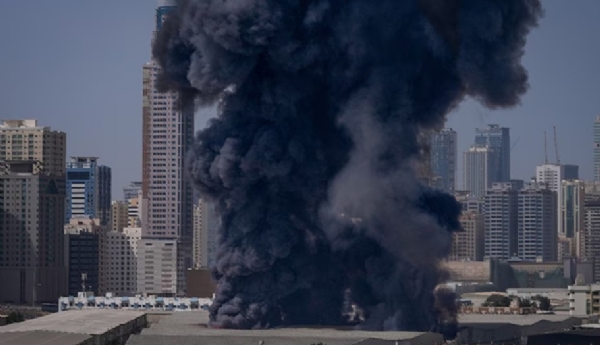
An Iranian attack has damaged a major power and water desalination plant in Kuwait, killing at least one Indian worker and causing significant structural damage to the facility, according to Kuwaiti authorities.
The strike comes amid a sharp rise in regional tensions as the wider U.S.–Israel–Iran war enters its seventh week, with Gulf states increasingly caught in the crossfire of missile and drone campaigns.
Damage and casualty at desalination plant
Kuwait’s Ministry of Electricity and Water said on Monday that a service building inside one of the country’s power and water desalination plants was hit “as part of Iranian aggression against the State of Kuwait.”
The ministry confirmed that the attack resulted in the death of an Indian national employed at the site and caused considerable physical damage to the building.
Technical and emergency response teams were immediately deployed to secure the site and ensure operations continue under emergency protocols, officials said, while Iran has not yet issued any official statement on the strike.
State media in Kuwait cited the ministry as saying the plant itself suffered heavy damage, underscoring the vulnerability of critical infrastructure in the Gulf during the current conflict.
Missile and drone attacks in Kuwait
The attack on the desalination plant followed a broader Iranian missile and drone barrage toward Kuwaiti airspace. The Kuwait Defense Ministry said on Sunday evening that 14 ballistic missiles and 12 drones were detected entering Kuwait’s airspace, with several of the drones reportedly targeting a military camp.
During the interception, 10 Kuwaiti soldiers were wounded, though none of the incoming weapons are reported to have fully penetrated air defenses without being shot down or diverted.
Kuwaiti commanders have warned that the country’s air‑defense systems have already intercepted hundreds of missiles and drones since the start of the regional war, but the repeated strikes are straining its ability to protect every civilian and military facility.
Regional escalation and warnings
The March 30 strike on Kuwait’s desalination plant is part of a broader pattern in which Iran has increasingly targeted energy and water infrastructure across the Gulf since the U.S.–Israel–Iran war began on February 28.
Earlier raids have hit fuel tanks at Kuwait International Airport and a desalination plant in Bahrain, raising fears of long‑term disruption to power and clean‑water supplies in the region.
Iranian state media reported that the country’s parliament speaker has warned the United States against any ground assault on Iranian territory, pledging that if Iran were attacked by land, its response would intensify against American allies across the Middle East.
At the same time, Israeli Prime Minister Benjamin Netanyahu said on Sunday that Israel intends to expand its offensive into southern Lebanon, signaling a further broadening of the conflict beyond the immediate Gaza and Iran–Israel axis.
Human and strategic cost of desalination strikes
Desalination plants play a crucial role in the Gulf, where seawater is treated to remove salt and minerals to produce potable water for both households and industry. Because the process is highly energy‑intensive, these plants are often integrated with nearby power stations, meaning attacks on one can ripple into disruptions for the other.
The death of the Indian worker in Monday’s strike has also drawn attention to the growing toll on foreign nationals in the region, as India tallies a rising number of its citizens killed or injured in the widening war.
As the United Nations and regional actors struggle to contain the crisis, Kuwait’s damaged desalination plant stands as a stark reminder that the battlefield in the current Middle East war is no longer restricted to traditional military fronts, but now extends to the very infrastructure that keeps Gulf cities powered and supplied with water.
---------------
Hindusthan Samachar / Jun Sarkar

30 Mar 2026
Heading back to the Moon: NASA’s Artemis II crew declare themselves fully ready for April 1 launch

30 Mar 2026