Washington, 30 March (H.S.):
NASA’s four‑person crew for Artemis II, the first crewed mission to the Moon in over 50 years, have declared themselves fully ready for what promises to be one of the most closely watched launches in recent space history. The mission is scheduled to lift off on Wednesday, April 1, from the Kennedy Space Center in Florida, when the Space Launch System rocket will carry the Orion crew capsule beyond low Earth orbit and toward our lunar neighbor.
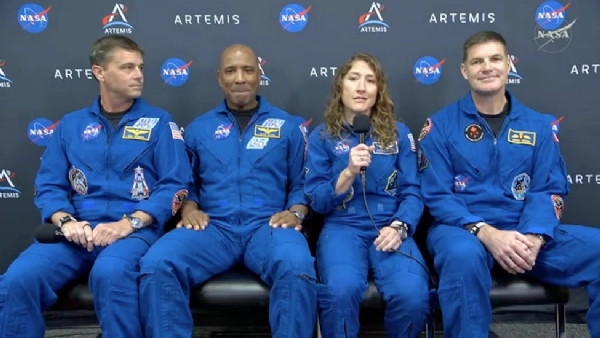
The crew – Commander Reid Wiseman, Pilot Victor Glover, Mission Specialist Christina Koch, and Mission Specialist Jeremy Hansen – said in a virtual press conference from Houston and later from Kennedy Space Center that they are “fully ready” for the “historic” launch.
Wiseman, speaking from quarantine just days before blast‑off, said, “This is the first time we’re actually flying humans aboard this vehicle. It feels surreal, but we’re at ease and excited to be here.”
Countdown and launch window
NASA has set the official countdown for Artemis II to begin around late Monday night, March 31, in Eastern Time, starting a 49‑hour, 40‑minute reverse tick‑tock sequence ahead of launch. If all systems remain nominal, the Space Launch System (SLS) rocket is expected to ignite and lift off from the Kennedy Space Center at 6:24 p.m. Eastern Daylight Time (EDT) on Wednesday, April 1.
The agency has a two‑hour launch window, so liftoff could occur anytime between 6:24 p.m. and 8:24 p.m. EDT on April 1, giving mission controllers some flexibility in case of minor technical or weather delays.
Meteorologists following the countdown have estimated roughly an 80 percent chance of acceptable weather conditions for launch at the Cape, a key factor in maintaining the April 1 target.
Mission profile: A lunar flyby
Artemis II is not a landing mission. Instead, it will send the four astronauts on a lunar flyby, looping around the far side of the Moon before returning to Earth.
The total mission is expected to last about 10 days, during which the crew will test the Orion spacecraft’s propulsion, navigation, communications, and life‑support systems in deep space – critical evaluations ahead of the planned lunar landing of Artemis III.
Once launched, the Orion capsule will remain in high Earth orbit for roughly 24 hours, where the team will conduct a thorough check of all systems. About 25 hours after launch, the spacecraft will begin its journey toward the Moon, using the Moon’s gravity to slingshot itself back toward Earth on what is called a free‑return trajectory.
The capsule will pass on the far side of the Moon, diving to within roughly 4,000‑odd miles (about 6,500 km) of the lunar surface, then turn back toward home without entering a stable lunar orbit or landing on the Moon.
This flight profile allows NASA to validate the spacecraft’s deep‑space capabilities and prepare the roadmap for permanent lunar exploration planned in later missions.
Reaching farther than any humans before
Ground systems manager Shaun Quinn, briefing reporters, emphasized that Artemis II will be the first human flight toward the Moon in 53 years, since the final Apollo mission, Apollo 17, in 1972. If the crew launches within the first two hours of the launch window on April 1, they are expected to venture 252,799 miles (about 406,000 km) from Earth, surpassing the distance record set by the Apollo 13 crew in 1970 by about 4,144 miles (6,700 km).
“That would take them farther from Earth than any human being has ever traveled,” Quinn said, framing the mission as a pioneer flight that opens the door for more ambitious lunar expeditions, including eventual landings at the Moon’s south pole.
Splashdown and future plans
At the end of the roughly 10‑day journey, the Orion capsule will execute a high‑speed re‑entry into Earth’s atmosphere and parachute to a splashdown in the Pacific Ocean, just off the coast of southern California near San Diego, around 8 p.m. EDT on April 10.
The total distance covered over the mission is estimated at roughly 685,000 miles (about 1.1 million km), much of it in the deep‑space environment beyond low Earth orbit.
NASA officials have described Artemis II as a test flight that lays the groundwork for later missions, including a planned uncrewed lunar orbit flight, followed by the Artemis III mission, which aims to put astronauts on the lunar surface starting from 2028 onward.
As the countdown clock ticks through the final hours, Wiseman and his crewmates have stressed that they are mentally prepared for any scenario, including delays or technical holds. “We’re 100 percent ready, whatever comes,” Wiseman said at a recent press briefing. “This is a once‑in‑a‑lifetime opportunity, and we’re ready to fly.”
For the world watching on April 1, the Artemis II launch will mark the start of a new chapter in human spaceflight, as astronauts once again head toward the Moon, not just to visit, but to begin a long‑term journey beyond Earth.
---------------
Hindusthan Samachar / Jun Sarkar

30 Mar 2026
Heading back to the Moon: NASA’s Artemis II crew declare themselves fully ready for April 1 launch

30 Mar 2026