Washington, 28 March (H.S.):
Donald J. Trump has delivered one of his most pointed rebukes yet to North Atlantic Treaty Organization (NATO) allies, openly questioning Washington’s long‑standing commitment to the transatlantic alliance amid a widening war with Iran that has now entered its fourth week.
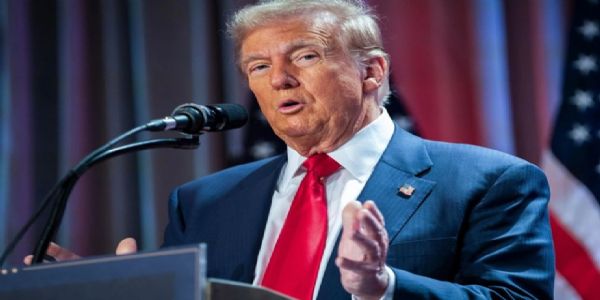
Speaking at an investment forum in Miami late Friday night, the US president declared that the United States “does not have to be there for NATO” if European members refuse to provide material support for the campaign against Tehran. The remarks, delivered in his signature confrontational tone, have reignited alarm in European capitals and cast fresh doubt over the future of the alliance’s core mutual‑defense guarantee.
Trump’s direct warning to NATO
Trump’s comments came two days after NATO as a body formally rejected his request that European members contribute troops, ships, or air assets to secure the Strait of Hormuz or directly back the US‑led strikes on Iranian military infrastructure. Speaking to an audience of investors, he said European allies had “always known” that Washington would stand by them in a crisis, but added that their current refusal to back Washington’s actions in Iran now called that reciprocity into question. “We would have always been there for them, but now, based on their actions, I guess we don’t have to be, do we?” he said, prompting laughter and applause from the crowd. “That sounds like a breaking story? Yes, sir. Is that breaking news? Well, that’s the fact. I’ve been saying that. Why would we be there for them if they’re not there for us? They weren’t there for us.”
US officials speaking on background described the remarks as a deliberate escalation, not a mere off‑the‑cuff jab. They said the president’s frustration was rooted in what he perceives as asymmetry: NATO countries have leaned heavily on tens of billions of dollars in US military aid for Ukraine, yet, in his view, have offered little more than political statements in the face of Washington’s air and missile campaign against Iran.
Trump has previously argued that NATO members have failed to meet defense‑spending benchmarks, and this week he framed their reluctance over Iran as evidence of a deeper reliability problem.
European leaders have not disguised their discomfort with the US decision to open direct hostilities against Iran after a series of missile strikes against Israeli and US targets in the Gulf. The European Union’s foreign policy chief, along with senior figures from France, Germany and the European Council, has repeatedly warned that the war risks triggering a wider regional conflagration, spiking oil prices and destabilizing global supply chains.
Several NATO members have pointed out that they were not consulted in advance of the US and Israeli military actions, and that the decision to expand the conflict went beyond the limited mandate of existing security structures in the region.
A senior diplomat from a founding NATO member state told reporters in Brussels that asking allies to join a war whose stated objectives remain unclear “flies in the face” of the alliance’s internal norms. “We don’t object because we’re unwilling to defend the West; we object because we weren’t part of the decision‑making and the risk‑assessment,” the official said. “If NATO is to remain credible, it cannot be used as a vehicle for Washington to drag other countries into conflicts that were planned in secret.”
Trump’s latest language reignites a long‑running debate about the durability of Article 5, NATO’s signature clause that treats an armed attack against one member as an attack against all. During his first term, the president repeatedly questioned whether the US would automatically rush to defend Baltic or Nordic allies if they were threatened, a stance that rattled European capitals and led to accelerated efforts to strengthen national defense budgets and command structures.
Over the course of 2025, some of that tension eased as NATO‑29 agreed to a more ambitious defense‑spending package and toned down their public criticism of Washington’s posture on Ukraine and China. But the Iran war has quickly reversed the trend.
In the Oval Office earlier this month, Trump told visiting Irish Taoiseach Micheál Martin that European allies who refuse to help secure the Strait of Hormuz or back US operations in Iran are “making a very foolish mistake.” He added that the US “does not need their help” to carry out its strategy, a formulation that echoes similar reassurances he gave at the Miami forum.
European officials have privately warned that such statements, if repeated in an election‑year context, could embolden adversaries who calculate that Washington’s willingness to rush to Europe’s defense is contingent on political convenience rather than treaty obligation.
Fallout in Brussels and beyond
NATO’s headquarters in Brussels has adopted a cautious tone, aiming to avoid a public war of words with the White House while signaling its discomfort.
In a statement issued on Friday evening, the alliance’s secretary‑general reiterated that the collective defense commitment remained “fully in force,” but acknowledged that members differed “on the best way to ensure security in the Gulf region.”
The statement also noted that several NATO‑29 governments have increased their maritime presence in the eastern Mediterranean and the Red Sea, actions that fall short of direct involvement in the Iran campaign but meet their own interpretations of burden‑sharing.
Defense analysts in Europe and Washington say Trump’s comments this week may accelerate a quiet shift that had already begun after Russia’s 2022 invasion of Ukraine. Some European countries are now quietly drawing up plans to assume greater responsibility for homeland defense, reduce reliance on US‑supplied intelligence and logistics, and build up independent strike capabilities in the likely event that Washington’s foreign‑policy priorities continue to diverge from those of the continent.
“The idea that the US can cut loose from Europe whenever it feels like it is not a theoretical concern anymore,” said a senior European security adviser who spoke on condition of anonymity. “Trump’s words are sharpening that sense of vulnerability.”
On the ground, the US‑led campaign against Iran has now entered its fourth week, with Washington firing hundreds of cruise missiles and precision munitions at Iranian missile‑launch sites, air defenses and naval assets along the northern Gulf. The US Department of Defense has stated that the aim is to degrade Iran’s ability to strike commercial shipping and regional allies, especially Israel, which has been hit by multiple waves of missile and drone attacks. Yet European governments have balked at joining that fight, arguing that a broader military escalation would hand Tehran a pretext to further disrupt global energy markets and deepen instability in the Middle East.
Trump’s remarks at the Miami forum suggest he is now framing the Iran war as a kind of test: one that measures not just Iranian resolve, but the willingness of NATO allies to stand beside Washington when the costs are political as well as military. That framing, in turn, has raised the stakes for a July summit in Washington, where NATO leaders are expected to confront the president directly over the future of the alliance’s security architecture. If Trump continues to insist that the US does not “have to be there for NATO” unless allies sign on to his preferred conflicts, European leaders may face a stark choice: either accept Washington’s definition of shared security, or begin to build a more autonomous defense posture of their own.
For now, however, the alliance’s official line remains that the partnership endures—even as the language of its most powerful member grows ever more conditional.
---------------
Hindusthan Samachar / Jun Sarkar