Tehran, 28 March (H.S.):
Iran has claimed a major strike on US naval assets in the Gulf, saying its forces hit six US tactical vessels near the Kuwaiti port of Al‑Shuwaikh and on the Dubai coast, with three landing‑craft utility ships sinking and the other three left burning. The Islamic Revolutionary Guard Corps (IRGC) has described the operation as the 84th round of what it calls “Operation True Promise 4,” and said a large number of American troops were killed in the missile and drone attacks.
Washington has not yet confirmed Iran’s casualty claims, but the assault marks one of the most direct and damaging blows yet to US forces in the current war with Iran.
Six US vessels hit in Al‑Shuwaikh and Dubai
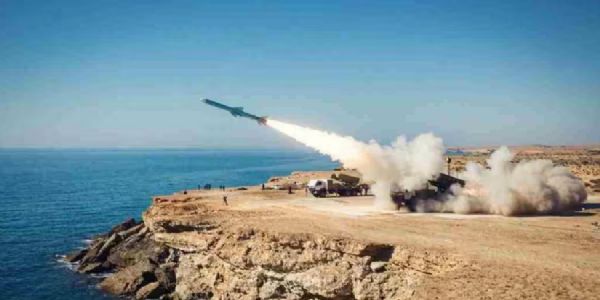
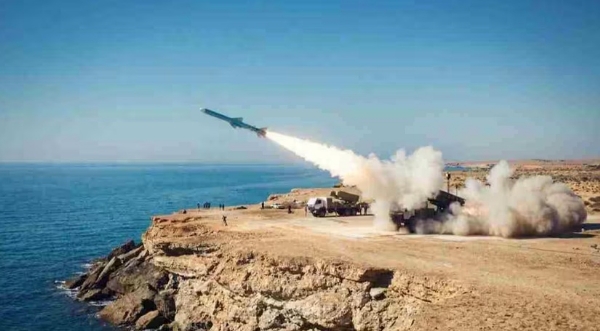
According to a late‑Friday statement from the IRGC Public Relations Office, Iranian forces used a mix of ballistic missiles and Kadr‑380 cruise missiles to target six US Landing Craft, Utility (LCU) ships moored at Al‑Shuwaikh Port near Kuwait City. The statement claims that three of the vessels sank immediately after being struck, while the remaining three were engulfed in flames and rendered inoperable.
The IRGC Naval forces have framed the operation as a precision strike on “Zionist‑American terrorists” and described it as a continuation of their broader campaign to degrade US military presence in the Gulf.
On the same night, IRGC‑linked Tasnim News Agency reported that Iranian forces also launched drone attacks against an American drone unit stationed at a beachfront hotel in Dubai. The report says troops from the US drone unit were hit by Iranian drones, and that their tactical equipment was destroyed. Tasnim described the strikes as part of a coordinated effort to punish US and Israeli forces for their bombardment of Iranian nuclear and military sites earlier in the week.
Iranian officials have not released a detailed breakdown of casualties among the US drone unit, but the statement insists that “a large number” of American soldiers were killed.
Washington’s cautious response
US defense officials speaking on condition of anonymity have acknowledged that multiple American vessels were hit in the Gulf on Friday, but have declined to confirm the exact number of ships lost or the scale of American casualties. They did say that the IRGC’s claims of “massive” death tolls may be exaggerated, and pointed out that the US Navy has long prepared for such asymmetrical missile and drone attacks in the region.
The Pentagon has not publicly disputed Iran’s description of the struck vessels as LCUs, which are small, relatively inexpensive landing craft used to ferry troops and supplies, rather than major warships.
The broader context of Friday’s attack lies in the 28th day of an increasingly intense war between Iran on one side and the United States and Israel on the other. In the past four weeks, US‑Israeli forces have conducted repeated strikes on Iranian nuclear facilities, air‑defense installations and missile bases, while Iran has responded with barrages of missiles and drones aimed at Israeli cities, US bases in the Gulf and carrier groups at sea. The Al‑Shuwaikh and Dubai strikes fit a pattern of Iranian efforts to bring the conflict to the water’s edge, where US land‑based airpower and missile defenses are less dominant.
Strategic stakes in the Gulf
Al‑Shuwaikh Port, just south of Kuwait City, has served as a key logistics hub for the US‑led coalition in the Gulf, handling everything from spare parts and fuel to troop rotations for forces operating out of nearby bases. By targeting LCUs there, Iran is signaling that it can inflict tangible damage on the US military’s ability to move men and materiel along the Gulf coast, even if it does not yet possess the capability to sink a large aircraft carrier or destroyer.
The choice of Dubai as a secondary target also underscores Tehran’s willingness to strike assets in what are normally considered stable commercial and tourism zones, turning busy ports and beaches into potential battlefields.
US officials have warned that any escalation in attacks on port facilities and civilian‑adjacent areas could further destabilize regional trade and energy flows. The Gulf already accounts for a major share of global oil exports, and repeated strikes on ports, refineries and shipping lanes have pushed insurance and freight costs upward.
Western diplomats in Geneva and Brussels have called on Iran and the US to step back from the brink, arguing that another round of tit‑for‑tat attacks risks triggering a wider regional war that would spill far beyond the immediate theater.
Iran’s narrative of “True Promise 4”
Iran is framing the Al‑Shuwaikh and Dubai strikes as a centerpiece of Operation True Promise 4, a campaign it says has already run 84 separate waves of missile, drone and naval attacks against US and Israeli forces. The IRGC has portrayed the operation as a war of deterrence, arguing that only repeated, visible hits on American assets will force Washington to agree to a ceasefire or negotiations. The language in Friday’s statements is notably harsh, describing US troops as “terrorists” and the Gulf littoral as a domain where Tehran can “cleanse” foreign military presence with its own weapons systems.
For the US, however, the downgrade of some of its smaller vessels does not erase the qualitative edge its Navy holds in big‑deck ships, submarines and long‑range airpower. The real test may lie in how Washington chooses to respond politically as well as militarily. After a similar Iranian strike on a US destroyer‑like platform earlier in the conflict, the Pentagon opted for a limited retaliatory strike without broadening the war. If the pattern repeats, it could suggest that both sides are walking the line between demonstrating resolve and avoiding a full‑scale regional war—but each new missile salvo makes that line harder to hold.
---------------
Hindusthan Samachar / Jun Sarkar

28 Mar 2026