Washington, 27 March (H.S.):
US President Donald Trump has publicly floated the possibility of taking control of Iran’s oil supply, signalling that regime‑level pressure over energy resources remains a live option even as he extends a pause on attacks targeting Iranian power plants.
The remarks come against a backdrop of sustained regional conflict, resilient Iranian crude exports, and deepening US‑Iran talks that both sides describe with marked ambiguity.
Trump’s ‘Option’ on Iranian Oil
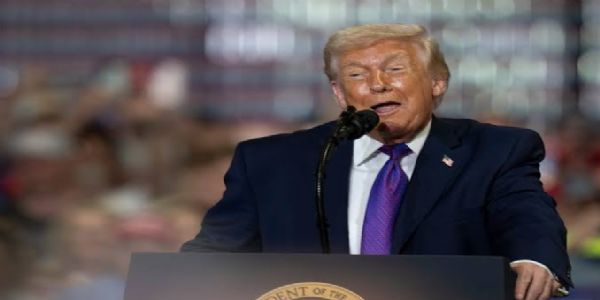
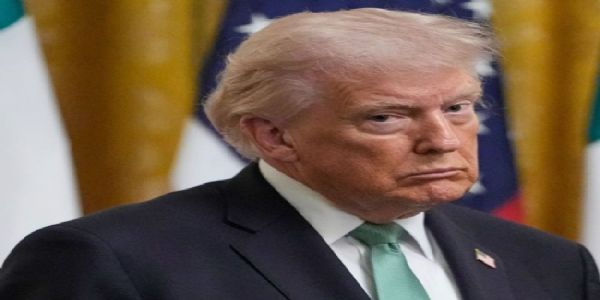
Speaking at the White House on Thursday during a Cabinet meeting, Trump told reporters that seizing Iran’s oil “is an option,” without spelling out any concrete military or economic plan.
Asked about the idea of taking control of Tehran’s hydrocarbon flows amid the ongoing Middle East crisis, he said, “I mean, I wouldn’t talk about it, but it’s an option,” underscoring that Washington is weighing maximal leverage over a country that still sits atop one of the world’s largest reserves.
Trump went on to cite the US‑led transition in Venezuela earlier in the year, where former president Nicolás Maduro was forced from power and the US began coordinating with acting president Delcy Rodríguez, as a model for how Washington might manage a future oil setup in another region.
He claimed that the United States has reaped “billions and billions of dollars” from the Venezuelan arrangement, describing it as a de facto “joint venture” in which Washington has captured substantial financial upside.
Energy Security and Hormuz Tensions
At the same time, Trump has sought to downplay risks to US energy security, arguing that Washington’s domestic oil reserves render it largely immune to shocks around the Strait of Hormuz.
“We have so much oil. Our country is not affected by this. We have more, we have twice the amount of oil as Saudi Arabia or Russia, and soon it’ll be three times the amount,” he said, reprising his long‑standing line on US energy independence.
On the regional front, Iranian Light crude has remained one of the few major grades able to transit the Strait of Hormuz, allowing Tehran to capitalise on higher global prices and a sharply narrowed discount to Brent.
Bloomberg‑based estimates, drawing on Tankertrackers data, suggest Iran has earned roughly 139 million dollars per day from exports of its flagship grade so far in March, up from about 115 million dollars per day in February.
Extended Pause on Energy‑Plant Campaign
Compounding the mixed signals, Trump has also extended the deferral period for US‑led strikes on Iranian energy infrastructure. On social media platform Truth Social, he announced that the pause on attacks against Iranian power plants and energy facilities would run for an additional 10 days, effectively pushing the deadline to April 6, 2026, at 8 p.m. Eastern Time.
Trump framed the extension as a response to a request from the Iranian government, and he claimed that direct and indirect talks with Tehran were “going well.”
However, Iranian officials have contradicted that characterisation, with some asserting that no formal negotiations have taken place and cautioning that Washington’s supposed openness remains unverified.
Strategic Bluff and Regional Fallout
Analysts say Trump’s language on Iranian oil mirrors a broader pattern of calibrated ambiguity designed to fracture Tehran’s decision‑making without immediately committing to a high‑risk invasion‑style scenario. Senior US security officials stress that the threat of targeting Iran’s revenue lifelines—its energy exports—serves as leverage in any eventual deal, even as Israel and the United States continue periodic air and missile campaigns inside Iranian territory.
For Iran, the combination of robust daily oil income and a still‑uncertain US posture on direct resource seizure has created a tense bargaining environment.
As the Strait of Hormuz remains effectively contested and global crude prices linger above 100 dollars a barrel for Brent, both Washington and Tehran appear to be treating oil not just as a commodity, but as a central weapon in the broader struggle for regional dominance.
---------------
Hindusthan Samachar / Jun Sarkar