New Delhi, 18 March (H.S.):
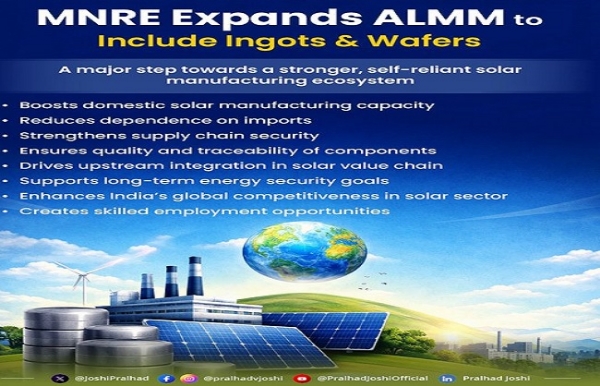
The Central government has expanded the Approved Models and Manufacturers (ALMM) framework to cover solar ingots and wafers, effective from 1 June 2028, in a move aimed at strengthening domestic manufacturing, reducing import dependence and advancing India’s ambition to become a global hub for solar‑energy production.
The decision positions India’s solar‑manufacturing ecosystem for higher value addition along the entire supply chain.
Union Minister for New and Renewable Energy Pralhad Joshi said this extension is a “decisive step” in building a robust domestic solar manufacturing base. He stated that the move will boost local production, enhance the resilience of the solar supply chain, cut reliance on imports and help ensure higher‑quality standards across the solar value chain.
Under the revised order of the Ministry of New and Renewable Energy (MNRE), the ALMM List‑3 for ingots and wafers has been added, extending the existing ALMM framework—earlier applicable only to modules and cells—to the upstream segment of the solar PV chain. The new provisions also safeguard ongoing projects by including transitional safeguards and grandfathering clauses.
By progressively tightening sourcing norms across modules, cells, ingots and wafers, the administration is pushing domestic content higher along the value chain, which is currently heavily dependent on imported ingots and wafers.
Since the introduction of the ALMM regime, domestic solar manufacturing capacity has recorded a sharp rise. ALMM List‑I (solar PV modules), notified in 2021, has expanded from about 8.2 gigawatts (GW) to roughly 172 GW in the domestic‑manufacturer pipeline, reflecting strong investor confidence in the regime.
Likewise, ALMM List‑II (solar PV cells), introduced more recently, has already reached around 27 GW within the first seven months, underscoring the framework’s effectiveness in attracting private capital into vertically integrated solar manufacturing.
---------------
Hindusthan Samachar / Jun Sarkar