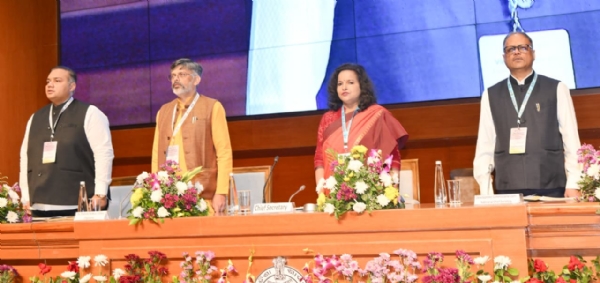
Bhubaneswar, 27 February (H.S.): Emphasising the need for a paradigm shift in policymaking, Prafulla Ketkar, Editor of Organiser, on Friday said Odisha must shed the “hangover of colonialism” and move beyond a “one-size-fits-all” approach to achieve the goals outlined in the State government’s ambitious document, Vision Odisha 2036 and 2047.
Speaking at the inaugural session of the two-day state-level policy consultation “Vikash Manthan 1.0” at the Convention Centre of Lok Seva Bhavan here, Ketkar observed that while the vision document is comprehensive and dynamic, its success depends on adopting an approach rooted in Odisha’s civilisational ethos and socio-cultural realities.
“The approach required to achieve the targets of Vision Odisha 2036 and 2047 must be based on ‘self’ (swa) — our own strengths, traditions and contemporary needs. We must move away from borrowed frameworks and colonial-era mindsets. A uniform template cannot address the diverse aspirations of our society,” he said.
Ketkar underlined that policy implementation must take into account the unique ethos and cultural consciousness of each region and community. Development, he said, should be facilitated in accordance with local traditions and knowledge systems rather than by imposing externally designed models.
Recalling remarks made two years ago by Mohan Bhagwat, Sarsanghchalak of the Rashtriya Swayamsevak Sangh, Ketkar noted that although Bharat attained political independence on August 15, 1947, the journey towards true freedom continues. “In terms of systems, mindset and psychology, we are yet to be fully free,” he said, describing the observation as significant for contemporary policymaking.
He pointed out that Bharat has withstood successive invasions by Greeks, Shakas, Huns, Kushans, Turks, Mughals, Mongols, the Dutch and the British, yet continues to exist as a cohesive nation. In contrast, he said, indigenous populations in countries such as America and Australia were drastically reduced following foreign invasions. Bharat’s enduring unity, he asserted, stems from its strong sense of civilisational selfhood and continuity over thousands of years.
Highlighting India’s cultural unity, Ketkar referred to the shared spiritual concepts from Kailash to Kanyakumari, and the pan-Indian reverence for the Ganga, Puri and Rameswaram. He noted that the Rath Yatra on Ashadha Shukla Dwitiya has been observed for generations, and that no ruler in Indian history altered the traditional Panchang, reflecting civilisational continuity.
Drawing a philosophical contrast, he said the West views time as linear, whereas Bharatiyas perceive it as cyclical. Even a common person, he remarked, believes that though Kaliyuga is ongoing, Satya Yuga will return. He added that the Indian concept of “bhugol” indicates an early understanding of the Earth’s spherical nature.
Ketkar concluded by stating that while Western thought often compartmentalises ideas and frames the relationship as man versus nature, the Bharatiya worldview is integral, recognising human beings as an inseparable part of nature.
---------------
Hindusthan Samachar / Monalisa Panda

27 Feb 2026
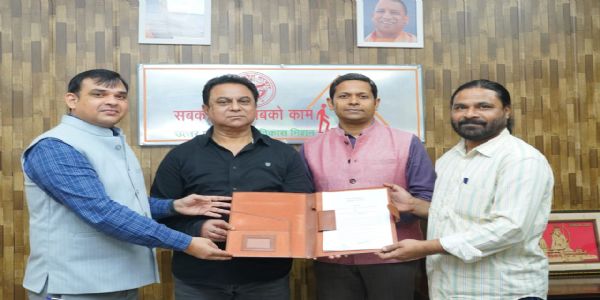
Skill Development Mission signs MoU with 6 institutions, youth to get future-ready training
27 Feb 2026