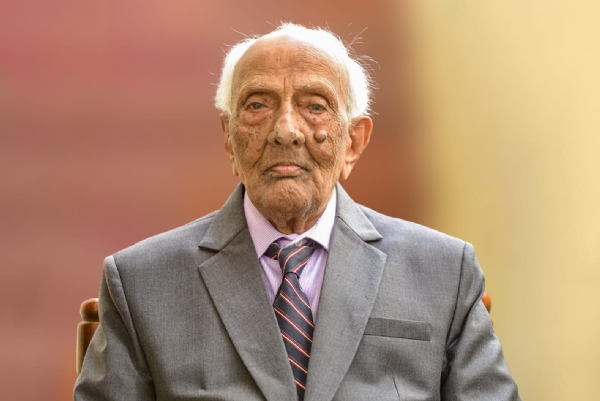
Bengaluru, 24 February (H.S.): Prof. C Mahadevappa.
Prof. C Mahadevappa, a popular Kannada teacher cum research scholar in ancient literature who turned 100 years in July 2022, has come out with his latest publication, ‘Ekottara Shathasthala’, a rare commentary on the mystic Shiva Sharana-vachanas of olden times by Siddhalinga Swamiji, the head of katttige Halli Lingayat Matha, a subsidiary of Chitadurga Muruga Matha.
Though this was one of his earliest editing efforts in textual criticism based on deciphering various palm leaf manuscripts, (a method/skill of editing old texts popularly known as ‘Grantha Sampadane’), the content of the title is strangely coincidental with his age 101 years completed, with the 101 steps for salvation delineated by 12th century sharanas and their probable predecessors too.
Born in a family of a school teacher turned butter merchant in Sosale village in Mysuru district in July 1922, he had worked as a coconut burfi vendor in the local bus stands to support the family income as the eldest child in the family.
An observant foreigner even clicked the child vendor’s photo which eventually was lost over time. His village house was across the Cauvery, and one could cross the river during normal days from Gargeshwari village on foot, which would save the person an hour’s extra walk via the T Narasipura bridge.
He would walk 38 km from Mysuru to save his parents a bus fare of 35 paise.
He initially learnt reading palm leaf manuscripts from his father S B Chenna Basavappa, a skill that came very handy in his maiden job in the Oriental Library of Mysuru University after passing out of B.A. (Honours) in Kannada.
Since there were no high school facilities locally, he had to move to Mysuru, where free residential hostel facilities were offered by rich philanthropists and religious institutions for the poor. With his good marks in science and maths subjects, he could have chosen popular streams but opted Honours course in Kannada. It was his fortune that the subject was taught by all-time great teachers like D L Narasimhachar, N Anantha Rangachar, K V Puttappa (Kuvempu), A R Krishna Shastri, G Venkatasubbaiah and T N Srikantaaiah among others.
After joining as a lecturer in Mysuru university colleges in the initial days, he was taking classes dressed in traditional attire — dhotis and the long coat. His teacher, now his senior colleague, Krishna Shastriji, advised him that he should switch over to modern day clothings, suit, boots and. The ‘pundit attire’, Prof Shastriji said should end with his generation. This is advice, Mahadevappa follows in all his public appearances today.
As a young lecturer, the professor had to teach his students translation of English passages to Kannada that would fetch upto 20 marks in examinations. He found that there was no proper teaching materials for the teachers. Thus began his work on a maiden self-published project titled ‘College Translation’ in 1949. The book was an instant hit in those days, earning praises from his teachers and students alike.
Kuvempu, his teacher commented, “College Translation was the first of its kind in Kannada”. The book was prescribed for the Inter and Degree students of Mysuru University.
This was followed by another translation effort in 1956 where he translated the famous English poet cum scholar of poetics, P B Shelly’s passage ‘A Defence of Poetry’ to Kannada with the title ‘Kavya Samarthane’.
His teacher, Prof. V A Thyagarajan opined that the work offered the readers a ‘scholarly and forceful translation which was true to the spirit of the original passage’.
‘Bhavachintaratna’ was his first edited publication in 1954, a Kavya of 15 CE AD poet Gubbi Mallanarya. It drew appreciation from D. L. Narasimhachar, regarded as an authority on editing ancient texts most scientifically. He opined, “I am fascinated by the introduction. You have brought together all available information in Tamil and Telugu. You have broken new ground and achieved something more than other previous writers in the field”.
Noted Sanskrit and Kannada scholar Dr K Krishnamurthy, extolled the efforts of Mr Mahadevappa’s ‘Udayadityalankaram’, an edited Kannada Alankara Shastra text and his interpretation for the first time, the opening and concluding poems of the text that were missing in the past popular editions. These poems throw new light on many historical aspects, like region and contemporary personalities of the times. “I am amazed at the way he has minutely identified and dug out the hidden shleshalankara in the poem ‘varagomedhakavispura …… vasanan bhavatsangadim’ to show how the poet Nagavarma had praised King Udayaditya.
Another new fact that emerged here was that the author belonged to the Veerashaiva faith, along with supporting evidence from another poet, Shadakshara Deva, of the later times.
‘Prabhu Geetha’, a Sanskrit translation of Allama Prabhu (12 CE AD) vachanas by 15th century scholar Magge Mayideva, a revered Rajaguru of Vijayanagara King Proudhadeva Raya II, where Mahadevappa made a mark.
The importance of this work is very unique in many senses. Usually, all ancient Kannada works have been from Sanskrit to Kannada, but Prabhu Geetha happens to be just the reverse of this order. In this instance, Sanskrit literature is seen borrowing from Kannada, the language of the region.
Another critical aspect is that the text is edited on the basis of a single palm leaf manuscript that was retrieved from the jaws of white ants. Till this work saw the light, scholars knew about the existence of such a text with wild guesses and speculations about the content.
Understanding the importance of the work, the then Vice President of India Bhairon Singh ji Shekhawat ji, released Prabhu Geetha, at his official residence in the capital Delhi, in the august presence of former Chief Justice of India Ranganath Misra in 2001.
The book has an elaborate introduction in English to reach out to wider national and global readership. Another edition with a Kannada preface and script was brought out in the same year.
The Professor is the first scholar to link Aajeevikas, an ancient religious sect written off as a ‘vanquished religion’ with a major demographic group like Veerashaiva, in Karnataka, with appropriate historical and literary evidence from vachana and old Kannada literature.
His research papers titled ‘Aajeeva Madhusmriti’ will back take the antiquity of Veerashaivism/Lingayatism back to the times of Makkali Gosala, an elder contemporary of Goutama Buddha and Jain Teerthankara Vardhamana Mahavira.
Noted Sanskrit scholar Dr S K Ramachandra Rao in his preface, remarked, “Prof. Mahadevappa, had skilfully linked the ‘Shunya Dhyana’ concept of Gosala with ‘Bayalu’ with philosophy of the Sharanas and ‘aaru hiriyaru’, with six elder famous philosophers in east India, with necessary quotes and references from vachanas.
The professor has authored several books concerning poet Nagavarma, whose existence in Kannada literary world is shrouded in mystery for decades. Scholars to date are a confused lot about the number of poets by name ‘Nagavarma’, who has authored texts in every literary format, ranging from kavya, alankara, grammar, and lexicons.
His research backed by literary evidence, has concluded that all these works attributed to two or more poets by name ‘Nagavarma’ have been the works of a single author. This scholarly research has been acknowledged as correct by Prof. G Venkatasubbaiah, a highly respected Kannada scholar cum lexicographer of recent times.
Yet another discovery of the professor is about the nativity of the highly acclaimed Sanskrit poet Bana Bhatta with Tadapatri town in present day Andhra Pradesh, based on a stone inscriptional evidences. Otherwise, Bana Bhatta has been claimed by several places in India.
Nighantu Raja, a lexicon synonyms of ayurvedic substances, was published in 2019, is a Sanskrit text written by Ayurvedacharya Narahari Pandita. The old lexicon is in shloka format on the lines of the popular text Amara Kosha.
‘Ekottara Shatasthala’, is the latest text published by Prof. Mahadevappa, which is yet to be released officially. The book is available in popular online publication markets.
Hindusthan Samachar / Manohar Yadavatti
24 Feb 2026