New Delhi, 09 November (H.S.):
The growing popularity of Vande Bharat Express trains among passengers is evident from the fact that occupancy on one of the country's routes has reached as high as 189.35 per cent. This indicates that passenger demand was nearly 1.9 times the number of seats available over the course of the journey. Approximately 3.98 crore passengers travelled on Vande Bharat trains during the financial year 2025–26, marking an increase of nearly 34 per cent compared with the previous financial year.
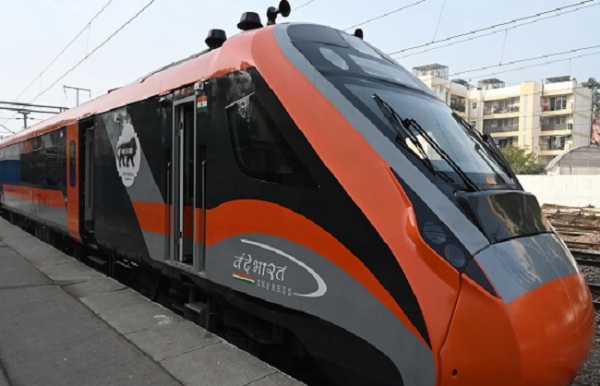
Amid this rising demand, Indian Railways has expanded the Vande Bharat network beyond chair-car services to include sleeper trains. Significantly, the same New Delhi–Varanasi route on which the country's first Vande Bharat Express was introduced in February 2019 has recently seen the launch of a new Vande Bharat Sleeper service. Railway Minister Ashwini Vaishnaw flagged off the train, and its regular commercial operations commenced on November 2. The Mangaluru–Thiruvananthapuram route in southern India recorded the highest occupancy, while the first Vande Bharat Sleeper service between Howrah and Kamakhya also registered a combined occupancy of 114.54 per cent.
Figures for the financial year 2025–26, recorded in official Railway documents, underline the growing demand for Vande Bharat services. The Public Relations Directorate of the Railway Board had sought information regarding the earnings, occupancy and punctuality of Vande Bharat trains. In response, the TG-1 Branch provided details of occupancy across various services.
The highest occupancy was recorded on the Vande Bharat Express operating between Mangaluru Central and Thiruvananthapuram Central. Train number 20632, running from Thiruvananthapuram Central to Mangaluru Central, registered an occupancy rate of 189.35 per cent, while train number 20631, operating in the opposite direction from Mangaluru Central to Thiruvananthapuram Central, recorded 174.77 per cent. Thus, occupancy on the service exceeded 170 per cent in both directions.
At first glance, an occupancy rate exceeding 100 per cent may appear surprising. If the number of seats on a train is fixed, how can its occupancy reach 189 per cent? The explanation lies in the way occupancy is calculated. It does not represent the number of passengers physically present on the train at a particular moment; rather, it measures the utilisation of seats over the entire journey.
On long-distance trains, passengers board and alight at different stations along the route. Once one passenger gets off, another can occupy the same seat from a subsequent station and travel to a different destination. Consequently, a single seat may be used by several passengers across different sections of the journey, allowing the overall occupancy rate to exceed 100 per cent. Therefore, an occupancy rate of 189.35 per cent does not mean that nearly twice the train's prescribed seating capacity was occupied simultaneously. Instead, it reflects the cumulative demand for and utilisation of seats along the route.
The rising popularity of Vande Bharat trains is also reflected in the number of passengers travelling on them. According to the Ministry of Railways, approximately 3.98 crore passengers used Vande Bharat Express services in FY 2025–26, compared with 2.97 crore in FY 2024–25. This represents an increase of nearly 34 per cent in passenger numbers in a single year.
Since the launch of the service, more than 9.1 crore passengers had travelled on Vande Bharat trains by April 2026, with approximately one lakh trips completed during this period. The New Delhi–Varanasi route has emerged as the busiest in terms of passenger numbers, having carried more than 73 lakh passengers so far.
In response to the growing demand, Indian Railways has also begun expanding its Vande Bharat Sleeper services. The country's first Vande Bharat Express was introduced on February 15, 2019, on the New Delhi–Kanpur–Prayagraj–Varanasi corridor. Nearly seven years later, the sleeper version of the train has also been introduced on the same route.
On October 31, 2026, Railway Minister Ashwini Vaishnaw and Uttar Pradesh Chief Minister Yogi Adityanath jointly flagged off the Varanasi–New Delhi Vande Bharat Sleeper train from Varanasi. Train number 27421 operates from Varanasi to New Delhi, while train number 27422 runs in the reverse direction. Regular commercial services commenced on November 2. It is the first Vande Bharat Sleeper service in Uttar Pradesh and the second such service in the country.
The country's first Vande Bharat Sleeper train was introduced between Howrah and Kamakhya in January 2026. According to the available figures for FY 2025–26, train number 27575, operating from Howrah to Kamakhya, recorded an occupancy rate of 127.66 per cent, while the return service, train number 27576, from Kamakhya to Howrah, registered 103.54 per cent. The combined occupancy of the sleeper service in both directions stood at 114.54 per cent. This indicates that the Vande Bharat Sleeper, introduced to cater to long-distance overnight travel, has also received a positive response from passengers.
In November 2026, another Vande Bharat Sleeper service was introduced between Bengaluru and Mumbai, taking the number of sleeper service pairs to three.
The four existing Vande Bharat Chair Car services on the Delhi–Varanasi route have also recorded occupancy rates exceeding 114 per cent. Train number 22415, operating from Varanasi to New Delhi, registered an occupancy of 117.26 per cent, while train number 22416, running from New Delhi to Varanasi, recorded 114.05 per cent.
The second pair of services on the same route also reported high occupancy. Train number 22435, operating from Varanasi to New Delhi, recorded 117.25 per cent, while train number 22436, running from New Delhi to Varanasi, registered 115.19 per cent. Thus, all four chair-car services on the route recorded passenger demand exceeding their available seating capacity.
This raises another question: how many Vande Bharat trains are currently operating across the country, and how much revenue are they generating for Indian Railways?
According to figures released by the Ministry of Railways on July 23, a total of 81 pairs, or 162 individual directional services, of Vande Bharat Chair Car trains were operating across the country. Since then, three pairs of sleeper services have been introduced on the Howrah–Kamakhya, Varanasi–New Delhi and Bengaluru–Mumbai routes.
Combining the 81 pairs of Chair Car services with the three pairs of Sleeper services gives a total of 84 pairs, or 168 individual directional services, across the country. Here, one pair refers to two services operating in opposite directions between the same destinations.
The revenue generated by Vande Bharat trains is equally noteworthy. However, the Railways has not made public a consolidated figure covering the total earnings of all Vande Bharat services across the country. According to a reply given in Parliament, the Railways does not maintain a separate train-wise revenue record, and earnings from Vande Bharat services are included in the overall passenger revenue of Indian Railways.
Nevertheless, regional figures provide an indication of the revenue generated by these trains. Vande Bharat services operated by Southern Railway earned passenger revenue of Rs. 540.65 crore in FY 2024–25. This increased to more than Rs. 803.86 crore in FY 2025–26, representing a rise of approximately Rs. 263 crore in one year. It is important to note that these figures relate exclusively to Vande Bharat services under Southern Railway and do not represent the earnings of the entire Vande Bharat network across India.
The total passenger revenue of Indian Railways stood at approximately Rs. 80,000 crore in FY 2025–26, compared with Rs. 75,500 crore in FY 2024–25, marking an increase of around 5.96 per cent. However, the separate contribution of Vande Bharat services to this overall passenger revenue has not been specified in the publicly available figures.
The combined occupancy rate of all Vande Bharat Chair Car trains across the country stood at 99.10 per cent in FY 2025–26. In comparison, the available figures for Vande Bharat Sleeper services showed an overall occupancy rate of 114.54 per cent. It is important to note that the sleeper occupancy figures relate to the Howrah–Kamakhya service. The newly introduced Varanasi–New Delhi and Bengaluru–Mumbai sleeper services are not included in the occupancy data for that financial year, as they commenced operations in November 2026.
Seven years after its introduction, the Vande Bharat network has expanded beyond chair-car travel to include sleeper services. An occupancy rate of 189.35 per cent on a route in southern India, a combined occupancy of 114.54 per cent for the existing sleeper service and a 34 per cent annual increase in passenger numbers all point to the growing demand for these trains.
During FY 2025–26, approximately 3.98 crore passengers travelled on Vande Bharat services, compared with 2.97 crore in the previous financial year, representing growth of nearly 34 per cent. By April 2026, the cumulative number of passengers carried by these trains had crossed 9.1 crore. The New Delhi–Varanasi route alone had served more than 73 lakh passengers.
---------------
Hindusthan Samachar / Jun Sarkar

18 Aug 2026