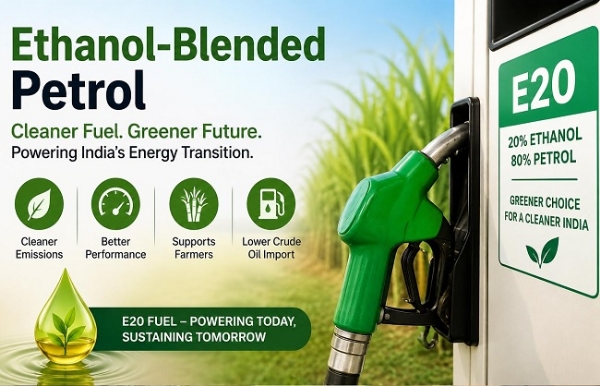
New Delhi, 07 November (H.S.): The Central Government on Saturday categorically rejected claims that petrol sold at certain fuel stations in Karnataka contained ethanol in excess of the prescribed limit. It also questioned the sampling and testing procedures adopted by the state, stating that all 56 samples tested in Karnataka as part of a nationwide fuel quality monitoring exercise had complied with the prescribed E20 standards.
In a statement, the Ministry of Petroleum and Natural Gas said that, according to public sector oil marketing companies (OMCs), all 893 samples of E20 petrol collected from retail outlets across 27 states and Union Territories had fully complied with the quality specifications laid down under the Bureau of Indian Standards (BIS) standard IS 17021.
The ministry said it had taken note of a statement issued by the Karnataka Government's Department of Food, Civil Supplies, Consumer Affairs and Legal Metrology, which claimed that petrol sold at certain retail outlets in the state contained between 26 per cent and 31 per cent ethanol.
In response, the three public sector oil marketing companies — Indian Oil Corporation Limited (IOCL), Bharat Petroleum Corporation Limited (BPCL) and Hindustan Petroleum Corporation Limited (HPCL) — clarified that the claims, as reported, were inconsistent with the findings of tests conducted in accordance with prescribed legal and technical procedures.
The ministry said that E20 petrol supplied by these three oil marketing companies across the country, including Karnataka, conforms to the Bureau of Indian Standards' specification IS 17021 for ethanol-blended motor gasoline. The companies also raised concerns over the sampling procedure and testing methodology adopted for the October 2026 exercise.
The ministry further stated that the Motor Spirit and High Speed Diesel (Regulation of Supply, Distribution and Prevention of Malpractices) Order, 2005, issued under the Essential Commodities Act, 1955, governs the relevant procedures. The Marketing Discipline Guidelines (MDG), 2024, also prescribe a standardised process for sampling, preservation of samples, testing and communication of results.
According to the ministry, a preliminary technical assessment conducted by the OMCs also raised concerns regarding the ethanol-testing methodology mentioned in the certificates.
Under IS 17021:2018 (Amendment No. 3, August 2025), the ethanol content in E20 fuel must be determined using specified testing methods. These include Fourier Transform Infrared Spectroscopy (FTIR) under ASTM D5845, the water extraction method under Annex C, or Gas Chromatography under ASTM D4815/D6839.
The Centre for High Technology (CHT), functioning under the Ministry of Petroleum and Natural Gas, continuously monitors ethanol blending levels and fuel quality at OMC retail outlets.
As part of an exercise conducted by the OMCs and the CHT Quality Coordination Cell (QCC), a total of 893 E20 fuel samples were collected from depots and retail outlets operated by IOCL (330), BPCL (280) and HPCL (283) across 27 states and Union Territories. The samples were tested at refinery and OMC quality-control laboratories to determine their ethanol content in accordance with Annex C of IS 17021.
All 893 samples were found to contain ethanol within the prescribed range of 19–21 per cent.
The ministry also explained that ethanol blending at OMC refineries and depots is carried out through established, calibrated and controlled systems. The process involves automated calibration and proportioning mechanisms at both refinery and depot levels, with blending undertaken in accordance with prescribed standards and quality-control protocols. It is, therefore, neither a manual nor an arbitrary process of mixing ethanol with petrol.
The ministry further said that claims suggesting an annual mileage loss of approximately Rs. 62,000 crore for consumers and repair expenses of around Rs. 39,000 crore for vehicles — amounting to a combined figure of nearly Rs. 1.01 lakh crore — should be examined carefully on the basis of established technical evidence.
It is noteworthy that more than 30 crore two-wheelers and over four crore four-wheelers have been running on E20 fuel for more than three years. More than six crore people visit petrol pumps every day to refuel their vehicles. The ministry argued that if there were any major quality-related problems with E20 fuel, incidents of vehicle damage would have emerged on a significant scale.
---------------
Hindusthan Samachar / Jun Sarkar