




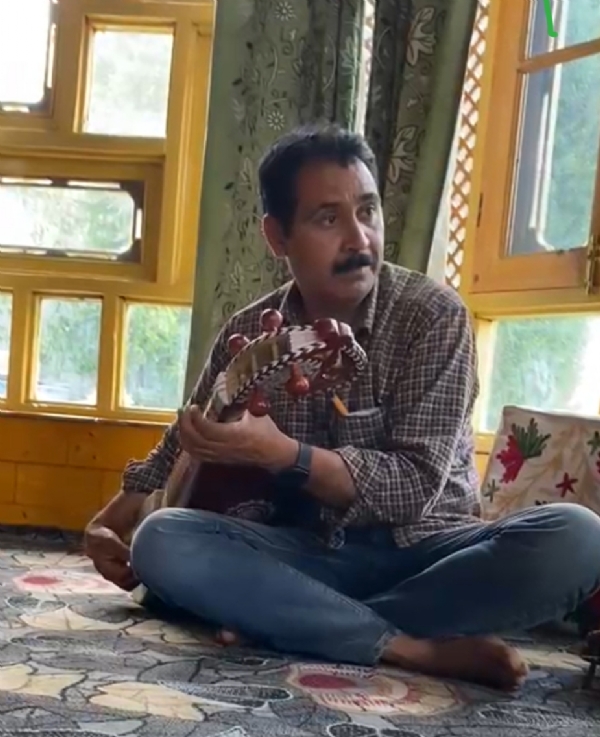
Srinagar, Nov 06 (HS): The rabab, regarded as the soul of Kashmiri music, is known for its distinctive shape and beauty. It is carved from mulberry wood and has 16 to 17 strings.
An ancient plucked-string instrument believed to have originated in Afghanistan, the rabab is thought to have reached Kashmir centuries ago, possibly during the reign of Sultan Zain-ul-Abidin in the 15th century. It gradually became an integral part of the Valley's folk music.
Considered the heart of Kashmiri Sufi and traditional folk music, the rabab continues to hold cultural significance. While rababs made in Kashmir are used for musical performances, many people now also buy them for their aesthetic appeal, to display in their homes or give as gifts.
Mushtaq Ahmad Dar, a craftsman from Narbal in central Kashmir’s Budgam district, says he is getting a steady stream of orders for rababs, not just from Kashmir but from other parts of the country and from abroad.
“I am devoted to making rababs with all my heart,” he told Hindusthan Samachar. “I get orders not only from Kashmir but from different parts of the country and from abroad.” He says the Kashmiri rabab is building a name for itself abroad as well.
Recalling a story, he said: “A local lawyer placed an order with me for a rabab and said he wanted to send it as a gift to a close relative living in America. It cost Rs 35,000. When he came to my workshop to collect it, he changed his mind after seeing it.”
“He said he would buy it for himself and keep it at home as a showpiece. Then he ordered more rababs and bought three rababs and a sarangi from me at a good price.”
Dar has set up a two-room workshop at his home, where he works from morning until evening, making not just rababs but three or four other instruments.
“My workshop is at home, and sometimes I work 14 hours,” he said. “I work non-stop from 9 in the morning to 10 at night. I make santoors and sarangis as well, but I get more orders for rababs because it is the king of Kashmiri instruments.”
He says the rabab is in high demand and costs more than other instruments. “Customers have rababs made to their taste,” he said. “Some ask for a particular type, and those are very expensive.”
Dar is happy with his work and satisfied with what it brings in. “I took it up as a hobby at first, and then it became my full-time profession,” he said. “I have no time for any other work. It is a very good source of livelihood. There are so many customers that many go back from my workshop empty-handed.”
He is the third generation of rabab makers in his family. He learnt the craft from his father, a government employee who practised it as a hobby. “Today, my father and brothers help me, and our children are also showing interest in carrying on the tradition,” he said. He added that a considerable number of people in the Valley are involved in the craft.
But Dar says mulberry wood, the main material for the rabab, is becoming scarce. “A rabab is made from mulberry wood, but it is getting hard to find, and that has raised fears that our work will suffer,” he said.
A rabab takes at least a month and a half to make, he said, and one with finer work takes longer and costs more. “An ordinary rabab costs Rs 35,000 or Rs 36,000, but I have sold one special type for Rs 1.20 lakh,” he said.
“I am always trying to make a more beautiful rabab. That is why my work never slows down, and my rababs are bought eagerly not only to play but also to keep at home as decoration.”
Structurally, the rabab is carved from a single block of wood, usually mulberry, with a hollowed-out body covered by a stretched skin membrane, usually goat skin. The strings pass over a bridge that rests on the membrane, which gives the instrument its soft, deep resonance.
It is played with a plectrum. Some of its strings are “sympathetic strings”, which are not played but vibrate on their own when the main strings are plucked.
Experts regard the rabab as an ancestor of the sarod. Over the centuries the name has been used for several different instruments, but the one common in Kashmir and Afghanistan today is known as the Kabuli rabab.
The traditional art reportedly faces challenges, including changing tastes and a lack of formal training. At the same time, it has received international recognition.
In 2024, UNESCO inscribed the art of crafting and playing rubab/rabab on its Representative List of the Intangible Cultural Heritage of Humanity, on a joint nomination by Afghanistan, Iran, Tajikistan and Uzbekistan.
---------------
Hindusthan Samachar / Zahoor Hussain Bhat